Students in Asia extend lead over a flagging US as AI reshapes education

Daftar Isi
Asian Students Maintain a Strong Edge as Global Results Slide
Activelifezero.com – Fifteen-year-olds in several Asian education systems continue to outperform peers in much of the West, even as test results point to a wider decline in the core skills students will need in an era shaped by artificial intelligence.
The 2025 Programme for International Student Assessment, released this week by the Organisation for Economic Co-operation and Development, shows weakening average achievement in reading, mathematics and science. The assessment, widely known as PISA, examines how well students can apply knowledge rather than simply recall it.
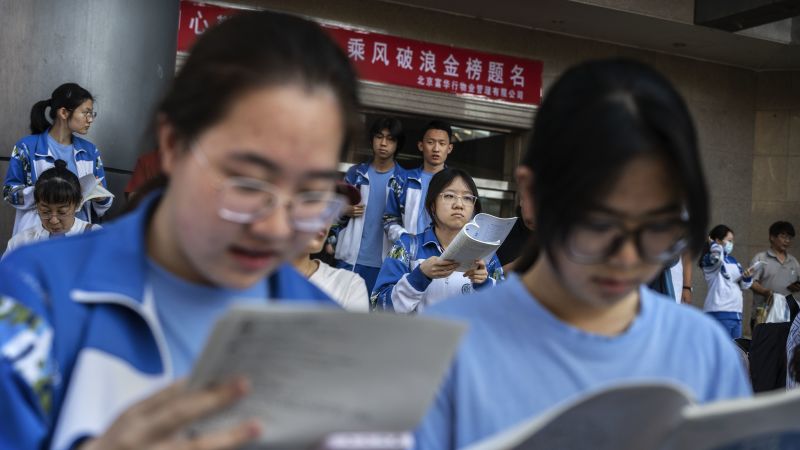
Students from Beijing and Shanghai, along with China’s Jiangsu and Zhejiang provinces, ranked among the leading participants last year. Singapore also remained near the top. Japan and South Korea appeared in the Asia-heavy top 10 across all three tested subjects, joined by Macao and Taiwan.
The results arrive as governments and companies place greater weight on technical capability, scientific research and AI development. Competition between China and the United States has intensified around innovation, research capacity and advanced technology. China has moved ahead of the United States in the volume of published scientific reports, while the two countries each spent more than $1 trillion on research in 2024.
US Reading Scores Near a Long-Term Low
American secondary-school students saw reading performance fall to close to its lowest point in roughly 25 years. The gap with participating Chinese jurisdictions remains pronounced, extending a pattern in which those Chinese test-takers have held a substantial advantage in PISA.
China’s participation figures also require context. Its submitted results cover Beijing, Shanghai, Jiangsu and Zhejiang, four prosperous areas along the country’s eastern coast, rather than a nationally representative sample. Critics have long argued that this limits broader comparisons with countries that test students across their full populations.
Even with that qualification, the long-term movement in the United States is difficult for educators to ignore. American scores have declined over the past decade, raising concerns about whether schools are adequately preparing students for work and citizenship in an information-saturated world.
The OECD findings suggest that wealth alone is becoming a less reliable predictor of educational success. As digital technology has spread, the relationship between student outcomes and national or household resources has weakened. That does not mean resources no longer matter; rather, it highlights how teaching practices, attention, reading habits and classroom conditions can shape performance alongside economic circumstances.
AI Raises the Stakes for Reading and Critical Thinking
Artificial intelligence may transform secondary education, but the report warns that the skills now slipping are precisely those that become more valuable when information is abundant and easily generated. Students need to judge credibility, compare evidence from different places and think carefully before reaching conclusions.
“Most troubling is the decline in the very skills that matter most in the AI age: evaluating information, making connections across multiple sources, and thinking critically about what we read,” Andreas Schleicher, OECD director for education and skills, wrote in the report.
“In a world increasingly flooded with information, our students are less likely to think deeply and separate signal from noise.”
That warning reaches beyond test-taking. AI tools can produce summaries, explanations and plausible-sounding answers within seconds. For students, the challenge is increasingly not just finding information, but deciding whether it is reliable, identifying what has been omitted and connecting ideas across sources. Strong reading comprehension and sustained attention are central to those tasks.
Digital distraction is one possible obstacle. The study could not establish a precise cause-and-effect relationship between technology use and lower achievement, but it identified classroom distraction as a significant concern. Just 28% of students globally said classmates were distracted by digital devices during science lessons. In China, Japan and South Korea, the figure was below 10%.
The contrast does not mean technology must be removed from schools. Instead, it points to the importance of using it with clear educational purpose. Singapore offers one example: its schools use technology while placing early emphasis on reading comprehension. The approach recognizes that devices can support learning, but cannot replace the foundational ability to read carefully and understand complex material.
More Students Are Reading Too Quickly
A related trend involves “hasty readers” — students who move rapidly through a passage but answer incorrectly. Their share nearly doubled from 2018 to 2025. This pattern may matter especially in digital environments, where students often encounter short, rapidly changing streams of content and may feel pressure to respond before fully processing what they have read.
The broader numbers are sobering. Average scores across OECD countries in science, reading and mathematics have reached record lows. The share of OECD students performing below a basic PISA benchmark rose from 16% in 2022 to 20% last year.
Those outcomes have potential consequences far beyond classrooms. The 2025 assessment cited a Stanford University study estimating that bringing every 15-year-old American to at least basic PISA proficiency could add more than $40 trillion to the US economy over their working lives. The figure illustrates how foundational skills can affect productivity, employment prospects, innovation and long-term economic growth.
For families and educators, the message is not that every student must follow a single national model. It is that reading deeply, concentrating through demanding material and questioning information remain essential skills. As AI becomes more common in education and daily life, the countries that combine useful technology with disciplined learning may be best positioned to preserve — and extend — their students’ advantage.
Related Reading
Frequently Asked Questions
What is Students in Asia extend lead over?
Students in Asia extend lead over is the main topic of this guide. The article explains the context, practical details, and next steps readers should understand.
Why does Students in Asia extend lead over matter?
Students in Asia extend lead over matters because readers are looking for a useful answer, not just a short summary. Good content should match search intent and help them decide what to do next.