Massive disruption hits UK airports after air traffic control issue

Daftar Isi
UK Airports Remain in Chaos as Air Traffic Control Outage Spills Into a Second Day
Activelifezero.com – Passengers across Britain’s major airports faced yet another day of cancellations, delays, and overcrowded terminals on Wednesday after a prolonged failure in the national air traffic control system left departure and arrival operations in disarray. The disruption, which began Tuesday and showed no sign of easing by midday Wednesday, struck London’s Heathrow, Gatwick, and Stansted airports hardest, while Manchester and other regional hubs also logged significant knock-on delays.
The scale of the breakdown was substantial. Aircraft-tracking data compiled by Flightradar24 placed the total number of flights canceled to or from UK airports on Tuesday at approximately 1,300. By Wednesday, the tracker reported that 177 additional flights had been scrapped, nearly all of them at London-Heathrow. Departures at Heathrow had resumed by the time the airport issued a statement on Tuesday, but arrivals continued to be canceled, and the airport warned that disruption was expected to persist through the day.
Passenger Impact and Airline Response
Ireland-based budget carrier Ryanair announced that roughly 65,000 of its passengers had been affected by the outage and that more than 50 of its scheduled flights had been canceled. The airline’s chief operating officer, Neal McMahon, used the platform to deliver a pointed rebuke of the control provider, calling for the resignation of NATS chief executive Martin Rolfe. McMahon pointed to the 2023 control failure that had already thrown travel into disarray for days.
“Families travelling on holiday, people travelling for work and thousands of visitors to the UK have once again paid the price for NATS’ abhorrent failure,” McMahon said.
Heathrow itself, which handled more than 84 million passengers in 2025 and ranks as the world’s seventh-busiest airport by passenger volume according to Airports Council International data, issued its own statement acknowledging the ongoing disruption and urging travelers to check flight status before heading to the terminal.
NATS Apologizes, Defends Its Systems
NATS, the UK’s principal provider of air traffic control services, confirmed on Tuesday that the technical fault had been corrected but acknowledged that the recovery process had dragged on longer than anticipated.
“We know this is hugely frustrating and apologise unreservedly,” the organization said in a statement, adding that it was operating normally and working to clear the backlog of queued flights.
Chief executive Martin Rolfe, pressed by critics, told the BBC that NATS’ infrastructure remains fit for purpose despite the failure.
“Whilst we never want these things to happen – and I absolutely apologize for the fact it has happened today – I do think we’re fit for purpose,” Rolfe said.
Passengers Describe a Day of Frustration
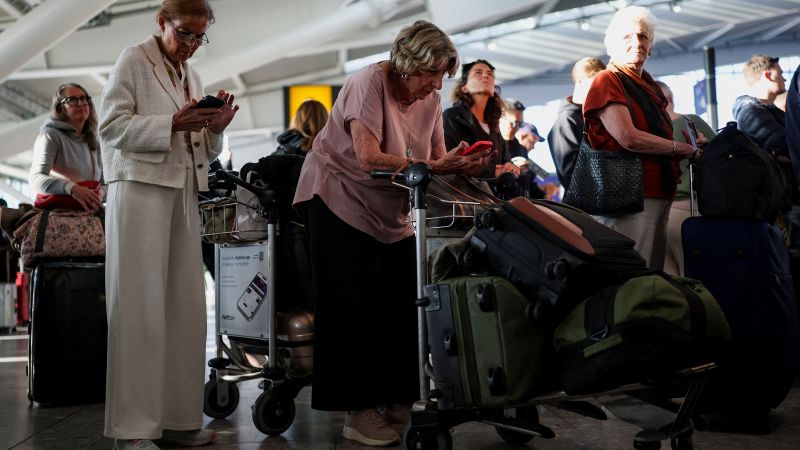
Social media filled quickly with photographs of enormous queues winding through airport concourses and with passengers venting their exasperation. One user on X described the episode as the “single most stressful and disappointing experience” they had ever had with any form of transport, noting that British Airways had offered a replacement routing involving a “24 hour 4 flight transit for a 2 and a half hour flight to Rome.”
Josie Donoghue, who was aboard a plane parked at Gatwick for three hours before her Ryanair flight to Ireland was ultimately canceled, compared the ordeal of navigating the terminal to escaping a maximum-security prison.
“Getting through that airport was like trying to get out of Alcatraz,” she said, referencing the former island penitentiary in San Francisco Bay. “It’s just an absolute nightmare down there. It’s the only word I can use to describe it.”
Not all reactions were negative. Several travelers took to social platforms to commend ground staff who worked through the chaos to rebook, re-route, and assist stranded passengers.
International Knock-On Effects
The disruption did not stop at British borders. Air India, the country’s flagship carrier, issued a statement on X confirming that the outage had forced it to “divert, delay or cancel multiple flights scheduled to operate to and from UK airports.” Qatar Airways similarly warned of delays and possible re-routing for its UK-bound and UK-departing services, underscoring how tightly the global network depends on the smooth operation of a single national control system.
A Pattern of Recurring Failures
This episode marks the second major control outage to hit Heathrow passengers within two years, and it sits within a broader pattern of annual disruptions at UK airports. In 2023, a NATS software failure grounded flights for days. In 2024, a global IT software crash produced widespread delays at airports worldwide, including several in Britain. Last year, Heathrow was shut entirely after a significant power outage triggered by a large fire in the vicinity, upending travel plans globally and affecting thousands of flights; the financial losses from that closure were estimated in the hundreds of millions of pounds.
UK Transport Secretary Heidi Alexander responded to the latest incident on X, saying she was “seeking assurances that lessons will be learned and systems that support aviation are up to the job.” The remark pointedly echoed questions that have followed each previous outage: whether the infrastructure underpinning one of the world’s busiest aviation corridors can withstand the frequency of failures now becoming routine.
For travelers still stranded in terminals across London and beyond, the question is less about policy and more practical: when will the backlog clear, and what compensation or rebooking options are available. NATS said it was working through the queue, but the airport’s own guidance remained that disruption was expected to continue.
Related Reading
Frequently Asked Questions
What is Massive disruption hits UK airports after?
Massive disruption hits UK airports after is the main topic of this guide. The article explains the context, practical details, and next steps readers should understand.
Why does Massive disruption hits UK airports after matter?
Massive disruption hits UK airports after matters because readers are looking for a useful answer, not just a short summary. Good content should match search intent and help them decide what to do next.