Who is Gadi Eisenkot, Netanyahu’s main challenger in Israel’s elections?

Daftar Isi
Gadi Eisenkot’s Rise Reshapes Israel’s Election Contest
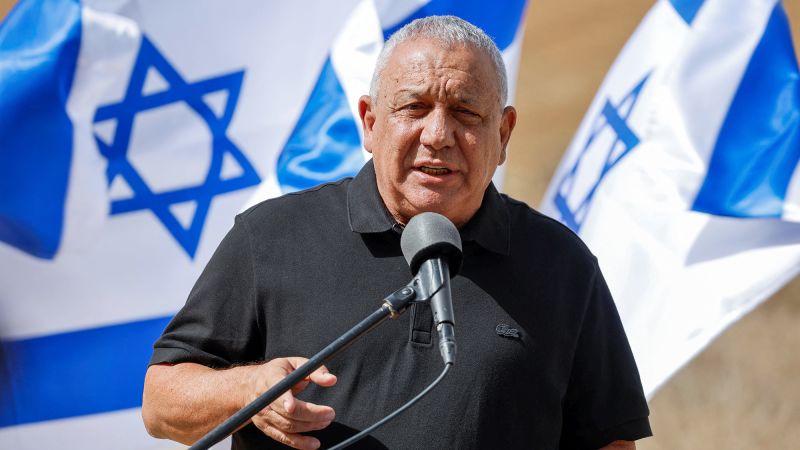
Activelifezero.com – As Israel approaches its October 27 election, Gadi Eisenkot has moved from the margins of political life to become Benjamin Netanyahu’s most formidable opponent. His appeal begins with a straightforward contrast: for voters seeking a change after years of Netanyahu’s leadership, Eisenkot represents an alternative with deep security credentials and a markedly different personal story.
The 66-year-old former military chief is also challenging a longstanding political pattern. Eisenkot is the son of Moroccan immigrants, and a victory would make him Israel’s first Mizrahi prime minister. Mizrahi Jews, whose families came from the Middle East and North Africa, have often been a major source of support for Netanyahu’s Likud party. Eisenkot’s emergence could test whether that alignment is changing.
A political dispute over identity
Questions about Eisenkot’s background came sharply into view after Yinon Magal, a prominent television host seen as close to Netanyahu, made remarks that triggered widespread outrage. Magal described Eisenkot using a racial slur and portrayed him as a “Mizrahi-Moroccan” figure controlled by “Ashkenazi elites.” The comments revived debate over historic social divisions between Jews of European heritage and communities with roots in the Middle East.
Magal later said he had not intended to insult Eisenkot’s background, arguing that he had used an underworld expression for someone acting as a public front while others directed events behind the scenes. Netanyahu condemned the remarks as well. Yet the controversy focused attention on a biography that differs significantly from the prime minister’s.
Eisenkot spent his early years in Tiberias and Eilat, far from Israel’s traditional political and economic centers. Netanyahu, by contrast, was raised in Jerusalem in an elite environment closely connected to public life and power. Eisenkot does not often foreground his ethnic identity, but observers see it as one element of his broader appeal.
Four decades in uniform
Before entering electoral politics, Eisenkot built his reputation during a 40-year career in the Israel Defense Forces. He joined the Golani Brigade in 1978 and ultimately served as IDF chief of staff from 2015 through 2019, during Netanyahu’s time as prime minister.
His period at the top of the military included a highly divisive 2016 case involving Sgt. Elor Azaria. Azaria shot and killed a wounded Palestinian attacker in Hebron. Right-wing politicians, including Netanyahu, pressed for a different response, but Eisenkot supported a military inquiry and trial. He argued that the issue went to the army’s discipline and ethical standards.
That episode helped define Eisenkot as a security figure willing to resist political pressure when he believed military norms were at stake. It also showed why his candidacy does not fit neatly into Israel’s usual left-right divide. His background gives him credibility with voters focused on defense, while his break with Netanyahu offers an opening to a broad anti-Netanyahu electorate.
War, loss and a new political purpose
Eisenkot entered politics in 2022 alongside Benny Gantz, another former IDF chief of staff. Following the Hamas-led attack on Israel on October 7, 2023, both men joined Netanyahu’s emergency war cabinet. They departed in June 2024, saying the government lacked a clear strategy for what would follow the war.
The conflict also brought profound personal loss to Eisenkot. His youngest son, Gal, was killed in Gaza in December 2023 at the age of 25, two months after the war began. Two of Eisenkot’s nephews also died in combat.
In an April 2026 article for Yedioth Ahronoth, Eisenkot connected that loss to his political mission.
“Over Gal’s grave, I swore that the price he paid, he and his friends, those he knew and those he didn’t, would not be in vain.”
He has described that commitment as central to his decision to remain in public life. For supporters, it adds a personal dimension to a campaign built around questions of leadership, security and the country’s direction after the war.
Strong polls, uncertain path to government
A year ago, Eisenkot was polling in the single digits. He now enters the campaign’s final phase as the leading opposition candidate. Recent surveys put his Yashar party at roughly 20 to 23 seats in the 120-member Knesset, ahead of Likud, and show him leading Netanyahu on the question of who is best suited to serve as prime minister.
Those numbers alone, however, do not determine who governs. Israel’s parliamentary system is driven by coalition-building. The president gives the mandate to form a government to the lawmaker judged most likely to assemble a governing majority, not necessarily to the leader of the largest single party.
That distinction may prove decisive. Polling indicates that neither Netanyahu’s bloc, which includes far-right and ultra-Orthodox parties, nor the parties opposed to Netanyahu are clearly positioned to win the 61 seats needed for a majority. A prolonged deadlock remains possible.
Eisenkot would need support from parties across the political spectrum, including centrists, left-wing factions and potential partners on the right. In some scenarios, Arab parties could become important to keeping a government in office. Netanyahu has spent years portraying cooperation with Arab parties as illegitimate, while some opposition figures have already ruled out such partnerships.
Eisenkot has said he would seek to form a government even without a 61-seat majority. That could create the possibility of a minority administration supported externally by Arab parties, though persuading right-wing partners to participate under those circumstances could be difficult.
The election therefore presents more than a contest between two politicians. It is also a test of whether Israel’s fractured political system can produce a new governing coalition—and whether Eisenkot’s military record, personal history and promise of change can translate into the parliamentary support required to replace Netanyahu.
Related Reading
Frequently Asked Questions
What is Who is Gadi Eisenkot Netanyahu s main?
Who is Gadi Eisenkot Netanyahu s main is the main topic of this guide. The article explains the context, practical details, and next steps readers should understand.
Why does Who is Gadi Eisenkot Netanyahu s main matter?
Who is Gadi Eisenkot Netanyahu s main matters because readers are looking for a useful answer, not just a short summary. Good content should match search intent and help them decide what to do next.