‘World’s first solar ambulance’ just proved it works

Daftar Isi
- A Dutch-built solar ambulance just completed an 800-kilometer trial across Kenya’s most remote terrain — and the results exceeded every expectation
- What the vehicle actually is
- The healthcare gap the vehicle is meant to close
- A decade of student-built vehicles
- Obstacles between prototype and practice
- Related Reading
- Frequently Asked Questions
A Dutch-built solar ambulance just completed an 800-kilometer trial across Kenya’s most remote terrain — and the results exceeded every expectation
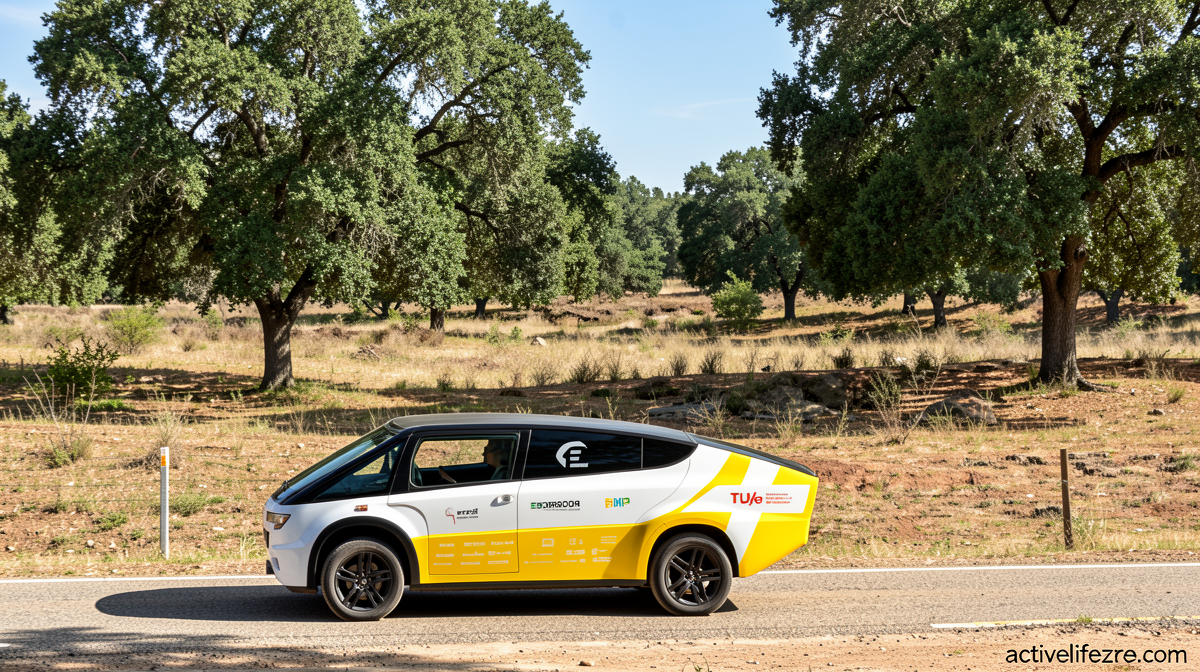
Activelifezero.com – When a vehicle packed with an X-ray unit, an ultrasound scanner, and a vaccine refrigerator sat motionless in a Kenyan village with no grid connection and drew more electricity from its own panels than it burned through running every onboard device at once, the students behind the project realized they had crossed a threshold. The prototype, named Stella Juva, had been designed to prove that a mobile medical unit could sustain itself entirely through sunlight. The two-day field exercise confirmed that it can.
The trial, carried out this month in partnership with the nongovernmental organization Amref Health Africa, pushed the vehicle well beyond laboratory conditions. Over the course of the exercise, the crew logged more than 800 kilometers (roughly 500 miles) of driving across varied Kenyan landscapes, including a multi-hour stretch along a dusty clay track riddled with potholes that led to a health clinic in Mosiro, a settlement in the Narok region of southwest Kenya where no electrical supply exists at all.
“We were all very positively surprised,” said Isabella Wanningen, a 22-year-old computer science and engineering student on the project team. “Stella Juva reacted even better than we had expected.”
No patients were treated during the trial. The onboard instruments were powered and cycled to verify performance, but the team estimates that, had clinical operations been permitted, roughly 200 individuals could have received care over the two-day window.
What the vehicle actually is
Calling Stella Juva an “ambulance” is technically accurate but somewhat misleading. The vehicle does not transport sick or injured people from one point to another. Instead, it functions as a self-contained mobile clinic: it carries the diagnostic and cold-chain equipment itself, along with the energy needed to run that equipment, directly into communities that lack both.
The roof is fitted with photovoltaic panels that generate electricity while the vehicle is in motion. When the unit parks, additional solar arrays unfold from the body, multiplying the charging surface area and allowing the system to produce surplus power even under full equipment load. That surplus is what made the Mosiro demonstration possible — the vehicle sustained every instrument simultaneously without drawing from any external grid or conventional fuel source.
Solar Team Eindhoven, the collective of 23 students drawn from Eindhoven University of Technology and two other Dutch educational institutions, describes the build as the “world’s first solar ambulance.” The designation is specific: no earlier vehicle has combined autonomous solar generation with a full complement of clinical-grade medical hardware in a single mobile platform.
The healthcare gap the vehicle is meant to close
Across the African continent, roughly one in three residents lives more than two hours from any functioning health facility. Even where a clinic exists within reach, unreliable or absent electricity constrains what staff can offer. Ultrasound screening for expectant mothers, cold-chain storage for vaccines, and basic radiographic imaging all depend on a steady power supply that many rural sites simply do not have.
John Kutna, program manager at Amref Health Africa, pointed to exactly this bottleneck when discussing the Mosiro visit.
“The solar ambulance would be quite useful in these locations,” he said, noting that expectant mothers in areas like Mosiro currently have little or no access to ultrasound services because of the power deficit.
Kennedy Wakoli, a family and reproductive health specialist also at Amref Health Africa, framed the broader opportunity in simpler terms: solar energy is available virtually everywhere, making it a uniquely suited power source for dispersed, low-density health infrastructure.
“Solar energy is everywhere,” Wakoli said, expressing hope that Stella Juva can serve as a catalyst for wider adoption of sun-powered medical systems in remote settings.
A decade of student-built vehicles
Stella Juva is not an isolated experiment. Since 2013, Solar Team Eindhoven has organized yearlong collaborative projects in which student teams design, build, and test sustainable vehicles. Earlier entries include Stella Vita, a solar-assisted campervan, and Stella Terra, billed at the time as the world’s first off-road solar-powered vehicle. Several of those projects have moved beyond the campus and into commercial territory.
The most prominent example is Lightyear, a startup founded by five alumni of the student program. This year the company unveiled a demonstration electric vehicle equipped with advanced solar-charging technology, developed in collaboration with the Japanese manufacturer Nissan. The trajectory from university workshop to automotive-industry partnership underscores how the skills and prototypes generated inside the student program can seed real-world products.
Stella Juva itself will be shipped back to the Netherlands after the Kenyan trial. The team’s stated intention, however, is not to retire the concept.
“We hope to inspire industry and society to use innovative technologies like Stella Juva to tackle some societal problems,” said Yarno Basten, a 23-year-old team member studying sustainable energy technology.
Obstacles between prototype and practice
The engineering question has been answered; the policy and financing questions remain. Funding for Kenya’s public-health sector is already strained, and the situation tightened further when the administration of US President Donald Trump reduced foreign-aid flows that had supported portions of the country’s medical infrastructure. Scaling a solar-powered mobile clinic from a single student-built unit to a fleet deployed across multiple regions would require sustained capital that no single university team can supply.
Still, Kenya has made notable progress in expanding its overall renewable-energy capacity, and solar power is increasingly present in the national energy mix. What has been missing, Kutna notes, is the specific application of that solar capacity to medical care. UNICEF and other agencies have backed solar-powered refrigeration units to maintain vaccine cold chains, and several corporate foundations have financed solar lighting at individual health facilities. A fully integrated, self-powered mobile clinic would represent a step beyond those piecemeal interventions.
Health-sector observers in Kenya suggest the successful trial could generate ripple effects well beyond the vehicle itself: encouraging local engineering students to pursue homegrown medical-technology innovation, demonstrating to policymakers that sunlight can substitute for grid electricity in clinical settings, and providing a tangible proof-of-concept that investors and donors can evaluate. Whether those ripples materialize will depend on decisions made in ministries, donor offices, and corporate boardrooms in the months ahead — but the technical foundation, at least, has been laid.
Related Reading
Frequently Asked Questions
What is World s first solar ambulance just?
World s first solar ambulance just is the main topic of this guide. The article explains the context, practical details, and next steps readers should understand.
Why does World s first solar ambulance just matter?
World s first solar ambulance just matters because readers are looking for a useful answer, not just a short summary. Good content should match search intent and help them decide what to do next.