First-ever evidence of a second-generation planet detected around dead star

Daftar Isi
Possible New Planet Emerges From the Debris of a Dead Star
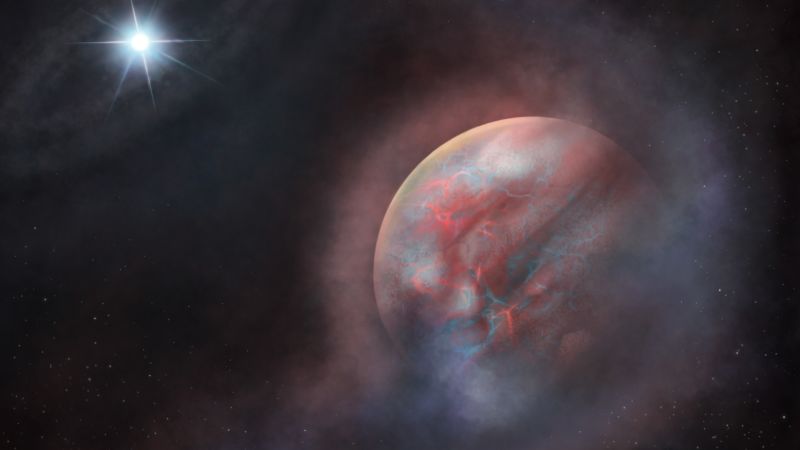
Activelifezero.com – A white dwarf roughly 270 light-years from Earth may be surrounded by an extraordinary kind of world: a giant planet assembled after its host star died. If confirmed, the object near HS 0209+0832 would offer the first evidence for a “second-generation” planet formed from material left behind during a star’s final transformation.
The candidate was identified through observations from NASA’s Hubble Space Telescope, the Transiting Exoplanet Survey Satellite, or TESS, and additional instruments. Researchers described the finding in a study published Monday in Nature Astronomy, while emphasizing that the planet has not yet been conclusively verified.
What makes the system unusual is not simply that a planet appears to orbit a white dwarf. Astronomers have already found several planets that endured their stars’ violent aging process. The possible object around HS 0209+0832, however, may have come together afterward, using stellar debris as its raw material.
Clues in the white dwarf’s atmosphere
HS 0209+0832 is the exposed, dense core of a star that was once more like the sun. As stars of that type run out of fuel, they swell into red giants, shedding their outer layers before leaving behind a compact and extremely hot white dwarf.
Planets that formed alongside the original star can sometimes survive if they circle at a sufficiently distant orbit. Other planets may be broken apart, while gas, dust and other ejected matter remain in the system. That mixture could potentially gather into an entirely new planet long after the first generation of worlds formed.
Researchers found an especially revealing chemical signature on the surface of HS 0209+0832: heavy elements, including niobium. Normally, these heavier materials rapidly sink below the visible outer layers of a white dwarf, leaving hydrogen and helium dominant at the surface. Their presence indicates that fresh material is falling onto the stellar remnant from its surrounding environment.
“This planetary material is very rich in an element called niobium,” said lead study author Jamie Williams, a doctoral student in the department of physics of the University of Warwick in England. “It’s the first time that this element is found in a white dwarf, and this implies that the planetary material is made from the ashes of the star as it died.”
The team believes intense extreme ultraviolet radiation from the hot white dwarf may be stripping material from the atmosphere of a nearby planet. That lost matter would then fall onto the star’s surface, producing the chemical evidence seen by the researchers.
“We think these elements fell onto the white dwarf’s surface because the white dwarf is very hot and emitting loads of extreme ultraviolet radiation, which is stripping the atmosphere of a nearby planet,” Williams said.
A repeating signal every 4.4 days
Further support for the candidate came from TESS observations. The spacecraft detected a subtle pattern in the system’s brightness that repeats every 4.4 days. The researchers say the signal matches what might be expected from a giant planet orbiting the white dwarf.
Still, the evidence does not yet amount to a confirmation. More observations will be needed to establish that the repeating signal truly belongs to a planet and to rule out other explanations.
“It’s not a confirmed planet,” Williams said. “It’s only a candidate for now.”
Confirmation would be important because it would show that planet building may continue even after a sunlike star has reached the end of its conventional life. It would also give astronomers a new laboratory for studying how planetary systems are reshaped by stellar death.
Long-lived conditions around cooling stellar remnants
White dwarfs gradually cool over immense spans of time. For worlds orbiting close enough to receive suitable levels of energy, that slow cooling can create a remarkably steady habitable zone. Unlike the shifting conditions around a star still undergoing rapid changes, the environment near a cooling white dwarf can remain stable for tens of billions of years.
“What’s interesting about planets orbiting close to white dwarfs is that because white dwarfs cool over time, their habitable zone is very stable. A second-generation planet could form and then be in the habitable zone for tens of billions of years,” Williams said.
That does not mean this candidate planet is known to be habitable, or even that it is a rocky world capable of supporting life. It is thought to be a gas giant. But a long-lasting stable zone could be significant for future studies of planetary evolution and the conditions that may allow life-friendly environments to persist.
A longstanding idea gains a potential example
The concept of second-generation planets is not new. The first exoplanets ever discovered orbited a pulsar, a rapidly spinning stellar remnant. Since pulsars are created in supernova explosions, any original planets close to the star would likely have been destroyed, making later-formed worlds a plausible explanation.
White dwarfs arise through a less explosive route, but their systems can still be filled with the remains of a disrupted planetary family. Surviving planets, fragments from destroyed bodies, and gas and dust expelled during the red giant phase may all remain available to form new structures.
“Although white dwarfs don’t form via supernova, they are surrounded by debris,” said study coauthor David J. Wilson, a research associate at the Laboratory for Atmospheric and Space Physics at the University of Colorado Boulder. “You have the planets that were lucky enough to survive the star’s giant phases, the shattered remains of those that weren’t, and leftover gas and dust ejected by the star as it turned from a giant to a white dwarf. So it’s a compelling idea that all that stuff might coalesce into new planets.”
Scientists are still working out the full sequence through which ordinary, first-generation planets form. The pathways that could produce a planet from a dead star’s leftovers are even less certain. HS 0209+0832 may provide an early opportunity to investigate that question, revealing whether stellar death can sometimes become the beginning of a new planetary chapter.
Related Reading
Frequently Asked Questions
What is First ever evidence of a second?
First ever evidence of a second is the main topic of this guide. The article explains the context, practical details, and next steps readers should understand.
Why does First ever evidence of a second matter?
First ever evidence of a second matters because readers are looking for a useful answer, not just a short summary. Good content should match search intent and help them decide what to do next.