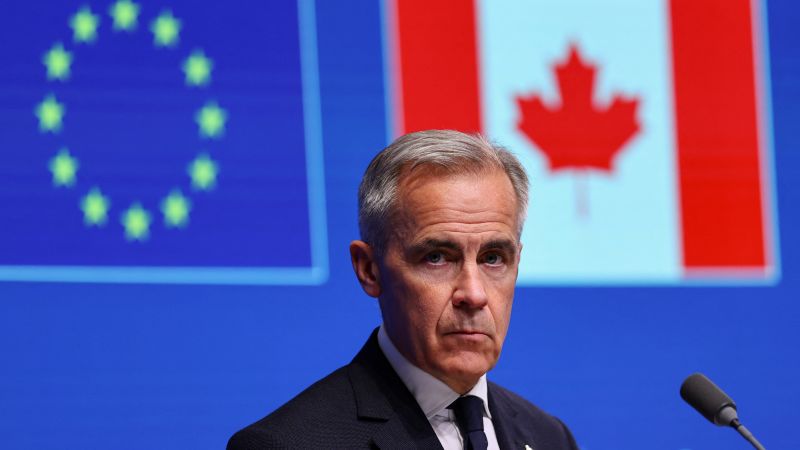
EU says Canada should become its first ‘associate member’ as ties with US fray

Daftar Isi
EU Floats Unprecedented “Associate Member” Role for Canada as US Trade Pressures Mount
Activelifezero.com – The European Union is considering a deeper partnership with Canada that could create a new category of relationship for a country outside Europe, as both sides confront growing trade uncertainty involving the United States.
European Commission President Ursula von der Leyen proposed that Canada become the EU’s first “associate member” during her State of the Union address in Strasbourg, France. Canadian Prime Minister Mark Carney attended the speech, underscoring Ottawa’s interest in strengthening its ties across the Atlantic.
“In this new world we must urgently reimagine our partnerships and build global coalitions for our resilience and democracies.”
Von der Leyen said the goal was to take the EU-Canada relationship as far as possible. The proposal arrives while Canada is in a trade dispute with the United States, its biggest commercial partner. President Donald Trump has also repeatedly suggested that Canada should become the 51st US state, an idea Carney has firmly rejected.
A Partnership Beyond Existing EU Models
The expression “associate member” does not currently describe a formal EU membership category, leaving major questions about how such an arrangement could work. It is not yet clear which rights, obligations or institutional links could be included, nor whether all 27 EU member states would support the idea.
Canada would face a basic obstacle to ordinary EU accession: geography. Full membership is designed for European countries and follows a lengthy process requiring unanimous approval from every EU member. Nine countries are currently recognized as candidates for membership.
Still, Canada has longstanding cultural and political links with Europe. A former British colony, it has a parliamentary democracy, universal health care and social-welfare systems that share features with European models. Canada also has a tiny land border with Europe through Denmark on Hans Island, located off northwestern Greenland.
Several European countries already maintain close ties with the bloc without becoming full members. Norway and Switzerland, for example, cooperate with the EU in areas including trade and border arrangements. Canada’s potential agreement, however, could go further than existing partnerships involving countries beyond Europe.
Ukraine, Moldova and Georgia hold association agreements with the EU, but these frameworks involve closer alignment with EU law. Canada may not seek that type of legal integration, making a tailored arrangement more likely if the proposal advances.
Trade, Energy and Technology at the Center
Possible areas of cooperation under discussion include reducing obstacles to trade, connecting Europe and Canada with undersea cables, redirecting pipelines so European markets can access Canadian gas, and expanding artificial intelligence and technology infrastructure.
Officials have also explored the possibility of allowing Canadians to live and work in Europe without visas. Such a measure would represent a significant change in mobility rights and would require detailed agreement among the governments involved.
Von der Leyen highlighted intelligent manufacturing, technology, defense, cybersecurity and artificial intelligence as priorities for closer cooperation. Energy, critical minerals and battery supply chains could also become central parts of the partnership.
Those sectors have become increasingly important as governments seek more reliable access to strategic materials, digital infrastructure and energy supplies. Canada possesses significant natural resources, while the EU is pursuing greater economic resilience and diversification in response to global disruptions.
Canada and the EU already have a substantial commercial relationship through the Comprehensive Economic and Trade Agreement, widely known as CETA. Large sections of that agreement began operating in 2017 and have supported steadily growing trade. However, the pact has not yet completed ratification in 10 EU countries, including France, Italy and Poland.
Washington Reacts to the Proposal
Trump responded sharply to the prospect of a special Canada-EU relationship, saying the United States could impose “heavy tariffs” on the bloc if it viewed the plan as hostile.
“If it’s a good intention, that’s fine. If it’s a bad intention, we’ll put very heavy tariffs on Europe, which is a possibility.”
Von der Leyen argued that the initiative should not be understood as an alliance directed at another country. The EU itself has faced tariffs imposed by the Trump administration on allies over the past year, adding to the pressure on European leaders to broaden economic partnerships.
“Not a partnership against anyone else, but for our common strength.”
Carney has made closer EU cooperation a prominent theme of Canada’s international strategy. On Sunday, he said Canada was pursuing a “unique alliance with the European Union.” Earlier this year in Davos, Switzerland, he called for “middle powers” to work together amid what he described as a “rupture in the world order.”
What Happens Next
Any associate-member model would need to move from political ambition to a detailed legal and institutional plan. Negotiators would have to define whether the relationship focuses mainly on trade, investment, energy and technology, or whether it could eventually include wider mobility, defense and policy coordination.
The proposal also raises practical questions for the EU. Member states would need to decide how closely an outside country could be connected to the bloc without gaining the full rights and responsibilities of membership. For Canada, the challenge will be balancing a deeper European relationship with the continuing importance of its economic ties to the United States.
For now, the initiative signals that Ottawa and Brussels see strategic value in building a stronger transatlantic partnership. Whether it becomes a formal new category or a collection of expanded agreements, the effort reflects a broader search for stability as trade disputes and geopolitical tensions reshape relationships among major democracies.
Related Reading
Frequently Asked Questions
What is EU says Canada should become its first?
EU says Canada should become its first is the main topic of this guide. The article explains the context, practical details, and next steps readers should understand.
Why does EU says Canada should become its first matter?
EU says Canada should become its first matters because readers are looking for a useful answer, not just a short summary. Good content should match search intent and help them decide what to do next.