An encounter with NASA’s game-changing ‘starglasses’

Daftar Isi
NASA’s Roman Telescope Prepares for Launch as Its Coronagraph Promises to Rewrite Exoplanet Science
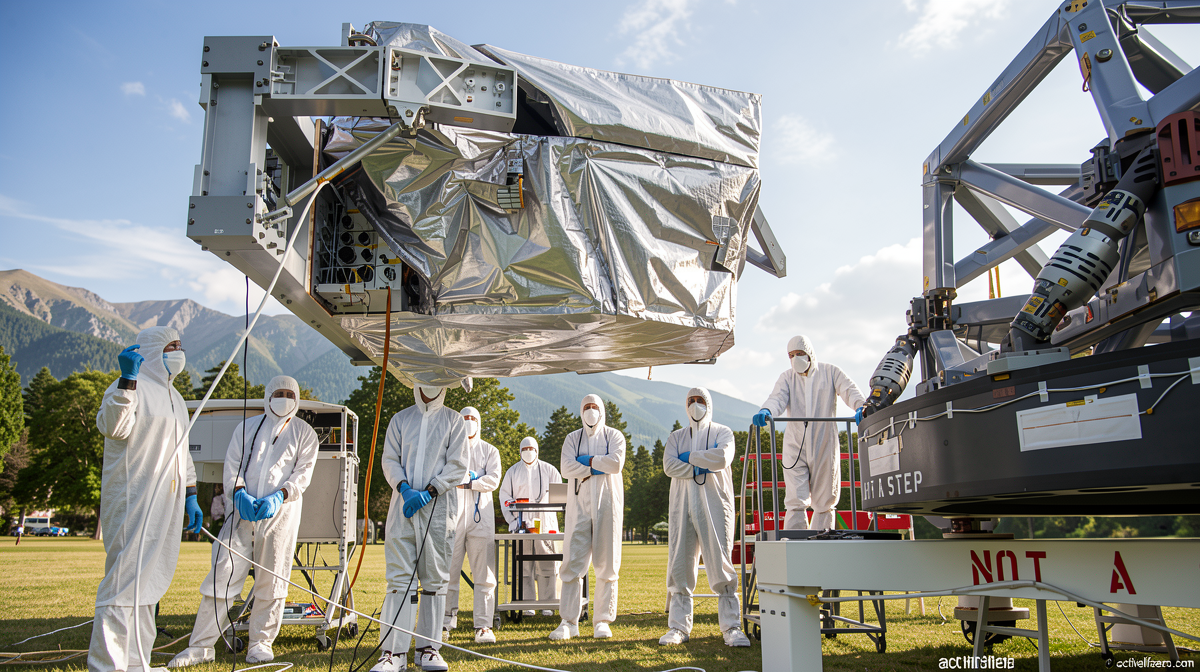
Activelifezero.com – The Nancy Grace Roman Space Telescope, NASA’s most ambitious flagship observatory since the James Webb Space Telescope, may lift off from Cape Canaveral as early as this weekend. If the launch window holds, the spacecraft will carry aboard an experimental coronagraph instrument that engineers at the Jet Propulsion Laboratory in Pasadena, California, have spent years perfecting in a spotless white clean room where every visitor donns a full-body “bunny suit” and surrenders all cosmetics, lotions, and scented products before crossing the threshold.
That coronagraph — informally dubbed the “starglasses” by the team that built it — represents a leap in observational capability. Its flexible mirrors adjust in real time to suppress the overwhelming glare of nearby stars, allowing Roman to peer at faint, Jupiter-mass planets orbiting other suns. In the most optimistic scenario, the instrument could even resolve cloud decks on those distant worlds. Over time, the technology is expected to mature enough to hunt for rocky, Earth-analog planets whose atmospheres might harbor the chemistry of life.
“Roman will investigate dark matter, dark energy and the structure of the universe itself, and accelerate the future of discovery of potentially habitable planets outside our solar system,” NASA Administrator Jared Isaacman stated when the completed telescope was revealed to the public in April.
A Name Carrying Legacy
The observatory bears the name of Nancy Grace Roman, the longtime NASA chief of astronomy who championed space-based telescopes decades before they became routine. Her conviction that Earth’s atmosphere was too turbulent and too polluted for the finest observations helped lay the groundwork for Hubble and, later, Webb. Roman the telescope will complement those predecessors while charting territory none of them were designed to explore — particularly the invisible scaffolding of dark matter and the accelerating expansion driven by dark energy.
Before the hardware ever leaves the ground, the engineering team relies on virtual-reality walkthroughs to verify that every optical element seats correctly within the assembly. It is a sci-fi-adjacent step in a process that, for a single instrument, can consume years of meticulous labor. The dedication required to build one piece of a space mission, as anyone who has walked the JPL corridors knows, is staggering.
Other Science Headlines From the Week
Two “Ghost” Ancestors Resurface in Human DNA
Researchers examining modern human genomes have identified signatures of two previously unknown ancestral lineages that left no recoverable fossils and no directly sequenced ancient DNA. Neanderthals and Denisovans, by contrast, yielded both skeletal remains and identifiable genetic traces in present-day populations. The two new branches, however, are known only through the marks they stamped onto our own genomes. Scientists have now devised a computational method to reconstruct these lost limbs of the human family tree. One lineage appears to have interbred with Homo sapiens in Africa more than 50,000 years ago; the second retains a far more tenuous and enigmatic connection to modern humans.
UCLA Marmot Study Finds Unlikely Sponsor on OnlyFans
When federal funding for a decades-long study of yellow-bellied marmots at the University of California, Los Angeles, was cut, the research team turned to a subscription platform to keep the project alive. Their channel, branded OnlyMarms, streams footage of the small rodents scurrying through alpine terrain — content that occasionally tips into mild comedy when the roly-poly animals scuffle. The effort underscores how precarious long-term ecological monitoring can be when grant cycles shift.
August’s Full Moon and a Partial Lunar Eclipse
Anyone stepping outside this weekend can observe August’s full moon at its brightest. The silvery disc also featured in a partial lunar eclipse that peaked just after midnight Friday, when Earth’s shadow swept across a portion of the lunar surface. Photographers across North and South America captured the moody, copper-tinted spectacle as the shadow crept over the terminator.
The Ganges Shark Remains Elusive
The critically endangered Ganges shark has never been photographed alive. It is one of only three shark species confirmed to inhabit freshwater rivers. Populations in parts of Pakistan, India, Bangladesh, Malaysia, and Myanmar are declining, known primarily because the animal surfaces as incidental bycatch in riverine fishing operations. Its continued invisibility to cameras makes every confirmed sighting a small conservation milestone.
Together, these stories illustrate the breadth of what a single week in science can encompass: from instruments poised to peer at alien atmospheres, to the quiet genetics of our own ancestry, to the small mammals and ancient sharks that remind us how much of the natural world remains undocumented.
Related Reading
Frequently Asked Questions
What is An encounter with NASA s game?
An encounter with NASA s game is the main topic of this guide. The article explains the context, practical details, and next steps readers should understand.
Why does An encounter with NASA s game matter?
An encounter with NASA s game matters because readers are looking for a useful answer, not just a short summary. Good content should match search intent and help them decide what to do next.