Catch the full moon as it slips into Earth’s shadow in a partial lunar eclipse

Daftar Isi
- A Near-Total Lunar Eclipse Will Paint the August Sky in Shadow and Crimson
- How a Partial Eclipse Differs from a Total One
- What Color Will the Shadowed Moon Take?
- Viewing the Event Safely
- How Often Do Lunar Eclipses Occur?
- A Side Note: Auroras and Space Weather
- The Cultural Name Behind the August Moon
- What Lies Ahead in the Lunar Calendar
- Related Reading
- Frequently Asked Questions
A Near-Total Lunar Eclipse Will Paint the August Sky in Shadow and Crimson
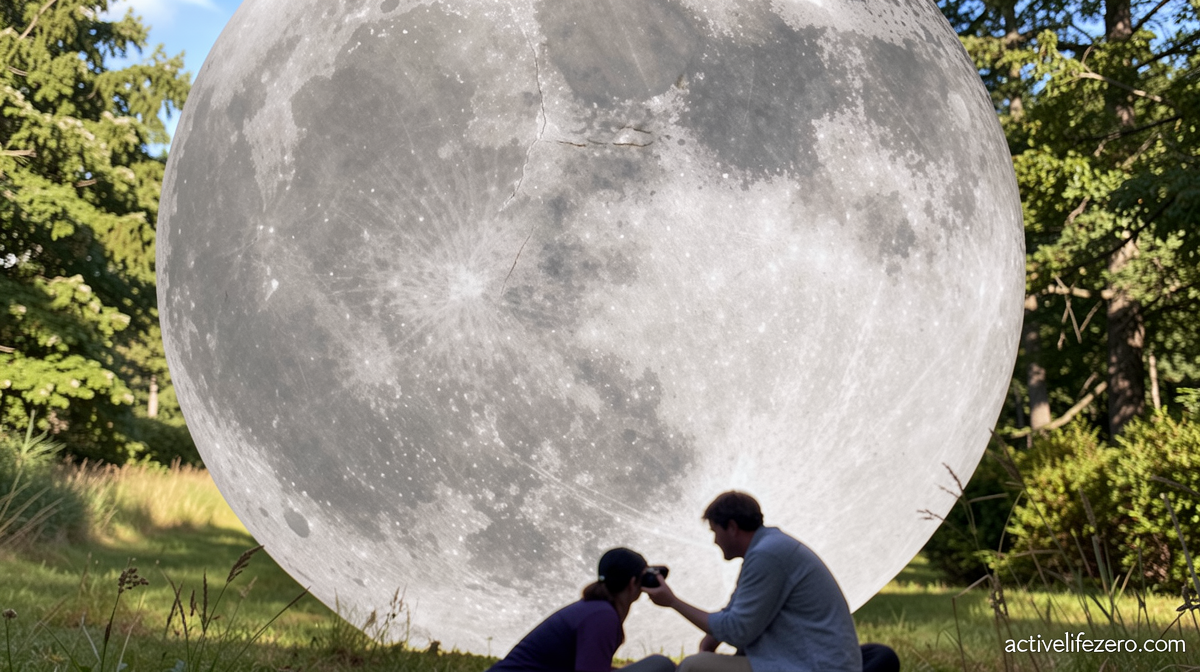
Activelifezero.com – On the night of Thursday into Friday, August 28–29, 2026, the full moon will slide deep into Earth’s shadow, with the planet’s umbra swallowing roughly 96 percent of the lunar disk. Though technically classified as a partial lunar eclipse because a sliver of the moon will remain outside the darkest region of the shadow, the event will look, to most observers, almost indistinguishable from a total eclipse. The result will be one of the most dramatic celestial displays of the year, visible to anyone with clear skies across North and South America during the evening and overnight hours.
Timing and visibility
The shadow’s first contact with the lunar surface will occur at 10:34 p.m. Eastern Time on Thursday. Maximum obscuration arrives at 12:13 a.m. ET Friday, just five minutes before the moon reaches its peak fullness at 12:18 a.m. ET. Because the eclipse unfolds during local evening and overnight hours for much of the Western Hemisphere, viewers from the continental United States through southern South America will have a window to witness most or all of the event without needing to stay up past the small hours.
How a Partial Eclipse Differs from a Total One
A lunar eclipse happens whenever the Sun, Earth, and Moon line up closely enough that Earth’s shadow falls across the lunar face. If the umbra—the innermost, darkest portion of that shadow—engulfs the entire moon, the result is a total lunar eclipse. When a segment of the disk stays outside the umbra, the event is labeled partial. This week’s geometry places the moon just barely short of full immersion, leaving only a thin crescent of unshadowed surface. That marginal distinction is what keeps the event in the “partial” category despite its near-total appearance.
What Color Will the Shadowed Moon Take?
During deeper eclipses, the moon frequently glows in shades of deep red and burnt orange. The physics behind that glow is straightforward: sunlight passing through Earth’s atmosphere scatters shorter wavelengths—violet, blue, green—while allowing longer wavelengths, the reds and oranges, to transmit through and bend around the planet’s limb onto the lunar surface. The effect is the same one that paints sunsets crimson, projected onto a celestial canvas.
How vivid that coloring will be on this particular night remains uncertain. Noah Petro, who leads the Planetary Geology, Geophysics and Geochemistry Lab at NASA’s Goddard Space Flight Center in Greenbelt, Maryland, told reporters the outcome is
“hard to predict.”
He added his best expectation for the visual:
“I would expect the side of the Moon furthest from the lit area might take on a darker hue with some red to it.”
Atmospheric conditions—volcanic aerosols, seasonal dust loads, and the particular thickness of air the sunlight must traverse—will all influence the final palette. No two eclipses produce identical coloration.
Viewing the Event Safely
Unlike solar eclipses, which demand specialized filters to protect the retina, a lunar eclipse poses no hazard to the naked eye. No glasses, no pinhole projectors, no special equipment is required. The primary challenge is simply finding a dark enough vantage point.
Petro cautioned that nearby streetlights, porch illumination, or bright commercial signage will wash out the subtle shading of the eclipsed disk. His recommendation is to seek a nearby park, a rural field, or any open space offering an unobstructed view of the night sky well away from urban light pollution.
Pamela Gay, a senior scientist at the Planetary Science Institute, framed the evening as an invitation to slow down and look up:
“Set yourself up a hammock, pull out a pair of binoculars, go out and enjoy the entire experience.”
Binoculars or a small telescope will reveal surface detail in the shadowed region—craters and maria taking on a coppery cast—that the unaided eye cannot resolve. A blanket, a thermos of coffee, and patience complete the setup.
How Often Do Lunar Eclipses Occur?
The number of lunar eclipses in any given calendar year fluctuates. Most years deliver two, but the geometry of the Sun–Earth–Moon system occasionally permits three, and on rare occasions yields none at all. Gay described the variability plainly:
“Some years, we actually get three.”
“Some years, we unfortunately get zero.”
Under normal circumstances, though, she noted, “there’s two good opportunities” each year for the three bodies to align within the narrow angular tolerance required for shadow contact.
The first such alignment of 2026 took place in March and produced a total lunar eclipse whose optimal viewing corridor ran across Australia and the broader Pacific basin. This August event marks the year’s second and, for most Western Hemisphere observers, its most accessible eclipse.
A Side Note: Auroras and Space Weather
The National Weather Service’s Space Weather Prediction Center flagged a possibility that elevated solar-wind activity late Thursday night could trigger geomagnetic storms. While those disturbances are not forecast to reach severe thresholds, moderate conditions could push the auroral oval far enough south to make northern U.S. states—Alaska, northern Minnesota, the Dakotas, Maine—witness faint green curtains in the sky, potentially coinciding with the eclipse itself. A rare double spectacle, should the conditions align.
The Cultural Name Behind the August Moon
The August full moon carries the common English name “sturgeon moon,” a designation rooted in Algonquin-speaking nations and other Indigenous groups around the Great Lakes. Lake sturgeon ran were abundant at this time of year and formed a critical protein source for those communities, making the month’s moon a marker of harvest season. Other Indigenous traditions assign different names to the same lunar phase: the Assiniboine of the Northern Great Plains call it the “black cherries moon,” while Eastern Woodlands nations refer to it as the “green corn moon,” each name encoding a distinct ecological calendar.
What Lies Ahead in the Lunar Calendar
Four additional full moons remain in 2026. The November and December full moons will qualify as supermoons—occurrences in which the Moon sits near perigee, its closest orbital point to Earth, and therefore appears marginally larger and brighter than average. For those who miss this August eclipse, the next lunar eclipse of 2027 has already been flagged by astronomers as the one worth planning around, given its superior geometry and visibility profile.
Whether you watch from a backyard in Tucson, a beach in Rio, or a hilltop in Patagonia, the coming hours offer a rare reminder that the largest object in our nightly sky can be dimmed, tinted, and reshaped by the very planet beneath our feet. No instrument beyond a pair of eyes and a clear horizon is needed to witness it.
Related Reading
Frequently Asked Questions
What is Catch the full moon as it slips?
Catch the full moon as it slips is the main topic of this guide. The article explains the context, practical details, and next steps readers should understand.
Why does Catch the full moon as it slips matter?
Catch the full moon as it slips matters because readers are looking for a useful answer, not just a short summary. Good content should match search intent and help them decide what to do next.