Overflowing lake adds new danger to desperate rescue efforts following China-Nepal disaster

Daftar Isi
Spilling Barrier Lake Forces Pause in China-Nepal Border Rescue
Activelifezero.com – Rescue teams working along the China-Nepal border were ordered to stand down on Friday after a newly formed barrier lake began overflowing its debris dam, introducing the prospect of secondary flash floods and landslides into an operation already strained by weeks of devastation. The lake, which sits roughly ten kilometers upstream of the Gyirong border port, now holds an estimated 2.5 million cubic meters of water — a volume large enough to fill approximately 1,000 Olympic-size swimming pools. Its uncontrolled release threatens to compound the destruction wrought by the initial disaster on Wednesday, when a glacier fracture triggered a catastrophic landslide and torrential flooding across the corridor.
What a Barrier Lake Means for the Ground Below
A barrier lake forms when debris from a landslide or rockfall dams a river channel, trapping water behind a wall of rock, soil, and sediment. Unlike engineered dams, these natural barriers are inherently unstable: their composition is heterogeneous, their foundations are often saturated, and their geometry can shift with every additional rainfall event. In the Himalayan foothills, where steep valleys concentrate runoff and seismic activity keeps slopes perpetually weakened, a barrier lake of this scale represents a ticking hydrological hazard. If the dam fails — whether through gradual erosion or a sudden structural collapse — the stored water can release within minutes, sending a wall of debris-laden floodwater downstream with little warning to communities or workers in the valley floor.
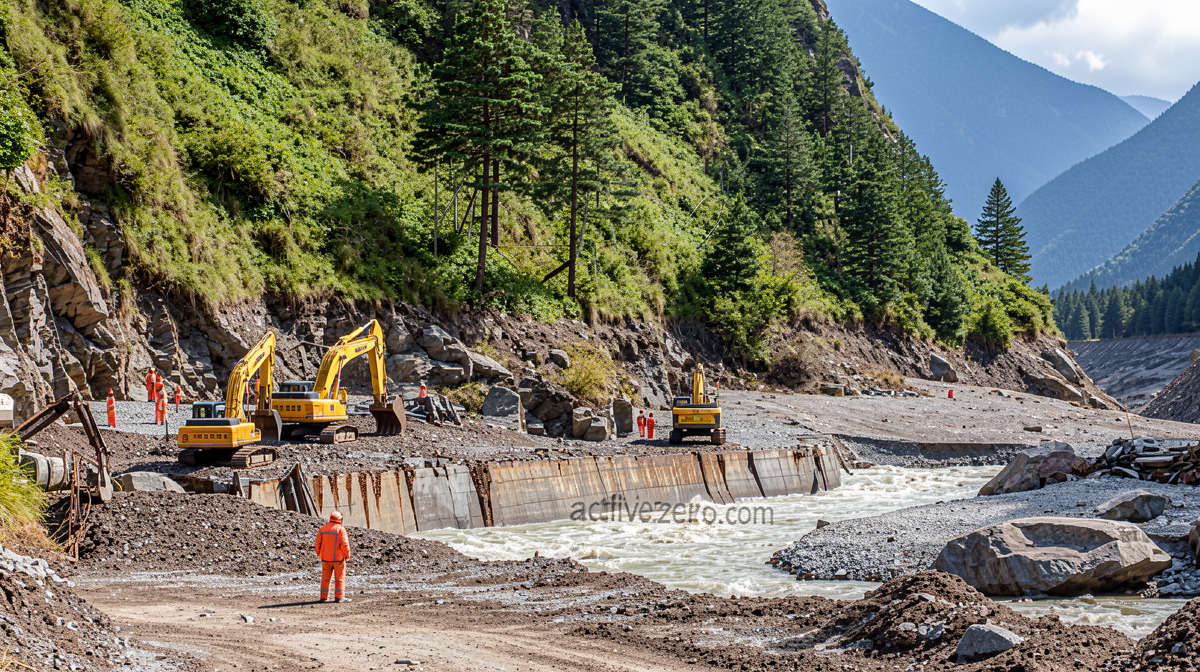
By late Friday morning, Chinese state media confirmed the lake was overflowing continuously, with no sign of stabilization. The situation was deemed too hazardous for rescue personnel to advance toward the hardest-hit sections of the border corridor. Chinese rescue teams were left waiting at a village several kilometers from the Gyirong port, assessing conditions while roads leading to the disaster zone remained choked for kilometers by thick mud and debris deposited by the Wednesday event.
On-the-Ground Conditions at the Dam
Helicopter operations in Nepal’s flood-stricken Rasuwa district were suspended as locals were observed scrambling up hillsides after word spread that the lake had begun to spill. A witness described the urgency of the scene to Reuters. Meanwhile, a member of the monitoring team dispatched to the barrier gave a midnight briefing describing the structure’s dimensions: roughly 150 meters in length and between 40 and 50 meters in height.
“The rocks and soil along the area are currently loose. During the assessment operation, secondary collapses occurred several times above the barrier,” Chen Hanxiao, a member of the team dispatched by China Anneng Engineering Rescue Lhasa Base, told state media in the midnight interview.
Chen added that safety personnel would remain posted at the site and would “immediately withdraw” the moment they detected signals of significant displacement in the dam structure. A senior official in Rasuwa district confirmed on Friday that Chinese authorities had shared real-time information about the overflow with their Nepali counterparts.
Expert Assessment: Two Lakes Under Watch
Austin Lord, a senior fellow in the energy, water and sustainability program at the Stimson Center think tank, told CNN’s Anderson Cooper on Thursday night (ET) that specialists were tracking not one but two barrier lakes in the affected corridor. The second sits just below the fracture point in the glacier that broke on Wednesday and initiated the original disaster. Chinese authorities appear to be monitoring that feature as well, referring to it in state media reports as an “impact crater.” Officials were also evaluating how a breach at the upper feature would cascade into the lower lake’s hydrology.
“They’re growing in volume. They’re not insignificant – but they’re not to the extent that if they failed that they could trigger an event on the scale that we saw,” Lord said, citing current conditions.
Lord cautioned, however, that the river corridor itself remains a danger zone for anyone conducting search and rescue on the ground.
“There is a concern for those doing search and rescue who are operating in the river corridor itself,” he added.
The principal variable in the coming days, Lord noted, is weather. Sustained rainfall would add substantial volume behind both dams, increasing hydraulic pressure on structures already showing signs of instability. A breach under those conditions could produce either a slow, sustained release or a sudden, catastrophic failure — both scenarios dangerous, but the latter leaving virtually no time for evacuation.
Why the Pause Matters
The decision to halt operations represents the latest complication in a rescue effort already hampered by destroyed infrastructure, blocked access routes, and the sheer remoteness of the affected valleys. Gyirong border port, a critical node for trade and transit between the two countries, sits directly in the path of any downstream flood pulse. Every hour of delay narrows the window for locating survivors in collapsed structures and buried roadways. Yet proceeding into a corridor where a 2.5-million-cubic-meter water body is actively eroding its own dam would risk turning a rescue mission into a second disaster.
Authorities on both sides of the border have dispatched dedicated teams to monitor the lake’s water level, dam integrity, and surrounding slope stability, while analysts work to model breach scenarios and adapt evacuation and rescue plans accordingly. Until the overflow stabilizes or the weather pattern shifts, the corridor remains in a state of suspended urgency — rescue crews holding position, eyes fixed upstream, waiting for conditions that may not improve for days.
Related Reading
Frequently Asked Questions
What is Overflowing lake adds new danger to desperate?
Overflowing lake adds new danger to desperate is the main topic of this guide. The article explains the context, practical details, and next steps readers should understand.
Why does Overflowing lake adds new danger to desperate matter?
Overflowing lake adds new danger to desperate matters because readers are looking for a useful answer, not just a short summary. Good content should match search intent and help them decide what to do next.