Several French cities impose curfews after weekend of chaos and protests spreading to parts of Europe

Daftar Isi
Curfews imposed after violent weekend in France
Activelifezero.com – Several French cities impose curfews after a weekend of protests, clashes and damage to businesses and public buildings. Restrictions have been introduced in parts of Paris, Lyon, Marseille, Nice and several communities in the Nord department as authorities seek to prevent further nighttime violence.
The demonstrations began with concerns over education but quickly developed into a broader movement focused on the cost of living, unemployment, inequality and dissatisfaction with government action. While many people have protested peacefully, violence in some areas has alarmed officials and residents.
Restrictions announced in Paris and other cities
Prime Minister Sébastien Lecornu called on municipalities to consider “partial curfews” on Monday, saying the measures were intended to protect people, businesses and public property.
In Paris, Place de la République is under curfew from 11 p.m. Monday until 6 a.m. Tuesday. Streets around Les Halles are subject to restrictions from 10 p.m. Monday until 6 a.m. Tuesday.
Lyon has banned gatherings on public roads from 6 p.m. to 9 p.m. Monday, followed by a curfew in parts of the city from 9 p.m. until 6 a.m. Tuesday. Marseille has prohibited demonstrations and other gatherings from midday until 8 p.m. local time.
Nice has imposed overnight restrictions on minors in its downtown area, from 9 p.m. Monday until 6 a.m. Tuesday. Lille, Douai, Wattignies and Denain are among the northern communities where curfews run from 8 p.m. Monday until 6 a.m. Tuesday.
More than 2,000 arrests after unrest
Several French cities impose curfews following a weekend in which more than 2,000 people were arrested. At least two people died, and serious injuries were reported, including two people who lost their hands.
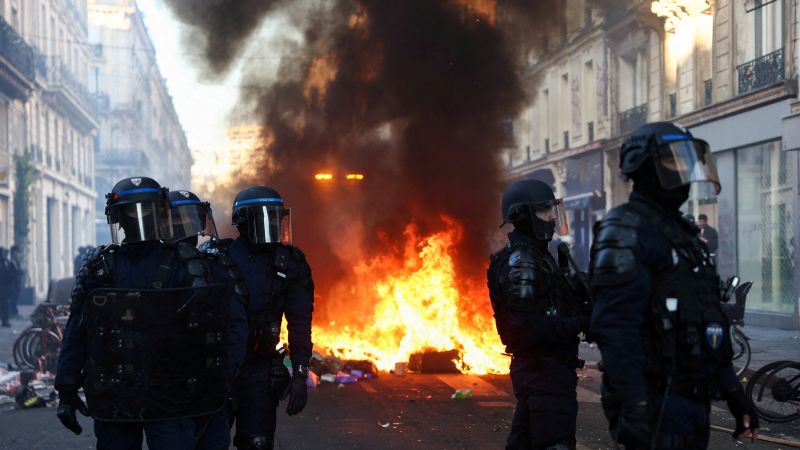
Police used tear gas during confrontations with crowds. In several locations, officers encountered hooded, black-clad groups accused of setting fires, looting shops and entering government buildings. Images of damaged historic structures highlighted the scale of the disorder.
Masked groups targeted shops and set fires in Paris after dark. In Lyon, protesters set the city’s tourist office ablaze. In Limoges, the spire of a 143-year-old town hall collapsed after a fire, reviving memories of the Notre Dame Cathedral blaze for some observers.
From school action to a national movement
The movement began in September at a high school in the Paris suburbs, where students and teachers went on strike to demand more staff and resources. Although those immediate demands were met, the initial action helped prompt wider demonstrations.
Students in other parts of France, frustrated by overcrowded classrooms and staffing shortages, began holding their own protests. Tensions grew after footage showed a police officer using a prohibited headlock on a girl.
Within weeks, the movement had expanded beyond education. Demonstrators raised concerns about daily living costs, employment prospects, inequality and the need for political and social change.
“This can’t go on,” said Maria Pallas, 57, a member of a major French trade union. “There’s the cost of living. There’s unemployment. There’s a bunch of things.”
More than half a million people demonstrated across France on Saturday. Much of the day was peaceful, with far-left leader Jean-Luc Mélenchon describing the Paris crowd as “moving calmly.” The most serious violence occurred later in the evening in certain areas.
Political pressure rises before election
The violence has intensified criticism that the government was not adequately prepared for the crisis. The unrest comes six months before an election to choose a successor to President Emmanuel Macron.
Macron said those responsible for destruction and looting would face consequences while also pledging to address the concerns voiced by demonstrators.
“Those who destroyed must pay,” Macron said Sunday evening. “Those who looted must pay back. Those who sought to bring down the Republic will be held accountable.”
FAQ: French curfews and local restrictions
Which areas are affected by the curfews?
Restrictions vary by municipality. They affect designated areas of Paris, parts of Lyon and Nice, and communities including Lille, Douai, Wattignies and Denain. Residents should check announcements from their local prefecture or city authority for the precise boundaries and times.
Why did several French cities impose curfews?
Authorities introduced the measures after protests led to clashes, fires, looting and damage in some locations. The stated aim is to reduce the risk of further violence and protect residents, businesses and public property overnight.
Are all demonstrations in France violent?
No. Most participants have demonstrated peacefully. However, violence involving smaller groups in some cities has led to arrests, injuries and the introduction of local restrictions.