
Astronomers trace a ghostly cosmic particle to distant ‘Shadow Blaster’ galaxy
Astronomers trace a ghostly cosmic particle to distant ‘Shadow Blaster’ galaxy
Astronomers trace a ghostly cosmic particle – Scientists have made a groundbreaking discovery by linking a high-energy neutrino detected on Earth to a remote star-forming galaxy dubbed the “Shadow Blaster.” This revelation, detailed in a study published on June 17 in *Nature Astronomy*, marks a critical advancement in unraveling the enigmatic origins of these elusive particles. The neutrino, identified as IC 210922A, was observed by the IceCube Neutrino Observatory in Antarctica, a facility renowned for its ability to detect cosmic neutrinos. The event, which occurs approximately every two to three years, provided a rare opportunity to investigate the galaxy’s potential role in generating such a particle.
The Elusive Nature of Neutrinos
Neutrinos, often referred to as ghost particles, are among the most mysterious components of the universe. Their ability to pass through matter without interacting—due to their lack of electric charge and minimal mass—makes them incredibly difficult to track. While they are abundant, their invisibility to traditional detection methods has long posed a challenge for astrophysicists. As Dr. Yuji Urata, a researcher at MITOS Science Co. Ltd. in Taiwan, explained, “Even when IceCube detects a high-energy neutrino, the position on the sky often has an uncertainty region that is much larger than the size of a galaxy.” This uncertainty complicates efforts to pinpoint their sources, especially when the origin is a steady, faint object.
“Neutrinos alone tell us that something energetic happened somewhere in the sky, but they usually do not tell us exactly what the source is, how far away it is, or what kind of object produced them,” Urata wrote in an email. “To answer those questions, we need light: radio, submillimeter, infrared, optical, X-ray and gamma-ray observations.”
Although neutrinos can originate from events like supernovae, stellar nuclear reactions, or the decay of heavy particles, their source remains elusive. This is where multi-wavelength observations become vital. In the case of IC 210922A, the team combined data from various telescopes to narrow down the location of the neutrino’s origin. The challenge was significant: no exploding stars, gamma-ray bursts, or visible light signals were detected in the region initially linked to the neutrino.
A Cosmic Coincidence Unveils the Mystery
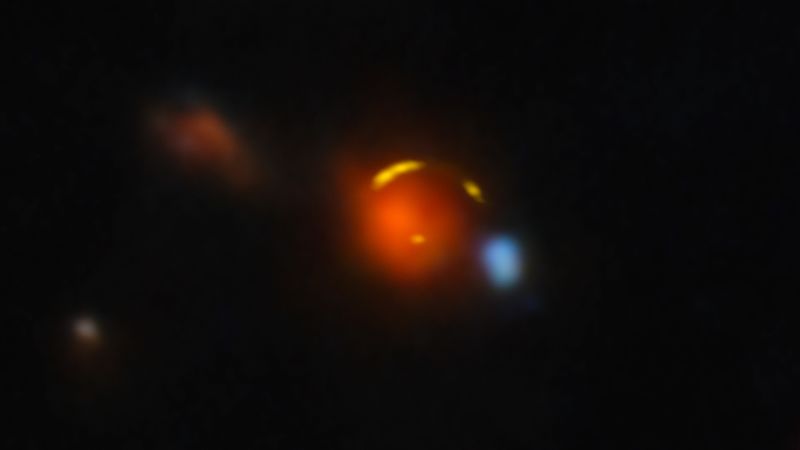
Lead author Urata and his team encountered an unexpected twist that led to a breakthrough. Days after the IceCube alert, they observed a galaxy with intense star formation, named JCMT0402−0424, using the James Clerk Maxwell Telescope and the Submillimeter Array in Hawaii. These instruments, situated on the summit of Mauna Kea, revealed a galaxy that emitted an extraordinary amount of infrared light—trillions of times more luminous than our sun. The nickname “Shadow Blaster” was chosen to reflect the galaxy’s dusty composition, which makes it nearly imperceptible in optical wavelengths, X-rays, or gamma rays.
“Blaster refers to the idea that despite its hidden nature, the galaxy may be a powerful source of high-energy particles and neutrinos,” Urata explained. The team’s analysis suggested that the galaxy’s activity, though concealed, could be responsible for the neutrino’s origin. However, the key to confirming this connection lay in an unforeseen observation: the galaxy was positioned behind a gravitational lens, a phenomenon that dramatically altered the researchers’ understanding of its visibility and role in cosmic events.
Gravitational Lensing as a Cosmic Magnifier
When the team used the Atacama Large Millimeter/submillimeter Array (ALMA) in Chile for further observations, they realized the galaxy’s location was not coincidental. The gravitational lensing effect, caused by a massive foreground galaxy, amplified the light from Shadow Blaster, making it easier to study its hidden features. This cosmic magnifying glass allowed scientists to detect a compact star-forming region that would have otherwise remained undetectable. “This lensing effect magnified the galaxy and allowed us to study a hidden, compact star-forming region that would otherwise have been much harder to detect,” Urata said.
Gravitational lensing occurs when the gravity of a massive object, such as a galaxy cluster, bends the path of light from a more distant object. This bending creates a magnified and distorted image, enabling astronomers to observe details in sources that are otherwise too faint. In the case of Shadow Blaster, the lensing effect not only revealed its structure but also highlighted its potential as a cosmic particle accelerator. Dense stellar nurseries, like the one in this galaxy, generate intense magnetic fields and radiation, which could facilitate the creation of high-energy neutrinos.
The identification of Shadow Blaster as a possible neutrino source offers a new approach for studying these particles. By combining neutrino detection with light-based observations, scientists can more accurately map their origins. This method has the potential to revolutionize the field of neutrino astronomy, providing insights into the high-energy processes that shape the universe. The discovery also underscores the importance of gravitational lensing in uncovering hidden cosmic phenomena, a tool that has become increasingly valuable as telescopes improve in sensitivity and resolution.
Implications for Future Research
Urata’s study represents a major step toward solving the puzzle of neutrino origins. The ability to link a neutrino to its galactic source opens the door for more targeted investigations. For example, if similar neutrinos are detected in the future, astronomers can use gravitational lensing and multi-wavelength data to identify their sources with greater precision. This could lead to a better understanding of how star-forming regions contribute to the production of cosmic particles and the dynamics of galactic evolution.
Erik Blaufuss, a research scientist at the University of Maryland, noted the significance of the IceCube observatory in capturing such events. “The IceCube detector has sensors embedded deep in the Antarctic ice, and it picked up the presence of a high-energy neutrino in 2021,” he said. “This kind of event is rare, which is why it’s so valuable for scientific inquiry.” While Blaufuss was not involved in the study, his insights highlight the collaborative nature of neutrino research, where data from different observatories and wavelengths are essential for piecing together the cosmos’ secrets.
As the field of neutrino astronomy continues to evolve, discoveries like Shadow Blaster could reshape our understanding of high-energy cosmic events. The interplay between neutrino detection and optical observations demonstrates how combining different techniques can overcome the limitations of individual methods. This galaxy, once invisible to the naked eye, now stands as a testament to the power of modern astrophysical tools and the persistence of researchers in deciphering the universe’s mysteries.
With the identification of Shadow Blaster, scientists are now closer to answering long-standing questions about neutrinos. The galaxy’s role as a potential source of these ghostly particles could lead to breakthroughs in understanding the mechanisms that drive cosmic activity. As Urata and his team continue their work, their findings may pave the way for new methods of tracing the origins of neutrinos, ultimately illuminating the hidden processes that shape the universe.
