How the world’s highest bridge became a tourist hot spot in China

Daftar Isi
China’s Highest Bridge Is Drawing Visitors Far Beyond Its Roadway
Activelifezero.com – High above the Beipan River in southwestern China, a suspension bridge built to shorten a difficult mountain crossing has developed a second identity: a destination for travelers looking for sweeping views and high-altitude adventure.
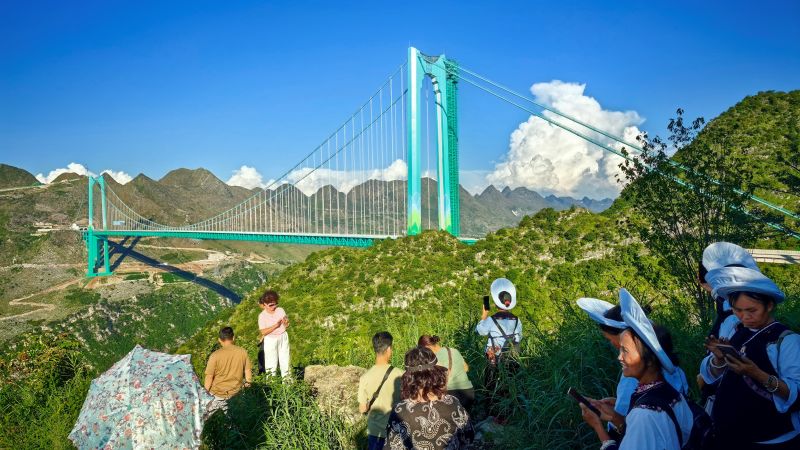
The Huajiang Grand Canyon Bridge, which opened in September 2025, rises 625 meters (2,051 feet) above the river in Guizhou province. Guinness World Records recognizes it as the world’s highest bridge. Its roadway stands nearly nine times farther above the water than the deck of San Francisco’s Golden Gate Bridge, creating a dramatic setting among the steep peaks and deep valleys of southwest China.
The structure was designed to transform travel across the canyon. A journey that once took around two hours can now be completed in about two minutes, linking rural mountain communities more directly with the broader road system. Yet the bridge’s role has expanded beyond transportation. From its opening through August 2026, it welcomed roughly 3.3 million visitors.
A bridge built for movement — and for looking down
At nearly 2.9 kilometers (1.8 miles) long, the Huajiang Grand Canyon Bridge crosses a landscape where mountains appear to roll continuously into the distance. Two enormous teal-colored towers rise from the gorge, emphasizing the scale of the engineering project.
For drivers, the bridge offers a quicker route. For visitors, the attraction begins beneath the traffic lanes. Glass viewing platforms inside the structure provide a direct look into the canyon far below. An exposed walkway along the side of the bridge gives guests another way to experience the height, this time with open space underfoot and the mountains surrounding them.
The most extreme option is bungee jumping. At one event, spectators gathered along the bridge as a young man prepared to leap from a platform beneath the roadway. After safety staff checked his harness and equipment, he stepped into the air and dropped toward the canyon floor. His descent lasted seven seconds before the bungee cord pulled him upward again, prompting applause from the crowd.
The bridge turns a feat of infrastructure into an experience that visitors can enter, walk through and view from perspectives unavailable to people simply passing over it by car. In a province known for rugged terrain, that combination of transportation, scenery and adventure has given the site an unusual appeal.
Tourism brings new opportunities to canyon villages
The rising number of visitors has also changed prospects for communities below and around the bridge. For local entrepreneur Lin Guoquan, the new route created an opening to build a hospitality business in a village that had previously seen far fewer outsiders.
Lin had spent years working as a chef in Yunnan, Zhejiang and Guangdong before returning to Guizhou. Back home, he began renovating old houses, including the home of his grandparents, into accommodations for travelers. He initially opened with nine rooms. The operation has since grown to 52 rooms, yet demand continues to outpace availability.
“When we first opened, we only had nine rooms. Now we have expanded to 52, and we still don’t have enough rooms for all our guests,” Lin said.
The pace of tourism became especially clear during the nine-day Chinese New Year holiday in February 2026, when the bridge’s service area logged more than 300,000 visits. That total exceeded the population of Buffalo, New York, illustrating how a remote mountain crossing can generate major visitor traffic when it becomes an attraction in its own right.
Lin has also used short-form video to introduce his village to a much wider audience. He has attracted more than 100,000 followers on Douyin, China’s counterpart to TikTok, by livestreaming local scenery with the vast bridge visible overhead. His online presence has become another path for travelers to discover the area and plan stays in the village.
“Lots of people book rooms at my homestay after watching my videos. They ask me for travel advice,” he said.
The need for a digital connection
Physical access alone is not enough for a tourism economy to grow. Visitors need reliable mobile service to share images, navigate, communicate and make travel arrangements, while local businesses need connectivity to reach customers beyond the canyon.
Mobile coverage in the area had once been limited. China Mobile and Huawei have expanded the network with additional base stations intended to support increasing visitor numbers. The development reflects a broader reality of modern tourism: spectacular destinations are often discovered online long before travelers arrive in person.
“What people see is this mighty physical bridge,” said Zhou Jianguo, a member of Huawei’s China strategy and business development division. “Yet a bridge in the digital world is equally necessary.”
For Guizhou, the Huajiang Grand Canyon Bridge represents more than a new record for height. It shows how large infrastructure can alter the relationship between isolated landscapes and the people who visit them. A project conceived to overcome geography is now helping turn that geography into an economic asset.
The bridge remains an essential route across the canyon, but its observation decks, cliffside views and bungee platform have added a different kind of value. Travelers come to cross it, but many now come specifically to pause, look down and experience the scale of the mountains that once made the journey so difficult.
Related Reading
Frequently Asked Questions
What is How the world s highest bridge?
How the world s highest bridge is the main topic of this guide. The article explains the context, practical details, and next steps readers should understand.
Why does How the world s highest bridge matter?
How the world s highest bridge matters because readers are looking for a useful answer, not just a short summary. Good content should match search intent and help them decide what to do next.