
US service member arrested at Capitol after calling for Trump’s impeachment
US Service Member Arrested at Capitol After Calling for Trump’s Impeachment
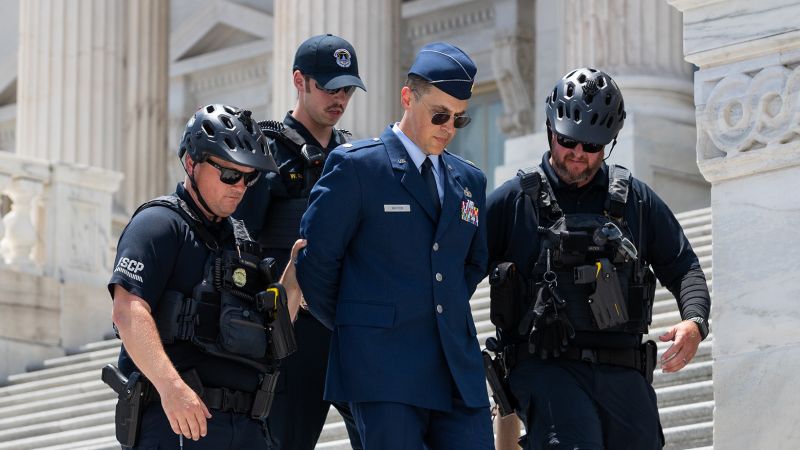
US service member arrested at Capitol – On Wednesday, a U.S. Air Force major was apprehended at the U.S. Capitol’s entrance following a public address advocating for the impeachment and ousting of President Donald Trump and Vice President JD Vance. The incident unfolded during a press event organized by Removal Coalition, a grassroots advocacy group. Jason Watson, the service member, was identified as an active-duty individual and appeared in full military attire. His arrest drew attention from Democratic representative Al Green of Texas, who was present at the gathering.
Capitol Police Statement on the Arrest
According to the US Capitol Police, Watson was “escorted” to the steps of the House by a member of Congress before being detained. The law enforcement agency emphasized that public demonstrations on the Capitol’s front steps are permitted only when accompanied by a congressional representative. When Watson continued his speech despite the warning, police issued lawful orders to halt the protest, citing the charge of 22-1307, which includes crowding, obstructing, and incommoding others. The police clarified that the Capitol grounds offer alternative locations for political expressions.
“The man refused our lawful orders and was then arrested,” stated Capitol Police in their official communication. The incident underscores the strict protocols surrounding public gatherings at the Capitol, which are designed to maintain order during high-profile events.
Legal Proceedings and Pending Charges
As of Tuesday, a DC superior court official confirmed to CNN that Watson is expected to be released, with no immediate intent to file charges against him. The DC attorney general, who holds the authority to decide on prosecution, has not yet provided a comment on the matter. CNN has since contacted the US Air Force to verify Watson’s status as an active-duty service member, though a response has not been received yet.
Watson’s Speech and Criticisms
During his address, Watson criticized the Trump administration’s recent military interventions in Venezuela and Iran, as well as the administration’s stringent immigration enforcement policies. He argued that these actions contravened several constitutional provisions, according to a video shared online by Removal Coalition. “For this, the president and vice president must be impeached, convicted, and removed,” Watson asserted in the recording.
Context of Military Dissent
Public dissent among active-duty military personnel is relatively uncommon, as service members are bound by the Uniform Code of Military Justice (UCMJ). This code mandates that soldiers follow orders and penalizes contemptuous remarks directed at the president, vice president, Congress, and other senior officials under Article 88. Additionally, the UCMJ prohibits military personnel from wearing uniforms during political demonstrations, a rule that Watson appeared to have broken.
“We started having conversations and took this desire that he had to come out very seriously,” said Jessica Denson, the founder of Removal Coalition. “We thought about the best way to make his sacrifice worth it,” she added, highlighting the group’s role in facilitating Watson’s public statement.
Rep. Green’s Support and Social Media Reaction
Democratic Rep. Al Green later shared a video on social media, lauding Watson’s actions as a bold stand for justice. “I just left the Capitol grounds, and I was there to witness a major in the United States military bend the arc of the moral universe toward justice,” Green wrote. He noted that Watson had “stood for impeachment of the president” before being removed from the scene. CNN has since sought additional comments from Green’s office regarding the incident.
Implications and Ongoing Debate
The arrest has sparked discussions about the balance between individual expression and adherence to military regulations. While Watson’s actions align with the principle of holding leaders accountable, they also challenge the traditional expectation that service members remain silent on political matters. Critics argue that the UCMJ’s strict rules may stifle dissent, especially in cases where military personnel feel strongly about policy decisions. Supporters, however, view the incident as a necessary step toward transparency and accountability in government.
Watson’s speech at the event provided a platform for addressing grievances against the administration, with specific focus on military operations and immigration policies. His presence in uniform added symbolic weight to his call for impeachment, emphasizing the gravity of his stance. The Removal Coalition, which organized the press conference, aims to amplify voices from within the armed forces, particularly those advocating for policy changes.
Public and Political Response
Watson’s arrest has drawn mixed reactions from the public and political figures. While some applaud his courage, others question whether his actions were justified under the circumstances. The incident also raises questions about the freedom of speech for military personnel and the extent to which they can participate in political discourse without facing consequences.
Capitol Police have maintained that their actions were necessary to enforce rules against unauthorized demonstrations. They stressed that the event was held on the House steps, a location reserved for congressional-sanctioned activities. This has led to debates about the fairness of the enforcement and whether the rules are applied consistently to all participants. For example, the presence of Rep. Green at the event suggests that some members of Congress may support the idea of public dissent, even if it occurs outside of official proceedings.
Watson’s case highlights the intersection of military service and political activism. As a service member, he is expected to uphold the UCMJ’s guidelines, yet his arrest demonstrates that exceptions can be made when individuals take a public stand. The Removal Coalition’s role in connecting Watson to the event underscores the collaborative efforts between grassroots organizations and active-duty personnel to challenge leadership decisions.
Despite the legal outcome, the incident has already generated significant media attention. CNN’s coverage of the event has prompted further inquiries into the legal process and the potential for future cases. The involvement of the DC superior court and the DC attorney general adds another layer of complexity, as their decisions will shape the broader narrative around Watson’s actions. Meanwhile, the absence of a confirmed legal representative for Watson has raised concerns about his preparedness for any possible proceedings.
As the situation continues to unfold, the focus remains on whether Watson’s arrest represents a landmark moment for military dissent or a standard enforcement of existing regulations. The public’s reaction, along with the responses from legal and political figures, will likely determine the long-term impact of this event on the relationship between the military and the political landscape.
Conclusion and Next Steps
Watson’s arrest at the Capitol has become a focal point for debates about free speech, military discipline, and the role of grassroots movements in political activism. While his actions were a clear challenge to the norms of military conduct, they also showcased the growing willingness of service members to express their views on pressing national issues. As the story develops, it will serve as a case study in the balance between accountability and expression, particularly in an era where public dissent is increasingly visible among those in uniform.
