Israel is holding its most important election in years. Here’s what’s at stake

Daftar Isi
Israel’s Election Could Shape Its Political Direction for Years
Activelifezero.com – Israeli voters will return to the ballot box on October 27 facing a decision that reaches beyond the identity of the next prime minister. The election comes after the Hamas-led October 7, 2023 attack, the deadliest security breakdown in Israel’s history, and the conflicts that followed in Gaza, Lebanon and Iran. For many citizens, the vote offers a chance to assess the leaders who were in power during that period and to choose the country’s direction during an era of continuing insecurity.
Benjamin Netanyahu, Israel’s longest-serving prime minister, is once again at the center of the contest. Recent Israeli elections have repeatedly become judgments on his leadership, but the political and personal stakes are especially high this time. His outgoing coalition completed a full four-year term, an unusual achievement in a system often marked by short-lived governments and repeated elections.
Netanyahu’s government was supported by far-right and ultra-Orthodox parties. Together, those partners drove policy in a more nationalist and religiously conservative direction. The government also faced intense domestic opposition in 2023 over its attempt to reshape the judiciary and reduce the power of the Supreme Court and other institutional restraints. Netanyahu, meanwhile, became the first serving Israeli prime minister to go on trial on corruption charges.
A Vote Shaped by War and Security
The political environment has been transformed by the events of October 7 and the military campaigns that followed. Israelis are weighing questions about security, responsibility, military service and the leadership needed during conflict. The wars also contributed to deeper international isolation for Israel, adding a foreign-policy dimension to an election already dominated by domestic divisions.
The central question is whether voters will endorse another period of government led by Netanyahu and his existing political allies, or seek a different coalition capable of steering the country away from that path. Yet even a clear public mood may not produce a quick answer. Israel’s electoral system means the result on election night rarely determines who will govern.
How Israel’s Coalition System Works
Israelis cast ballots for party lists rather than for individual prime ministerial candidates. Seats in the 120-member Knesset are distributed through proportional representation, and a party must receive at least 3.25% of the vote to enter parliament. Thirty-seven lists are registered for this election, although polling indicates that roughly 11 to 13 parties may cross the threshold.
No single party has ever secured the 61 Knesset seats required to govern alone. The largest party therefore does not automatically take power. Instead, the decisive phase begins after the vote, when party leaders negotiate alliances, policy commitments and cabinet posts. Those talks can last days, weeks or even months.
This structure reflects the many political, religious, ethnic and ideological divisions within Israeli society. It also gives small parties considerable leverage. A party with only a modest number of seats can become essential to either major bloc, while votes cast for a party that fails to clear the threshold do not translate into parliamentary representation.
Eisenkot Emerges as Netanyahu’s Main Rival
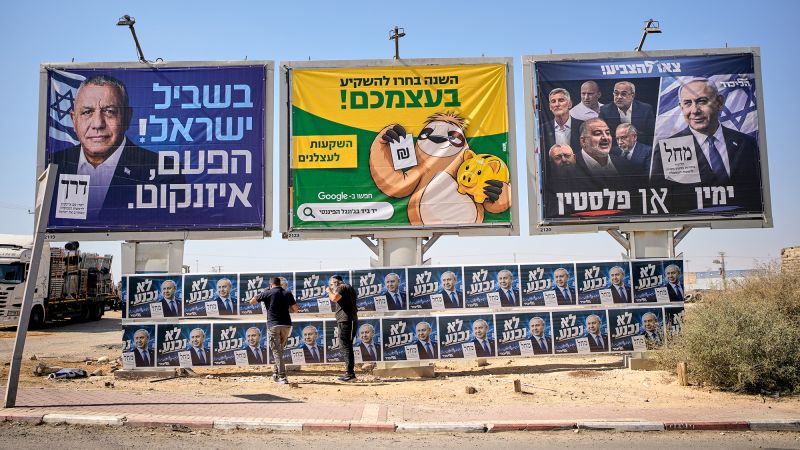
Netanyahu’s Likud remains one of the country’s largest political forces. Its principal challenge comes from Yashar, a new centrist party led by former military chief of staff Gadi Eisenkot. In one recent Channel 12 poll, Yashar was projected to win 23 seats, compared with 21 for Likud. Other surveys show a markedly different picture: Channel 14 projected Likud at 30 seats and Eisenkot’s party at roughly 20.
In direct assessments of who is better suited to serve as prime minister, Eisenkot has maintained a consistent advantage over Netanyahu. Still, personal preference is only one part of the equation. A party’s ability to assemble a workable coalition ultimately determines whether its leader can become prime minister.
Most polling places Netanyahu’s prospective bloc between 49 and 55 seats. That grouping includes Likud, two far-right parties led by Bezalel Smotrich and Itamar Ben-Gvir, and two ultra-Orthodox parties. Even at the upper end of those projections, the bloc would remain short of a majority.
An Opposition With Its Own Obstacles
The parties opposing Netanyahu may appear stronger when their projected seats are counted together, but they are far from unified. Eisenkot sits near the center of a wide ideological field. To his right are parties associated with former Prime Minister Naftali Bennett and former Defense Minister Avigdor Liberman. On his left is the Democrats party, led by Yair Golan.
Bennett and Liberman have not endorsed Eisenkot, and both retain ambitions to lead the government themselves. Their positions make it difficult to assume that an anti-Netanyahu majority would naturally produce an Eisenkot-led coalition.
Any alternative government could also require support from Arab parties, or at least their decision not to block it. Several opposition figures have rejected cooperation, narrowing their routes to a governing majority. Palestinian citizens of Israel make up about one-fifth of the country’s population, making Arab turnout potentially significant in close contests.
Small Margins May Decide the Result
The election could end in several ways: a Netanyahu-led coalition, an opposition government, a minority administration, a broad unity arrangement, or another period of deadlock followed by a new election. The outcome may turn on relatively small shifts in turnout and on whether smaller parties cross the 3.25% barrier.
A few thousand votes can be enough to determine whether a party gains representation, vanishes from the Knesset or becomes the pivotal partner in coalition negotiations. That uncertainty is why October 27 may be only the beginning of Israel’s political reckoning rather than its conclusion.
Related Reading
Frequently Asked Questions
What is Israel is holding its most important?
Israel is holding its most important is the main topic of this guide. The article explains the context, practical details, and next steps readers should understand.
Why does Israel is holding its most important matter?
Israel is holding its most important matters because readers are looking for a useful answer, not just a short summary. Good content should match search intent and help them decide what to do next.