Why is China less worried about an AI dystopia than the US?

Daftar Isi
China’s Everyday AI Experience Is Shaping a Different Public Mood
Activelifezero.com – Artificial intelligence has become an ordinary part of life for many people across China, from public services and schools to hotels and online shopping. That daily familiarity helps explain why fears of an imminent AI-driven catastrophe appear far less prominent than they are in the United States.
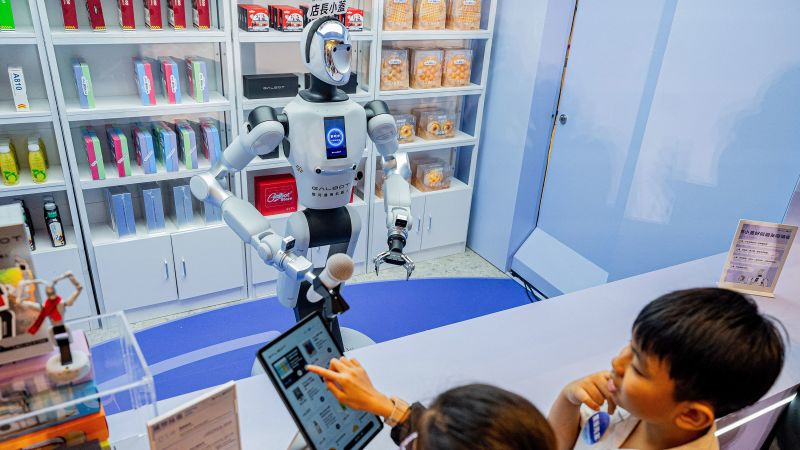
Residents can interact with AI-powered digital staff for some local government services. Students may photograph written work and receive rapid feedback, while hotel visitors can have parcels brought to their rooms by delivery robots. For many users, AI is not mainly an abstract warning about the future; it is a practical tool already saving time and reducing friction.
A Morgan Stanley survey released Monday found that 80% of respondents in China used AI at least once a week, compared with 54% in the United States. Another survey, conducted earlier this year by Ipsos, found that 83% of Chinese respondents considered AI-powered products and services exciting. In the US, that view was shared by 33% of respondents.
Convenience Before Controversy
Chinese technology companies are competing intensely to offer free chatbots and AI features inside popular apps. The technology is also being adopted in fields including e-commerce, manufacturing and filmmaking. As AI becomes tied to inexpensive services and visible productivity gains, it is often assessed through its immediate usefulness.
“Most Chinese people meet AI as a cheap product first and as a debate second,” said Poe Zhao, an analyst and founder of Hello China Tech, a newsletter focused on China’s technology industry.
“When a technology shows up as a useful, low-cost service, people judge it by what it does for them, not by what it might do to them.”
Shi Hongchao, a 51-year-old from Liaoning province in northeastern China, described AI as increasingly unavoidable in social and professional life.
“Everyone I know says AI has already permeated every aspect of our lives,” Shi said. “Everyone is either talking about it or has already started using it. It feels almost unstoppable at this point.”
This widespread exposure differs from a US debate that has frequently focused on the dangers of increasingly capable systems. American researchers and technology leaders have publicly called for slower development, warning that advanced AI could create risks extending beyond job losses, misinformation or privacy concerns.
Different Trust in Government
Public confidence in government is another major part of the divide. An Edelman survey found that 86% of respondents in China trusted their government to do what is right, while 39% of US respondents expressed the same confidence in their own government.
Xu Jingyuan, a 22-year-old business student in Beijing, said AI should be understood primarily as a technology meant to help people. He also expressed faith in the state’s ability to manage its hazards.
“This technology was created to serve humanity,” Xu said. “We shouldn’t see it as something to fear, but as something that brings greater conveniences to our lives.”
Xu said the government is “absolutely capable” of managing AI-related risks. His view reflects a broader expectation that authorities will intervene if technology causes serious problems.
“In the US, there is a general public perception that without whistleblowing, big corporations could escape accountability or scrutiny due to weak government oversight,” said Lian Jye Su, chief analyst at technology research firm Omdia. “Whereas in China, I think there is this very strong confidence from the public that if any sh*t hits the fan, the government will step in.”
Political Systems Shape the Debate
The two countries also approach public disagreement differently. Whistleblowers, contentious hearings and sharp policy disputes are common features of the US political system, particularly in a polarized democracy. Such debates can amplify concern about whether companies, regulators and elected officials are responding quickly enough to emerging technologies.
China’s one-party political structure gives the state greater capacity to establish priorities from the top down and limits open criticism of official agendas. That does not mean Chinese authorities ignore AI dangers. Instead, the warnings that do emerge often focus on retaining control over systems, preventing malicious use and reducing social disruption rather than on the possibility of human extinction.
Zhao said the language surrounding risks is notably different.
“Chinese warnings are quieter and use a different vocabulary. The dominant framing is loss of operational control, malicious use and social disruption, rather than human extinction,” Zhao said.
Chen Yixin, China’s intelligence chief, published an article last Sunday calling for AI to be incorporated as a strategic industry in national economic development while also setting out concerns Beijing identifies around the technology. The balance reflects China’s broader ambition: accelerate AI adoption and competitiveness while keeping the technology under state supervision.
What the Difference Means
The contrast is not simply a question of whether one public understands AI better than another. It reflects how people encounter the technology, the institutions they expect to oversee it and the kinds of risks emphasized in public discussion.
In China, a person using a chatbot, school feedback tool or delivery robot may see AI first as a convenient service. In the US, many people encounter the subject through arguments over powerful companies, employment disruption, misinformation, surveillance and the long-term safety of advanced systems. Both perspectives recognize that AI can transform society, but they begin from markedly different assumptions about who will be responsible if it goes wrong.
As China and the United States remain leading AI powers, those differences may influence not only consumer behavior but also how each country develops regulations, supports industry and defines responsible use. The central challenge for both is likely to be the same: ensuring that rapid deployment delivers real benefits without leaving the public to absorb the costs of failures that could have been prevented.
Related Reading
Frequently Asked Questions
What is Why is China less worried about?
Why is China less worried about is the main topic of this guide. The article explains the context, practical details, and next steps readers should understand.
Why does Why is China less worried about matter?
Why is China less worried about matters because readers are looking for a useful answer, not just a short summary. Good content should match search intent and help them decide what to do next.