Canada-EU alliance isn’t meant to be a US rival with ‘better manners,’ Carney says

Daftar Isi
Carney Promotes Closer Canada-EU Partnership Amid Trade and Security Pressures
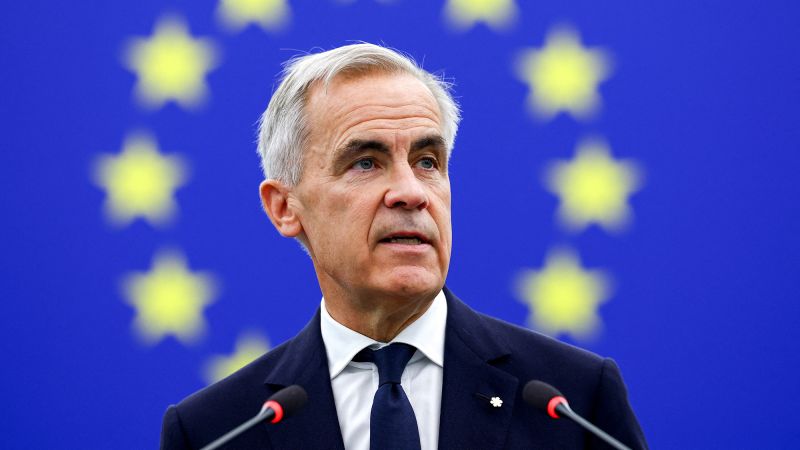
Activelifezero.com – Canadian Prime Minister Mark Carney has argued for a deeper partnership between Canada and the European Union, presenting the idea as a way for democracies to strengthen their independence rather than form a new geopolitical camp aimed at Washington.
Speaking to European lawmakers in France on Thursday, Carney addressed concerns that a more formal Canada-EU relationship could become an alternative power bloc in competition with the United States. His remarks followed a proposal from European Commission President Ursula von der Leyen for Canada to become the European Union’s first “associate member.” The proposal drew a new tariff threat from US President Donald Trump.
“I’m not proposing a third bloc in order to become a great power rival, only with better manners,” Carney said.
Canada and the European Union have each faced tariffs imposed by Trump, increasing the urgency of finding economic partners and protecting access to key supplies, markets and technologies. Carney framed closer cooperation as a response to vulnerability, not an effort to wield influence over other countries.
“We do not seek power to dominate others. On the contrary, we are pursuing resilience so no one can control our open markets, impair our sovereignty, threaten territorial integrity or undermine our freedoms, our democracies, our rule of law.”
Resilience at the Center of the Proposal
Carney’s speech emphasized the value of democratic countries working together during what he described as a period of “new storms.” He pointed to climate change, trade being used as a political weapon and weakening democratic standards as shared challenges for Canada and Europe.
His argument was that a stronger relationship would help both sides preserve room to make their own economic and political choices. In that view, cooperation on strategic industries would make Canada and the EU less exposed to pressure from outside powers and less dependent on any single trading relationship.
“Europe and Canada are stronger together,” Carney said. “A Canada-EU alliance would create a beacon for other democracies.”
The Canadian leader occasionally delivered portions of his address in French and repeatedly referred to the longstanding historical links between Canada and Europe. The speech sought to connect those cultural and political ties to practical cooperation on modern economic and security priorities.
Energy, Minerals and Technology
Carney welcomed von der Leyen’s ambition to establish an associate-member relationship for Canada. He said polling showed an “overwhelming majority” of Canadians favored stronger connections with Europe.
Among the areas he identified for expanded work were critical minerals and energy security. These sectors have become increasingly important as governments look to secure the materials needed for industry, energy systems and emerging technologies. Carney highlighted Canada’s capacity to supply Europe with liquefied natural gas and hydrogen.
Energy cooperation could give the proposed partnership a concrete economic purpose, while critical-mineral collaboration could support supply chains that both Canada and European countries consider strategically important. Carney also included defense production, payment systems and artificial intelligence among the areas where joint efforts could be developed.
On artificial intelligence, he suggested that Canada and Europe could work together on safety protocols. Such cooperation would place the focus not only on developing the technology, but also on creating safeguards around its use.
Education and Mobility Links
Carney’s proposal extended beyond trade, industry and security. He called for greater personal mobility between Canada and Europe, particularly for young people seeking opportunities to study, work or live across the Atlantic.
“We should deepen our people-to-people ties, allowing our youth to live, work and study where they want on either side of the Atlantic,” he said.
He also suggested that Canada should gain access to Erasmus+ and Horizon, two major EU programs that support education and scientific research. Participation in Erasmus+ could expand opportunities for students and young people, while Horizon is a significant source of funding for research activity.
The wider message of Carney’s address was that Canada and the European Union can reinforce their ties without defining themselves solely through their relationship with the United States. His proposal presents a Canada-EU alliance as a practical effort to protect open markets, democratic institutions and national sovereignty at a time of growing economic and political uncertainty.
Related Reading
Frequently Asked Questions
What is Canada EU alliance isn t meant?
Canada EU alliance isn t meant is the main topic of this guide. The article explains the context, practical details, and next steps readers should understand.
Why does Canada EU alliance isn t meant matter?
Canada EU alliance isn t meant matters because readers are looking for a useful answer, not just a short summary. Good content should match search intent and help them decide what to do next.