The Fed meeting is a pivotal moment for the bond market

Daftar Isi
Bond Market Pressure Puts Federal Reserve Decision in Focus
Activelifezero.com – Rising Treasury yields have made this week’s Federal Reserve meeting a critical test of whether policymakers can maintain confidence in their effort to control inflation. Markets are increasingly prepared for the central bank to lift its benchmark rate on Wednesday, its first increase since 2023, after inflation data for August showed price pressures had not eased as much as investors hoped.
Trading in interest-rate futures has moved decisively toward a quarter-point increase. CME FedWatch showed a 93% probability of a hike, a dramatic change from the uncertainty that surrounded the decision only weeks ago. Before the latest inflation figures, markets had viewed a rate increase and a pause as nearly equally likely outcomes.
The shift comes as bond investors have pushed yields higher across the Treasury market. On Tuesday, the 10-year Treasury yield briefly reached its highest point since 2007. It had finished at 4.6% after the Fed’s July 29 meeting and has since moved above 5%, returning to levels not seen in nearly two decades.
Why Yields Matter Beyond Wall Street
Treasury yields influence far more than government borrowing. They help set the direction for mortgage rates, corporate financing costs, auto loans and other forms of consumer credit. Higher yields can also increase the interest burden carried by the federal government while making it more expensive for companies to fund expansion or refinance existing debt.
Bond prices and yields move in opposite directions. When investors sell bonds, their prices decline and the yield available to new buyers rises. The recent sell-off has therefore created a feedback loop for policymakers: if investors conclude that inflation risks are being underestimated, they may demand still higher yields to hold longer-dated debt.
The two-year Treasury yield, which is particularly sensitive to expectations for Fed policy, is at its highest level in more than two years. It stands roughly 100 basis points, or one percentage point, above the Fed’s benchmark rate. That gap has strengthened the market message that monetary policy may need to become tighter.
A Credibility Test for Kevin Warsh
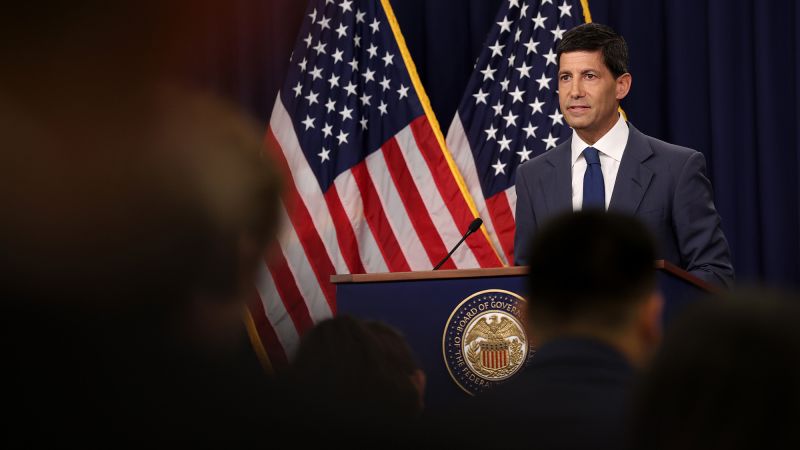
Chairman Kevin Warsh’s remarks will be examined closely even if the Fed delivers the widely expected quarter-point increase. Investors will be looking for signs that officials remain focused on persistent inflation and are prepared to respond if price growth fails to slow.
At the July meeting, Warsh said he preferred markets to react to underlying economic conditions rather than attempt to anticipate every move by the central bank. He noted the increase in Treasury yields at the time and characterized it as a response to tangible economic developments.
“Market participants are learning to play the ball, not the referee — and market prices will continue to respond in the direction and magnitude they see fit,” Warsh said on July 29. “This is, in my view, a change for the better — and we’re just getting started.”
Since then, the bond market has continued to signal concern. Inflation has remained sticky, while the war with Iran has added to worries that price pressures could worsen. Broader uncertainty surrounding the Middle East conflict, government borrowing needs, corporate debt issuance and expectations for further central-bank tightening have all contributed to the rise in yields.
Vail Hartman, a US rates strategist at BMO Capital Markets, argued that a decision to leave rates unchanged would be difficult to reconcile with the market’s current expectations and the Fed’s inflation mandate.
“At this stage, it would be very difficult for the Fed to leave rates unchanged this week without eroding its inflation-fighting credibility,” Hartman said in a note.
Hartman also pointed to the unusually strong market conviction behind a rate increase.
“Historically, the Fed has seldom deviated from rate decisions that markets have priced with such high conviction,” Hartman said. “Surprising with a hold would trigger a sharp rally in the front end of the curve and a sell-off in longer-dated Treasuries, [the] US dollar and risk assets.”
What a Pause Could Signal
If the Fed unexpectedly holds rates steady, short-term Treasury securities could rally because traders would reassess the likely path of policy. Longer-term bonds could face renewed selling, however, if investors interpret a pause as evidence that the Fed is not acting forcefully enough against inflation.
That distinction is important. A policy pause could initially look supportive for some financial assets because it would reduce expectations for immediate borrowing-cost increases. But a loss of confidence in the inflation outlook could have the opposite effect over time, lifting long-term yields and unsettling stock markets, the dollar and other risk-sensitive assets.
Ed Yardeni, president of Yardeni Research, said Warsh’s recent rhetoric has made the Fed’s next move especially consequential.
“[Warsh] has been talking hawkishly since June. Now, he has to deliver a rate hike,” Yardeni said in a note.
Yardeni said the signals from both short- and long-dated Treasuries point in the same direction.
“After all, he promised to follow the financial markets’ lead. The 2-year and 10-year yields are clearly calling for a rate hike,” Yardeni said. “If they keep rising after Warsh’s presser on Wednesday, then he will still have a credibility problem.”
The Market’s Message After Wednesday
A quarter-point increase would align the Fed with prevailing market expectations, but it would not necessarily end the pressure on bonds. Investors will focus on Warsh’s assessment of inflation, the outlook for future decisions and whether policymakers believe financial conditions have tightened enough to restrain demand.
For households and businesses, the key issue is whether the jump in market yields becomes a lasting feature of the borrowing environment. A sustained period of elevated Treasury yields could continue to filter through to loans, housing finance and business investment. For the Fed, Wednesday’s decision is therefore not simply about one adjustment in interest rates. It is also about persuading markets that inflation control remains the central objective as bond investors demand clearer evidence of that commitment.
Related Reading
Frequently Asked Questions
What is The Fed meeting is a pivotal?
The Fed meeting is a pivotal is the main topic of this guide. The article explains the context, practical details, and next steps readers should understand.
Why does The Fed meeting is a pivotal matter?
The Fed meeting is a pivotal matters because readers are looking for a useful answer, not just a short summary. Good content should match search intent and help them decide what to do next.