Body of war criminal Mladić lies in state in Serbian capital ahead of funeral

Daftar Isi
Belgrade Turns Out for Ratko Mladić as Serbia Defies Brussels Over War-Crimes Legacy
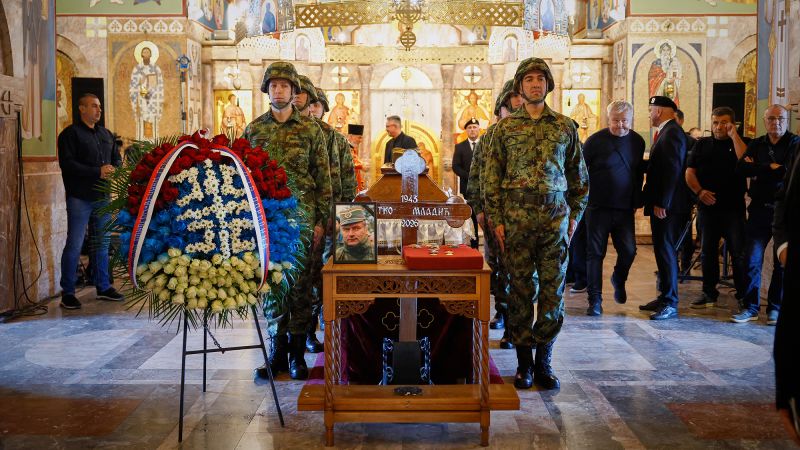
Activelifezero.com – Thousands of mourners gathered before dawn at the modest Church of St. Luke in central Belgrade on Monday to pay final respects to Ratko Mladić, the Bosnian Serb military commander whose coffin lay draped in the national flag beneath his officer’s cap and saber. Men in fatigues stood guard on either side of the casket as the city prepared for what pro-government outlets described as a full military honors ceremony, with Patriarch Porfirije, head of the Serbian Orthodox Church, set to lead the funeral service.
The spectacle unfolded against a backdrop of sharp diplomatic friction. Serbia, still an aspirant for European Union membership, proceeded with the public homage despite explicit warnings from Brussels that glorifying a convicted genocide perpetrator runs counter to the values underpinning the bloc’s enlargement path. The tension between Belgrade’s domestic politics and its stated ambition to join the EU has now become impossible to ignore.
A Commander’s Final Hours and a Nation’s Grief
Mladić died at age 84 on August 27 in The Hague, Netherlands, where he had been serving a life sentence for genocide, war crimes, and crimes against humanity committed by his forces during the Bosnian war of 1992 to 1995. Although the funeral arrangements were formally organized by his family, the Serbian government dispatched a military aircraft the previous week to transport his remains home. Soldiers carried the flag-wrapped coffin through Belgrade, and a commemoration ceremony took place Saturday at an official army venue before the public lying-in-state on Monday.
For many Serbs, Mladić remains a figure of national pride rather than international condemnation. Milan Dobric, a mourner who traveled from Kosovo specifically for the funeral, captured the sentiment of the crowd:
“He was a man who gave everything in his life for the Serbian people. I am glad that this morning people are coming to pay special respect.”
In the days following his death, nationalist admirers held candlelit vigils, painted a series of murals bearing his likeness across Belgrade’s streets, and lit flares in his name. On Sunday evening, soccer supporters unfurled a massive banner of Mladić’s face at a match in the capital and chanted his name through the stands.
The Conviction: Srebrenica, Sarajevo, and the Camps
The International Criminal Tribunal sentenced Mladić in 2017 after finding him responsible for orchestrating the 1995 massacre at Srebrenica, where more than 8,000 Bosnian Muslim men and boys were killed. The tribunal also held him accountable for the years-long siege of Sarajevo, the Bosnian capital, and for establishing concentration camps where detained non-Serb civilians and captured enemy soldiers were held under brutal conditions.
Srebrenica had been designated a United Nations “safe haven” for Bosniaks. In July 1995, Bosnian Serb forces overran the enclave, forced men and boys to strip, executed them, and bulldozed their bodies into mass graves. The war itself, which erupted after the breakup of the former Yugoslavia when ethnic Serbs in Bosnia seized large swaths of territory to create a separate entity linked to Serbia, left more than 100,000 people dead and over one million displaced before a US-brokered peace agreement ended hostilities in 1995.
Notably, Serbia has consistently refused to formally recognize that genocide occurred at Srebrenica, preferring the term “horrific crime” in official language.
Brussels Pushes Back; Belgrade Pushes Harder
Marta Kos, the EU’s enlargement commissioner, canceled a scheduled visit to Serbia in protest, stating that the glorification surrounding Mladić’s death is incompatible with the values on which the EU path is built. A number of other European officials, regional leaders, and relatives of wartime victims joined the chorus of criticism.
President Aleksandar Vucic, a populist and former extreme nationalist who backed Serbia’s expansionist policies during the war, dismissed the diplomatic row. He characterized the funeral as an “emotional outpouring” that “has nothing to do with whether Vucic allowed something or not.” He did not attend the ceremony himself.
“We (Serbs) have been persecuted and harassed for 30, 40 years … always guilty whatever happens. People just won’t take it any more.”
Vucic, who has previously accused Kos of “lying,” has intensified his anti-Western rhetoric in the run-up to an early parliamentary election expected next month. His administration’s EU bid has effectively stalled, weighed down by democratic backsliding at home and his refusal to join international sanctions against Russia over its invasion of Ukraine.
A Pattern of State Honors for Convicted War Criminals
Mladić’s state funeral is not an isolated gesture. Last year, Serbia buried Nebojsa Pavkovic, the former army chief of staff also convicted of war crimes, with full military honors at a cemetery reserved for distinguished individuals. Together, these ceremonies signal a deliberate political choice: to frame wartime accountability as foreign imposition rather than domestic reckoning, and to mobilize nationalist sentiment ahead of elections.
For the families of Srebrenica’s victims and for Bosniaks across the region, the spectacle in Belgrade’s streets underscores how little the political settlement of 1995 has translated into shared historical memory. The EU enlargement process, already fragile, now faces a test of whether its candidate criteria can survive a member-to-be’s public veneration of the very figure convicted of the continent’s first genocide case since World War II.
Related Reading
Frequently Asked Questions
What is Body of war criminal Mladić lies?
Body of war criminal Mladić lies is the main topic of this guide. The article explains the context, practical details, and next steps readers should understand.
Why does Body of war criminal Mladić lies matter?
Body of war criminal Mladić lies matters because readers are looking for a useful answer, not just a short summary. Good content should match search intent and help them decide what to do next.