Two men rescued from flood-stricken Nepali power plant where scores feared trapped

Daftar Isi
Voices from the Dark: Two Workers Pulled Alive from Nepal’s Flood-Severed Power Tunnel
Activelifezero.com – Nine days after a wall of debris-laden water tore through the Trishuli River valley and swallowed entire construction sites beneath the Himalayan foothills, two men emerged alive from the sealed tunnels of the Trishuli 3A hydropower station. Their extraction marked the first confirmed survival from inside the buried infrastructure, and it came accompanied by something even more staggering: rescuers reported hearing additional voices echoing from deeper within the collapsed passages.
The breakthrough unfolded under grueling conditions. Roughly a dozen rescue workers hauled one man through a narrow borehole in the earth, clapping and cheering as he surfaced. A second individual followed in quick succession. Bipin Regmi, the police chief overseeing operations in the devastated Nuwakot district, confirmed the recoveries and noted that a medical team was already en route to the site.
The Scale of the Catastrophe
What struck the Trishuli basin was not a conventional river flood. A torrent of water thickened with pulverized rock, sediment, and cement-like slurry surged downstream with enough force to obliterate bridges, wash away entire work camps, and seal underground chambers where crews had been laboring. The event killed more than 1,200 people across Nepal and triggered landslides that compounded the entrapment at several energy projects simultaneously.
Nepali authorities have confirmed that over 900 workers remain unaccounted for across multiple Himalayan hydropower installations. Among the missing are nationals of China, South Korea, and India, reflecting the multinational workforce that has long staffed Nepal’s ambitious push to convert its mountain rivers into electricity exports. The Trishuli River, a major tributary of the Gandaki system, has been the backbone of the country’s largest generation projects since the 1990s, and its upper reaches are dotted with tunnels, intake shafts, and underground powerhouse chambers carved into unstable glacial terrain.
Inside the Rescue Operation
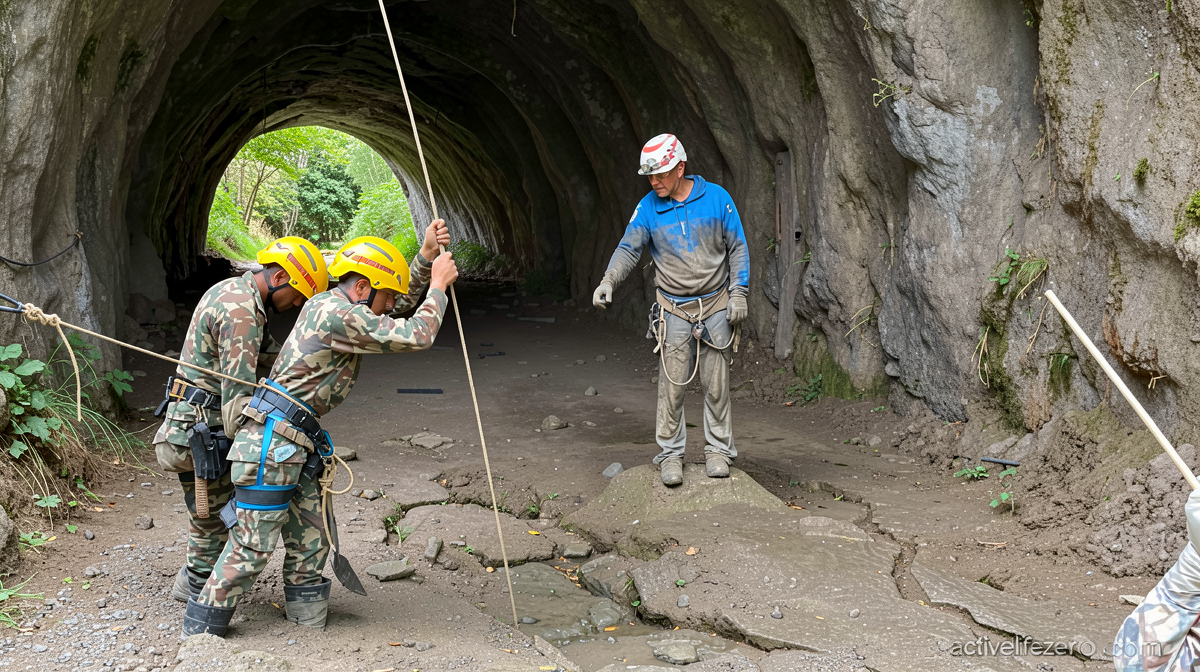
At Trishuli 3A specifically, 42 workers were unaccounted for when the flood struck. The tunnel connecting the surface access point to the buried powerhouse stretches more than four kilometers — roughly 2.5 miles — through rock that had been fractured by the initial seismic shock of the floodwave. Engineers and military engineers have been boring laterally into the tunnel from a secondary shaft, attempting to reach the sealed section where the missing men were last known to be working.
The two men pulled out were recovered from within that tunnel system. Their survival, nine days after entrapment, has electrified the relief effort and raised the question of how many others might still be breathing in the dark beyond the next bend.
What the Clock Means Underground
Parikshit Mehra, an Indian army colonel commanding a specialized rescue detachment at the Trishuli 3A site, offered a blunt assessment of the physiological timeline facing anyone sealed in a mountain tunnel. Speaking from outside the borehole where his team was working, he outlined the stages of deterioration:
“The first 48 hours are the most crucial. People who are stuck tend to panic much more than when they are outside in the open. Getting stuck in a tunnel you can’t see anything. Generally if you stay in the dark you get disoriented in about 24-25 hours. Beyond that, (after) 48 hours, you start hallucinating. And then I think from there on it’s always a fight.”
Yet Mehra closed his remarks with a note that underscored why the operation continued around the clock despite the odds:
“There have been miracles.”
Why Nepal’s Energy Ambition Cuts Both Ways
Nepal’s hydropower sector represents the country’s single largest infrastructure investment and its most promising export commodity. The government has long positioned the nation as a future electricity supplier to India and Bangladesh, and the Trishuli corridor alone hosts several multi-hundred-megawatt plants. That ambition, however, has meant concentrating thousands of workers in narrow tunnels bored through geologically active rock, often at altitudes where weather windows are short and evacuation routes are limited.
The current disaster has forced a reckoning. Questions are mounting over whether tunnel designs adequately account for flash-flood scenarios, whether emergency ventilation and communication systems were installed before full crews moved underground, and whether multinational contractors operated under uniform safety protocols. For the families of the more than 900 missing workers — many of whom are foreign nationals whose governments are now coordinating consular assistance — the answers will come slowly, measured in borehole centimeters and shifting rock.
For now, the focus remains on the voices still being heard. Every additional hour of drilling narrows the window Mehra described, but it also narrows the distance between the rescue crew and whoever is waiting in the dark, counting on the sound of steel on stone to mean that someone is still coming.
Related Reading
Frequently Asked Questions
What is Two men rescued from flood stricken?
Two men rescued from flood stricken is the main topic of this guide. The article explains the context, practical details, and next steps readers should understand.
Why does Two men rescued from flood stricken matter?
Two men rescued from flood stricken matters because readers are looking for a useful answer, not just a short summary. Good content should match search intent and help them decide what to do next.