
What happened when a White man carrying a large wooden cross met a Black man at the nation’s largest Confederate monument
A New Perspective on Stone Mountain: Faith, Heritage, and Healing
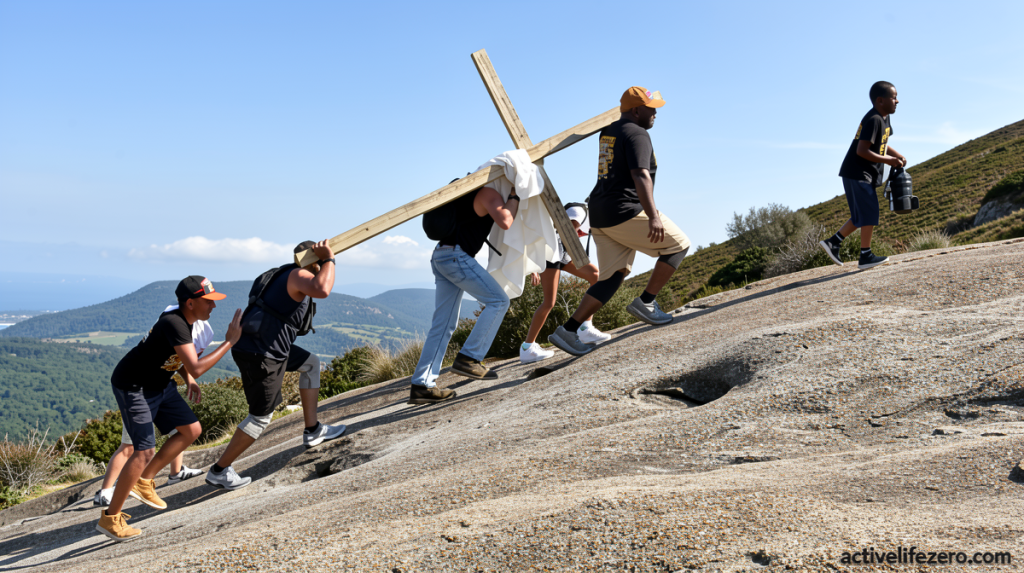
activelifezero.com – On a bright Fourth of July morning, Jean Shifrin found herself pausing on a steep trail as an unusual procession made its way toward her. Squinting against the sunlight, the photographer watched as a White man and two Black men carefully navigated an eight-foot wooden cross up the slippery incline. The scene was both striking and unexpected for someone who had spent years observing this particular mountain.
At the forefront marched one of the Black men, his athletic build reminiscent of a football linebacker. He balanced the heavy cross on his left shoulder while calling out enthusiastically in a commanding voice, “Yessir! Yessir!” Behind him, the White man gripped the center beam of the cross, his tattooed arms already flushed red from the summer heat. A third man, equally sturdy, followed at the back of the group. They were accompanied by an enthusiastic crowd, including a young boy clutching a Bible and a middle-aged Chinese woman who repeatedly encouraged them with “Jiayou!”—Mandarin for “Keep going!”
The Mountain’s Complex Identity
Shifrin, a slender sixty-eight-year-old photographer, was no stranger to peculiar sights at Stone Mountain. Rising 825 feet above the Atlanta area, this massive rock formation carries a complicated legacy. Often called the “Mount Rushmore of the Confederacy,” the monument features a colossal carving etched into its granite surface that has made it a symbol of White supremacy for many Americans.
The carving portrays three central figures of the Confederacy—Robert E. Lee, Thomas “Stonewall” Jackson, and Jefferson Davis—each mounted on horseback. This impressive artwork towers higher than the presidential faces at Mount Rushmore and represents the largest Confederate monument in the United States. However, the mountain’s history extends far beyond this single image.
Stone Mountain holds the distinction of being the birthplace of the modern Ku Klux Klan and has served as a gathering point for various White supremacist organizations throughout the decades. Simultaneously, it has become a focal point for Black Lives Matter demonstrators and other activists advocating for the removal of the more than six hundred Confederate monuments that remain scattered across the country.
Shifrin’s Personal Journey
For much of her life, Shifrin viewed Stone Mountain primarily as a monument to hatred. As a Jewish woman who had personally encountered antisemitism, she felt deep revulsion toward any expression of prejudice. “I was revolted,” she recalled about her first encounter with the carving in the 1990s. “The more I learned about the history of it and how it was started — it just got uglier and uglier.”
Yet the mountain had also become a place of personal healing during a difficult period when Shifrin suffered from a severe genetic condition that left her uncertain whether she would ever walk again. This duality made her curious about the new scene unfolding before her. Could this mountain reveal yet another dimension of its meaning?
When Shifrin began climbing to photograph the diverse crowd gathering at the summit, she realized something profound: there existed multiple approaches to challenging Confederate symbolism. Her years of documenting visitors to Stone Mountain had never prepared her for what she witnessed on that July afternoon.
Beyond Religion and Heritage
What Shifrin discovered challenged conventional narratives. The men carrying the cross were motivated by something deeper than simple religious devotion. While defenders of Confederate monuments frequently claim they are preserving heritage rather than promoting hate, the historical record tells a more complex story.
Alexander Stephens, the Confederate vice president, articulated this perspective clearly in his famous “Cornerstone Speech.” Three weeks before the Civil War began, he declared:
“Our new government is founded upon exactly the opposite idea,” Stephenson said in a speech three weeks before the start of the Civil War. “Its foundations are laid; its corner stone rests upon the great truth that the Negro is not equal to the White man; that slavery, subordination to the superior race is his natural and normal condition.”
The Stone Mountain memorial emerged from similar convictions. Initiated in the early twentieth century by a Confederate widow who also envisioned including KKK members in the carving, the project required more than fifty years to complete, finally finishing in 1972.
A Transformed Landscape
Today, Stone Mountain Park—located sixteen miles outside Atlanta—has evolved into something quite different from its origins. The park opened on April 14, 1965, exactly one century after Abraham Lincoln’s assassination. What was once a bastion of segregation now functions as a “mini-United Nations,” welcoming people of various races, religions, and cultural backgrounds.
Visitors come daily to exercise, meditate, and celebrate together on this ancient rock. For Shifrin, witnessing the cross-carrying men represented proof that transformation was possible—that even the most contested monuments could become spaces of reconciliation and hope. The mountain, once a symbol of division, was becoming something more inclusive, one step at a time.
