
These people say worshiping ancient Greek gods is a route to modern happiness
Modern Devotees Find Spiritual Fulfillment Through Ancient Greek Deities
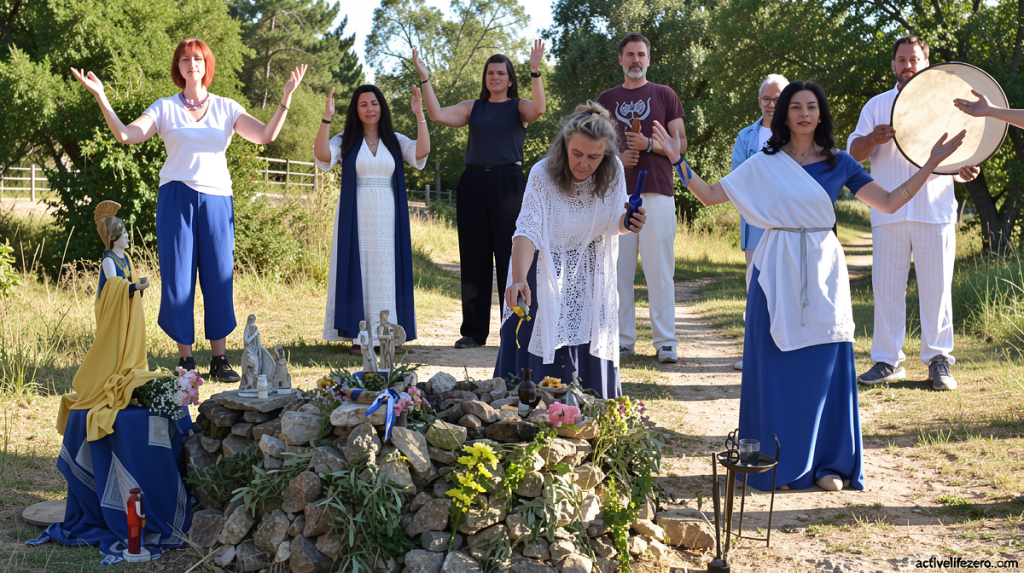
activelifezero.com – In a quiet corner of Athens, a gathering unfolds that bridges millennia. Participants emerge from behind a ceremonial banner, their white robes flowing as they participate in rituals that echo practices from antiquity. Men and women form a semi-circle around a stone altar while a procession winds through the space. One woman carefully positions a miniature statue of Athena—the revered goddess of wisdom—at the rear of the altar, while fragrant frankincense fills the air. Though the setting evokes scenes from classical antiquity, this is decidedly contemporary Athens.
This devoted community continues to honor deities such as Athena, Zeus, Dionysus, and Poseidon through authentic religious practice rather than mere cultural nostalgia. Today’s gathering marks Plynteria, a traditional Athenian purification celebration dedicated to ritually cleansing Athena’s sacred image. The participants belong to Labrys, a modern Hellenistic organization that promotes both communal ceremonies and personal home worship, helping practitioners connect with the ancient gods immortalized in masterpieces like Homer’s “The Odyssey.”
Hollywood’s Greek Myth Retellings Spark Debate
Christopher Nolan’s upcoming summer adaptation of Homer’s epic poem adds another chapter to the story of Odysseus, featuring an ensemble cast that includes Matt Damon portraying the hero and Zendaya as Athena. Yet for certain Labrys members, the film represents something more complex. Named after the double-edged axe—a sacred emblem in both Minoan and Greek civilizations—Labrys members view Hollywood’s fascination with Greek mythology as evidence that Western pop culture has distanced contemporary Greeks from their ancestral heritage.
Christos Panopoulos, who co-founded Labrys and adopted the religious name “Pandion” after two legendary Athenian kings, has expressed disappointment regarding Greek representation in Nolan’s production and similar projects. “It’s an appropriation,” he stated while fellow members constructed a stone altar for the ceremony. “You don’t have one Greek actor.”
His concern extends beyond casting choices. Panopoulos believes the outside world has created an artificial boundary between modern and ancient Greece. He argues that contemporary Greeks have lost agency over how their cultural narratives are presented globally—a situation he suggests Hollywood would never tolerate when depicting ancient Indian stories.
A Living Tradition, Not a Revival
For practitioners like Panopoulos, their movement represents neither historical reenactment nor a modern revival. Instead, it constitutes an unbroken continuation of religious practices that have persisted throughout Greek history. Even Greek Orthodox Christianity, which became the dominant faith after Emperor Theodosius I prohibited pagan sacrifices and closed temples toward the close of the fourth century CE, absorbed numerous ancient traditions. Deities were transformed into religious icons; Poseidon, for instance, evolved into Saint Nicholas, protector of seafarers.
Panopoulos discovered Greek Polytheism following years of spiritual searching during his adolescence. “I saw that the system that suited me and most explained my established beliefs and experiences of the world was polytheism,” he reflected. “Because I’m Greek, I happen to be born here, the closest thing is Greek polytheism.”
With a gentle, knowing smile, he acknowledged that no dramatic moment occurred when Zeus descended to issue commands—recognizing how skeptics might view modern adherents of the Greek Pantheon. For him, the connection developed gradually, a process of “getting in tune with something.” Greek Polytheism provides the framework through which he comprehends existence and his place within it.
Labrys members may attribute significance to Zeus or Apollo in ways that other faiths reserve for God, Allah, or other supreme beings. “The myths and the religious acts are like a symbolic language to do something, in order to achieve something,” Panopoulos clarified. “And what we want to achieve is a connection with the divine. This is the point.”
While Labrys represents one community for Greek Polytheists, it is not alone. The organization emerged from a 2007 division with the Supreme Council of Ethnic Hellenes, known as YSEE, following disagreements that Panopoulos characterized as YSEE’s excessive emphasis on political matters rather than spiritual practice.
