
The smell of death lingers in Venezuela’s ruined streets as overwhelmed hospitals race to save lives
The Smell of Death Lingers in Venezuela’s Ruined Streets as Overwhelmed Hospitals Race to Save Lives
The Devastating Aftermath of Two Quakes
The smell of death lingers in Venezuela – Decades of mismanagement have left Venezuela vulnerable to disasters like the twin earthquakes that struck the country last Wednesday. These tremors, measuring 7.2 and 7.5 on the Richter scale, shattered infrastructure and exposed the fragility of the nation’s healthcare system. In Caracas, Dr. José Manuel de Los Ríos Children’s Hospital stood as a grim symbol of the crisis, with its intensive care unit operating at a fraction of its capacity. According to Dr. Huníades Urbina-Medina, the hospital’s director, the facility can now accommodate only four patients at a time, far below its former limit of ten. “We once had the resources to handle up to ten patients,” he explained. “But for over a decade, we’ve lacked enough staff, medications, and even mechanical ventilators.”
Survivors and the Struggle for Survival
Among the four children in the ICU, one patient is a 12-year-old girl who was buried under a collapsed building. She remains in severe pain, her injuries threatening her life. Despite the ongoing efforts to treat those affected, the hospital has seen roughly 100 children receive care since the earthquakes, a number that barely scratches the surface of the total injured. The official death toll, reported by the Venezuelan government, now exceeds 1,900, with over 10,000 others listed as wounded. Yet, both citizens and experts suspect this figure is a significant underrepresentation of the true scale of the disaster.
“No hospital in Venezuela is prepared for the day-by-day,” said Dr. Urbina-Medina. “But with this catastrophe, it’s worse because we don’t have enough medicines, personnel, or equipment here.”
The Role of External Factors in the Crisis
Before the quakes, the government had often defended its healthcare system, attributing its shortcomings to U.S. economic sanctions. However, the events of the past week have forced a reevaluation of that stance. The U.S. Geological Survey estimates that the earthquakes may have claimed tens of thousands of lives, raising concerns about the accuracy of the government’s count. In 1999, when a similar disaster hit La Guaira, officials never released an official death toll, a precedent that has left many questioning current transparency.
Ecuadorian rescue teams made headlines by pulling a 12-year-old boy alive from the rubble in La Guaira. This success, however, is now overshadowed by the reality that the “golden window” for survival—the critical period after an earthquake when most lives can be saved—has largely closed. With limited resources, rescuers face increasing challenges as the search for survivors becomes more arduous.
Disrupted Education and Temporary Shelters
The earthquake’s impact extends beyond hospitals. Preliminary reports indicate that 432 schools in Caracas have sustained damage, forcing the government to extend closures. While many classrooms remain intact, some have been repurposed as shelters for displaced families. The situation highlights a broader pattern of systemic failure, as the crisis has eroded the capacity of public institutions. “The system was already struggling,” noted Dr. Andrés Cortiz, a volunteer with Healing Venezuela, a British charity providing medical care. “Now, it’s under siege.”
The collapse of infrastructure is not limited to hospitals. At least three health centers are critically damaged, and six others are only partially functional, according to Christian Lindmeier, a spokesperson for the World Health Organization. The WHO described the hospitals as being “under significant strain” due to overcrowding and chaotic operations. “The emergency has pushed them to their limits,” Lindmeier said.
A Brain Drain That Deepened the Crisis
Long before the earthquakes, Venezuela’s healthcare and education systems were already in decline. A brain drain of skilled professionals has left both sectors desperate for resources. Dr. Urbina-Medina, who has witnessed this exodus firsthand, pointed to the departure of qualified medical staff as a major factor in the current crisis. “Many professionals left the country in search of better opportunities,” he said. “This has crippled our ability to respond effectively.”
The same trend has affected schools, where teacher shortages have worsened the challenges of educating students. The recent earthquakes have accelerated this departure, with some medical personnel leaving just days after President Nicolás Maduro was detained by U.S. authorities. The government’s decision to end Cuba’s long-standing medical mission—a key lifeline for underserved communities—has further strained the system. “We’ve lost a vital support network,” said Cortiz.
The Unyielding Stench of Tragedy
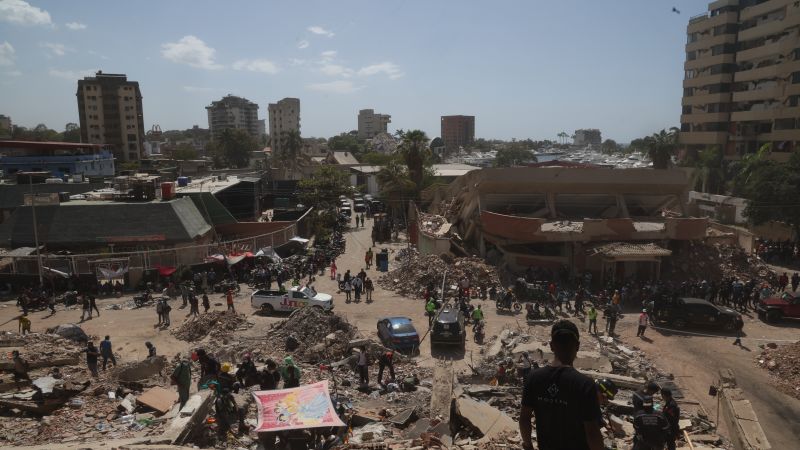
Two days after the earthquakes, the scent of decay became unmistakable in Caracas. Crushed buildings, buried under layers of concrete and rebar, released a pungent aroma that lingers in the air. Despite the overwhelming smell, families of the trapped continue to wait patiently by the rubble, hoping for news of their loved ones. Mirella Herrera, one such mother, has spent every day outside the ruins, her determination unwavering. “We can’t give up,” she said, her voice steady amid the chaos.
The devastation is compounded by the government’s slow response. While emergency services work tirelessly, the lack of coordination and resources has left many without adequate care. The quakes have also revealed the fragility of Venezuela’s infrastructure, with roads, power grids, and water systems suffering severe damage. As the days pass, the focus shifts from immediate rescue efforts to the long-term battle for survival.
A Nation on the Brink: The Aftermath of Devastation
What was once a country plagued by economic hardship and political turmoil has now faced a new, harrowing chapter. The earthquakes have not only devastated physical structures but also tested the resilience of its people. In the absence of a reliable death toll, the tragedy deepens, as uncertainty looms over the true extent of the loss. “This is more than an earthquake,” said Urbina-Medina. “It’s a reflection of our nation’s systemic failures.”
As the dust settles, the road to recovery remains uncertain. The government’s ability to manage the crisis will depend on its capacity to mobilize resources and restore trust. For now, the smell of death persists, a constant reminder of the lives lost and the struggle to rebuild. In the heart of Caracas, the ruins stand as a testament to a country on the brink, where the aftermath of disaster meets the enduring consequences of a crumbling system.
