
Swiss voters poised to reject 10 million population cap in referendum, projection shows
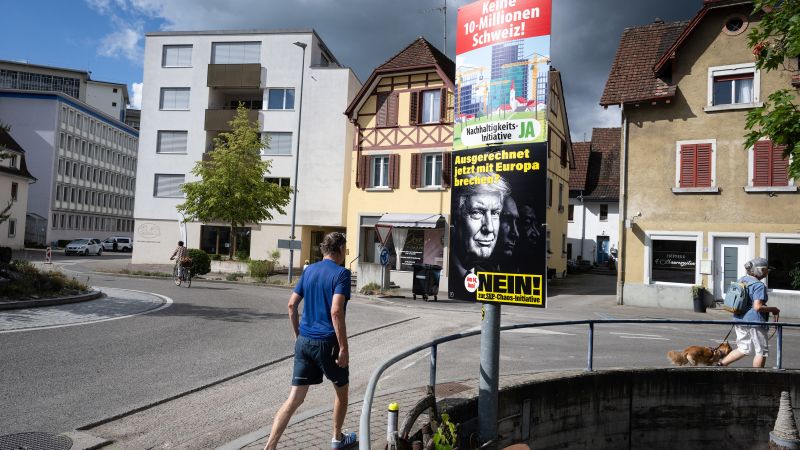
Swiss Voters Set to Reject 10 Million Population Cap in Referendum, Projections Suggest
Swiss voters poised to reject 10 million – Early voting trends from national broadcaster SRF suggest that Swiss citizens are likely to reject a proposal to limit the country’s population to 10 million, as revealed by preliminary projections ahead of the Sunday referendum. The forecast, based on analysis of current voter sentiment, indicates that 55% of participants oppose the measure, while 45% support it. This outcome highlights a preference for maintaining economic stability and preserving the nation’s relationship with the European Union over addressing concerns about immigration’s impact on public services, housing costs, and crime rates.
Shifting Priorities in a Divided Society
The projected rejection of the population cap underscores a broader trend of prioritizing economic continuity and EU integration over restrictive immigration policies. Despite growing worries about demographic changes, voters appear to have weighed the potential downsides of the proposal, such as disruptions to labor markets and strained bilateral ties with Brussels. The referendum, often compared to the 2016 Brexit vote in the UK, has sparked anxiety among businesses, which fear the measure could end Switzerland’s free movement of labor agreement with the EU—a cornerstone of its economic strategy.
The initiative, backed by the right-wing Swiss People’s Party, seeks to cap population growth at 10 million by 2050, with a provision to terminate the EU labor mobility pact if the threshold is exceeded for two consecutive years. However, the plan has faced skepticism from experts and voters alike, who argue that the current rate of population growth is not yet a crisis. Switzerland’s existing population of 9.1 million, with foreigners accounting for nearly 28% of residents, has already surpassed many neighboring EU nations in growth speed. Official projections suggest the country could reach 10 million by the early 2040s, yet the proposal remains a contentious issue.
Concerns Over Economic and Social Impact
Voters’ apprehensions extend beyond population numbers, focusing instead on the broader implications of the policy. According to Urs Bieri of GFS Bern, a polling firm, the referendum’s failure stems from a lack of confidence in the plan’s ability to address concerns without causing unintended consequences. “The initiative was framed as a solution to chaos, but voters questioned whether it would truly solve the problem or create new ones,” Bieri explained. “They worried about how restricting immigration might affect their daily lives, including access to healthcare and support services.”
“People are also concerned about the potential for labor shortages, especially in sectors like hospitality and healthcare, which rely heavily on migrant workers,” Bieri added. “There’s a perception that limiting population growth now could undermine Switzerland’s ability to compete globally, especially in a time of economic uncertainty.”
The referendum has also been criticized for its potential to destabilize Switzerland’s diplomatic relationships with the EU. Critics argue that the proposal, which could lead to stricter immigration controls, might provoke a rift with Brussels after a difficult 2025, when U.S. President Donald Trump imposed the highest tariffs on European goods, including Swiss exports. This backdrop of global trade tensions may have influenced voters to avoid drastic measures that could further complicate bilateral ties.
Political Strategy and Public Perception
The Swiss People’s Party, which spearheaded the initiative, has long championed policies aimed at reducing immigration. Its campaign emphasized the idea that only 10% of new residents are skilled workers, while asylum seekers are more likely to be associated with criminal activity. However, opponents of the measure, including migration analysts, contend that these arguments oversimplify the issue. “The initiative is being portrayed as a radical solution, but the public is more focused on practical outcomes,” said Patrick Leisibach, a migration expert at Avenir Suisse.
“Voters are concerned about how a ‘yes’ vote would impact their personal welfare, such as having enough caregivers or healthcare professionals in the future,” Leisibach noted. “They’re also worried about the potential for economic slowdowns if the labor market becomes constrained by tighter immigration rules.”
While the rejection of the population cap signals a preference for open borders, the measure still enjoys significant backing among certain groups. This support aligns with a growing movement across Europe advocating for stricter immigration controls, reflecting a polarized debate on the role of migrants in shaping national economies. The referendum’s outcome, though a narrow defeat, reinforces the idea that Swiss voters are balancing immediate concerns with long-term strategic considerations.
Despite the projected rejection, the proposal’s support highlights the complexity of the issue. For many, the idea of capping population growth resonates with fears about overpopulation and resource allocation, even as others see it as a risk to Switzerland’s economic openness. The Swiss People’s Party’s ability to mobilize public opinion on this matter underscores its influence in national politics, though the referendum’s result suggests that its message may not have fully convinced the broader electorate.
Implications for Switzerland’s Future
The referendum’s outcome could influence future policy decisions, particularly regarding immigration and EU relations. While the population cap was rejected, the debate it sparked may lead to incremental changes in how Switzerland manages its demographic growth. For instance, the government could introduce more targeted immigration reforms that address specific concerns without fully abandoning free movement principles.
Additionally, the result may signal a shift in public sentiment toward a more pragmatic approach to migration. Voters appear to recognize that while immigration poses challenges, it also offers benefits such as economic diversification and cultural enrichment. This nuanced perspective reflects a broader European trend, where citizens are increasingly seeking balanced solutions rather than outright bans or caps on population growth.
As the final votes are counted, the rejection of the 10 million cap reinforces Switzerland’s commitment to maintaining its status as a global economic hub. The referendum’s outcome also highlights the importance of public communication in shaping voter decisions, with experts emphasizing the need to clearly articulate the trade-offs of such policies. Moving forward, the Swiss government will likely focus on how to address immigration concerns without jeopardizing its economic and diplomatic relationships with the EU.
Ultimately, the referendum serves as a microcosm of the larger debate on immigration in Europe. While the Swiss population cap may not pass, the discussion it has generated will continue to shape policies in the region. The result, though a close call, reveals a society that values stability and cooperation, even as it grapples with the complexities of a changing world.
