
Keiko Fujimori declared winner of razor-edge Peru election
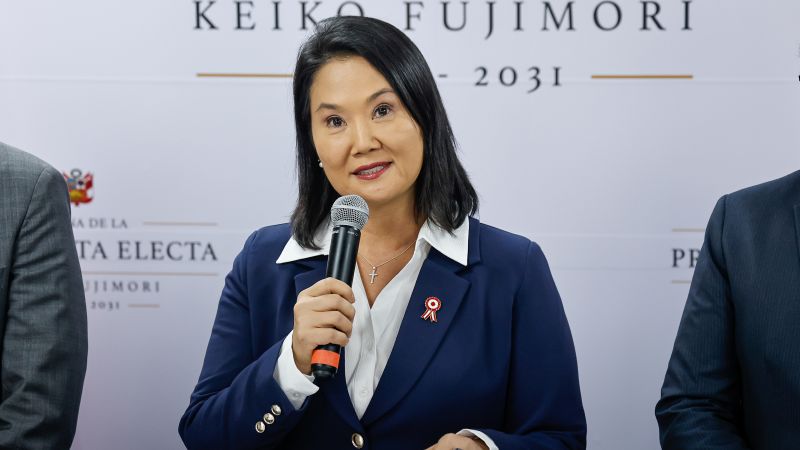
Keiko Fujimori Secures Narrow Victory in Peru’s Tumultuous Presidential Election
Conservative Leader Prevails in High-Stakes Race Amid Polarization
Keiko Fujimori declared winner of razor – Peru’s National Office of Electoral Processes (ONPE) officially announced Friday that conservative candidate Keiko Fujimori has emerged victorious in the nation’s presidential election, marking a pivotal moment in a deeply divided political landscape. The runoff vote, held on June 7, concluded with Fujimori narrowly surpassing leftist contender Roberto Sánchez by a margin of just 49,641 ballots. With approximately 18 million valid votes cast, Fujimori’s Popular Force party secured 50.13% of the total, while Sánchez’s Together for Peru garnered 49.86%. This razor-thin victory has reignited debates about the integrity of the electoral process and the future direction of the country. Fujimori, the eldest daughter of former President Alberto Fujimori, has long been a central figure in Peruvian politics. Her political career spans over a decade, with her most recent campaign being her fourth attempt for the presidency. Previous bids in 2011, 2016, and 2021 ended in defeat, but this time, she has managed to consolidate support across a fractured electorate. The ONPE’s final proclamation came after weeks of meticulous vote counting, a process that has been scrutinized by both supporters and critics. Fujimori’s victory is not just a personal triumph but also a reflection of the shifting dynamics in a nation grappling with persistent instability.
Following the announcement, Fujimori took to X to express gratitude toward voters, emphasizing that her win signals the beginning of a “new chapter” for Peru. In a post that quickly trended, she stated, “Peru is entering a new chapter with the support of its people. I will lead this transition with responsibility, humility, and a profound sense of duty.” This sentiment resonated with many, particularly those who view her as a symbol of continuity and resolve amid years of political turmoil. However, the narrow margin of victory has also raised questions about the depth of public support and the potential for lingering dissent.
The election result is expected to reshape Peru’s political landscape after one of its most tightly contested presidential races in recent memory. Fujimori’s campaign, which capitalized on a mix of traditional conservative values and populist appeal, managed to bridge gaps between urban and rural constituencies. Her father, Alberto Fujimori, once a revered leader, now casts a long shadow over the current administration. The legacy of his presidency, which ended in 2000 with his ousting due to a corruption scandal, continues to divide the nation. His subsequent conviction on charges of embezzlement and human rights violations further cemented his status as a controversial figure, though a controversial pardon in 2023 has rekindled his influence.
Fujimori’s path to the presidency has been shaped by her father’s legacy, both as a source of strength and a point of contention. At just 19, she became the first lady of Peru, a role that exposed her to the complexities of governance and political maneuvering. Her later campaigns have often been framed as efforts to reclaim her family’s political dominance, a narrative that has garnered significant traction. The recent victory, however, is not merely a continuation of her father’s influence—it is a testament to her ability to adapt to the evolving needs of a modern electorate.
The swearing-in ceremony for Fujimori is set for July 28, where she will assume the presidency alongside Luis Fernando Galarreta as first vice-president and Miguel Ángel Torres Morales as second vice-president. This transition comes at a critical juncture, as Peru seeks to stabilize its economy and address social grievances. Fujimori’s administration will face challenges ranging from economic reform to reconciliation with leftist factions that have long opposed her leadership. The vice-presidential appointments also highlight strategic alliances, with Galarreta representing the traditionalist wing of her party and Torres Morales offering a more centrist perspective.
The close race between Fujimori and Sánchez underscores the deepening polarization that has defined Peru’s recent political scene. Sánchez, who previously criticized the vote count, has vowed to challenge Fujimori’s government, citing irregularities in overseas ballots. He has already filed an appeal with the Inter-American Commission on Human Rights (IACHR), arguing that the electoral process was flawed. This move has added a layer of uncertainty to the outcome, with some observers suggesting the result could be contested for months. The ONPE, however, has defended its procedures, asserting that a comprehensive review found no significant inconsistencies in the vote tally.
Fujimori’s victory also places her in the spotlight as Peru’s ninth president in a decade, a period marked by frequent shifts in power and policy. Her leadership will be closely watched for its approach to addressing long-standing issues such as corruption, economic inequality, and the legacy of her father’s authoritarian rule. Critics argue that her administration may face resistance from those who view her as a continuation of Fujimori’s era, while supporters see her as a pragmatic leader capable of restoring confidence in the political system.
The election’s outcome reflects broader trends in South American politics, where leaders often rise through a combination of family connections and populist messaging. Fujimori’s campaign, which emphasized anti-corruption and economic stability, resonated with voters frustrated by years of political gridlock. However, the narrow margin of victory suggests that the nation remains deeply split, with many questioning whether her win will bring lasting change or simply prolong the cycle of political instability.
As the nation prepares for a new chapter, Fujimori’s leadership will be tested by the challenges of governance. The Popular Force party’s dominance in the runoff highlights its appeal to a segment of the population that favors conservative policies and strong leadership. Yet, the slim victory also serves as a reminder of the fragility of Peru’s political consensus. Analysts warn that the country’s future will depend on Fujimori’s ability to balance her father’s influence with her own vision for progress.
Despite the uncertainty, the electoral process has been a source of both hope and skepticism. For many Peruvians, the final vote count represents a victory for stability and a rejection of the chaos that has plagued the country since the 2000 ousting of her father. Others, however, see it as a reaffirmation of the political system that has allowed figures like Fujimori to rise, even as they face accusations of repeating past mistakes. The road ahead will require careful navigation, with the potential for both breakthroughs and setbacks in the years to come.
“Peru is entering a new chapter with the support of its people. I will lead this transition with responsibility, humility, and a profound sense of duty.”
The result also has implications for the broader Latin American region, where Fujimori’s win could influence the balance of power and set precedents for future elections. Her victory underscores the enduring appeal of conservative leaders in a continent where leftist movements have historically held sway. As she prepares to take office, Fujimori will need to address the concerns of a population weary of political dysfunction, while also navigating the complex legacy of her family’s rule.
With her father’s influence still present, Fujimori’s administration will be scrutinized for any signs of continuity or deviation from his policies. The 2023 pardon of Alberto Fujimori has sparked debates about accountability and the role of family ties in shaping political outcomes. While some view the pardon as a necessary step to unify the nation, others see it as a reward for past corruption. Fujimori’s campaign has sought to distance herself from her father’s more controversial actions, but the connection remains a powerful narrative in her favor.
As the country transitions to a new era, the focus will shift to Fujimori’s policy agenda and her ability to build a coalition that spans ideological divides. The narrow margin of victory suggests that her margin of support is not overwhelming, requiring her to demonstrate tangible progress on key issues to secure long-term legitimacy. The opposition, led by Sánchez, has already signaled its intent to challenge the results, ensuring that the political drama will continue beyond the official proclamation.
Ultimately, Fujimori’s win marks a decisive shift in Peru’s political trajectory, but the road to stability will be anything but straightforward. The nation’s voters have chosen a leader who embodies both the promise of continuity and the challenge of reform, setting the stage for a presidency that will be as polarizing as it is transformative. Whether her leadership can bridge the deep divides in Peruvian society remains to be seen, but one thing is certain: the outcome of this election has reshaped the country’s political future in profound ways.
