
Top general fired by Trump administration criticizes use of military for political missions
Top General’s Op-Ed Critiques Military’s Political Role
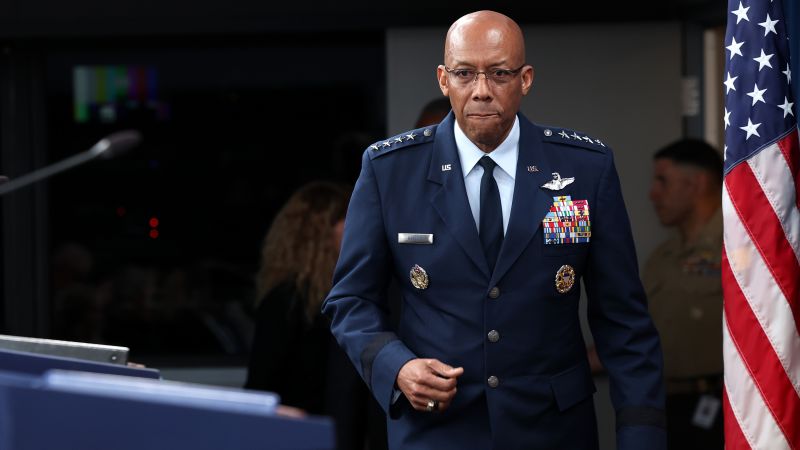
Top general fired by Trump administration – Former Chairman of the Joint Chiefs of Staff Charles Q. Brown, who was dismissed by Defense Secretary Pete Hegseth in February 2025, recently published an op-ed in Foreign Affairs that highlights the risks of employing the military for politically driven missions. The piece underscores concerns about the Trump administration’s strategy of deploying troops to address domestic issues, such as crime in urban centers. Brown, a retired Air Force general and the second Black individual to hold the position of America’s highest-ranking military officer, argues that such actions undermine the military’s core purpose.
“When presidents leverage the armed forces for more politically charged objectives, like tackling crime in major cities, the military’s role becomes more complex and vulnerable,” Brown wrote alongside Duke political science professor Peter Feaver and North Carolina attorney Andrew Kragie. “Relying on a military response instead of addressing the root causes of dysfunction in civilian institutions shifts focus away from the primary mission of combat,” the authors continued. “Moreover, the military should not bear the responsibility of preserving the nation’s political stability. Overburdening them risks compromising their entire mission.”
The op-ed does not directly target President Donald Trump or current government officials, but it references actions taken during his tenure. Specifically, the authors note that both Trump and former President Joe Biden had turned to the military for significant roles in responding to the COVID-19 pandemic. However, they emphasize that the current administration’s use of military resources in cities like Washington, D.C., and Los Angeles represents a different kind of challenge.
The Context of the Firing
Brown’s dismissal occurred as part of a broader purge within the Trump administration, which targeted diversity and inclusion initiatives across the military and federal government. Alongside him, Admiral Lisa Franchetti, the first woman to serve on the Joint Chiefs of Staff, was also removed from her post. This move, coupled with the administration’s push to streamline military operations, raised questions about the criteria for leadership decisions.
At the Aspen Ideas Festival, Brown expanded on his concerns, criticizing the administration’s pattern of firing Pentagon officials. “What’s happening now is not rooted in merit,” he stated, pointing out that those removed were highly qualified individuals. “I worry about how these actions affect the morale and opportunities of those still serving. Are they being given a fair chance to grow in their careers?”
Hegseth’s Defense of Military Deployments
Defense Secretary Pete Hegseth, who oversaw Brown’s firing, has since defended the administration’s use of the military for domestic missions. In a statement on Thursday, he praised the National Guard’s efforts in Washington, D.C., during protests. “These individuals can’t perceive the value of law and order and common sense,” Hegseth argued. “There’s no ideological motive in this group, and this operation is purely about restoring stability.”
Hegseth’s comments reflect the administration’s broader narrative, which frames military involvement in cities as a necessary measure to combat crime and chaos. However, Brown and his co-authors challenge this perspective, suggesting that such deployments create a dependency on the military to solve problems that should be addressed by civilian governance. “This approach diverts the military from its fundamental combat duties,” they wrote, highlighting the tension between the military’s traditional role and its evolving use in political contexts.
A Focus on Patriotism and National Unity
Beyond the critique of military politicization, the op-ed also reflects on the concept of patriotism in light of America’s 250th anniversary. The authors propose that true patriotism involves embracing the nation’s founding ideals while recognizing progress made over the centuries. “Patriotism is about acknowledging the promise of America’s origins, the achievements of its history, and the possibilities of a shared future,” they asserted. “The virtue of serving a cause greater than oneself, which is central to military training, is accessible to all citizens, regardless of their uniform status.”
They further suggest that this milestone offers an opportunity to strengthen the interdependence that the Founding Fathers envisioned. “The 250th anniversary should inspire a renewed commitment to collaboration and unity,” the authors wrote. “It’s a moment to reflect on how the military and civilian institutions can work together to secure the nation’s future.”
The Broader Implications of Military Use
Brown’s critique extends to the potential long-term consequences of politicizing the military. He argues that when leaders expect the armed forces to act as a political tool, they risk eroding public trust in the institution. “The military is a symbol of national strength, but it can also become a pawn in partisan struggles if overused for non-combat purposes,” he said. “This not only strains the military’s capacity but also distorts its image as a neutral force.”
The authors also warn against the normalization of military interventions in domestic affairs. They point to historical precedents where the armed forces have been enlisted for tasks beyond their original mandate, such as enforcing civil rights or managing natural disasters. “While the military can provide critical support in emergencies, its role should remain distinct from the political processes that shape national policy,” they concluded. “Otherwise, the line between military and civilian authority blurs, and the armed forces lose their independent authority.”
A Call for Reflection and Reassessment
Brown’s op-ed serves as a reminder of the importance of maintaining a clear separation between military and political functions. “The use of troops in cities is a symptom of a larger issue: the administration’s tendency to prioritize immediate political gains over long-term institutional stability,” he wrote. “This practice risks turning the military into a permanent solution for transient problems.”
Despite the criticism, the administration maintains that deploying the military is a practical response to crises. “Law and order is something every American deserves,” Hegseth reiterated, framing the National Guard’s presence as a justified measure against disorder. However, Brown and his co-authors urge a more reflective approach, emphasizing that the military’s role should complement, not replace, civilian governance. “The military is a powerful instrument, but it must not be the sole actor in defining the nation’s course,” they argued, calling for a balanced integration of military and political strategies.
CNN’s Oren Liebermann and Haley Britzky contributed to this report, highlighting the ongoing debate about the military’s role in American politics. As the country marks its 250th year, the discussion over how best to preserve its founding principles—and the role of its armed forces in doing so—remains a critical topic for both leaders and citizens alike.
