
Hobbit-like humans may have scavenged Komodo dragons’ leftovers to survive
Hobbit-like humans may have scavenged Komodo dragons’ leftovers to survive
Hobbit like humans may have scavenged – Researchers have uncovered new evidence suggesting that the diminutive prehistoric human relatives, known as Homo floresiensis, were likely scavengers rather than hunters. This conclusion challenges earlier assumptions about their advanced capabilities, such as hunting large animals or using fire to cook meat. The study, published in *Science Advances*, reveals that these “hobbit” humans, with their small stature and modest brain size, may have relied on the remains of animals left by Komodo dragons to survive on the isolated Indonesian island of Flores.
Unearthing the Past in Liang Bua Cave
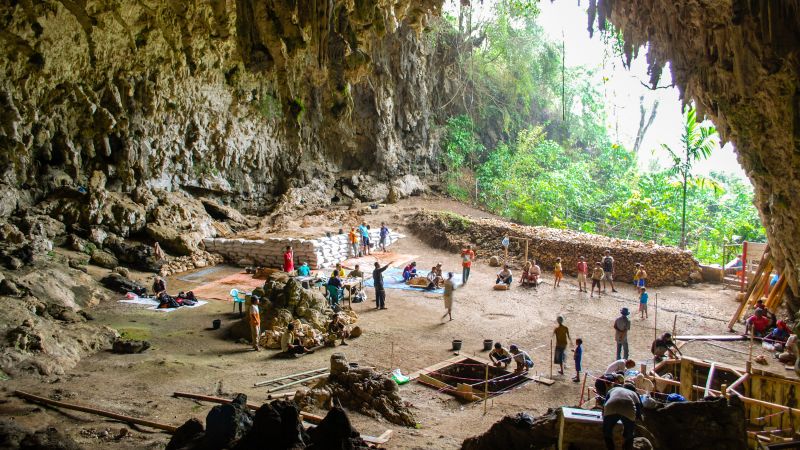
The discovery of Homo floresiensis fossils in Liang Bua cave on Flores in 2003 sparked global fascination. These remains, including a skull the size of a grapefruit, indicated a hominin species that stood approximately 3.3 feet tall. Alongside these fossils, archaeologists found stone tools and bones of Stegodon florensis insularis, an extinct elephant relative weighing around 1,260 pounds and measuring roughly 5 feet at the shoulder. This led to speculation that the hobbits had hunted Stegodons using the tools to access their meat. However, recent findings may reshape this narrative.
“I wanted to see if we really could show that H. floresiensis was the hunter that it had been portrayed as for decades,” said Dr. Elizabeth Grace Veatch, lead author of the study and a paleoanthropologist at the Smithsonian Institution’s National Museum of Natural History.
Veatch and her team conducted a detailed analysis of the Stegodon bones, examining how they were modified after the animals died. Their research focused on the patterns of tooth marks and cut marks, comparing them to those left by Komodo dragons and human tools. The results suggest that the hobbits were not the primary hunters of Stegodons but instead took advantage of the leftovers left behind by these formidable predators.
Reevaluating Tool Use and Fire
While thousands of stone tools have been found near Homo floresiensis fossils, their purpose remains a topic of debate. Dr. Briana Pobiner, a coauthor of the study, noted that the tools were likely crafted from local chert to process meat. However, the presence of burned bones in the cave hinted at the use of fire, a trait typically associated with advanced hominins like Neanderthals or Homo sapiens. This study, however, adds a new layer to the discussion.
The researchers designed an experiment to test how Komodo dragons interact with their prey. Observing a dragon named Rinca at Zoo Atlanta, they noted its powerful bite and how it fed on a goat carcass. This provided insight into the type of damage these reptiles could inflict on Stegodon bones. By comparing these marks to those found in the Liang Bua cave, the team discovered a striking similarity, leading them to conclude that the hobbits were not active hunters but opportunistic scavengers.
“After comparing the marks on the Stegodon bones with our sample of Komodo dragon tooth marks and cutmarks, I was surprised by how similar most of the marks were to our Komodo dragon sample,” Veatch wrote in an email.
Komodo dragon tooth marks were predominantly found on the most nutritious parts of Stegodon, such as the muscles and internal organs. In contrast, the cut marks made by hobbit tools were concentrated on less desirable sections of the animal. This discrepancy suggests that the tools were used to access the meat after the dragons had already consumed the bulk of it. The study’s findings imply that Homo floresiensis may have scavenged the remnants of Stegodon carcasses, rather than actively hunting them.
Implications for Human Evolution
The research also highlights a potential link between Homo floresiensis and Homo erectus. Earlier theories speculated that the hobbits were closely related to this early human species, given their shared tool-making abilities. However, the new evidence complicates this connection. While the tools indicate some level of sophistication, the absence of clear hunting behavior and the use of fire for cooking challenges the idea that they were as advanced as previously thought.
The study’s authors emphasize that scavenging is a highly adaptive strategy. It requires intelligence, such as recognizing the value of a carcass and using tools to extract meat efficiently. Komodo dragons, as the island’s sole carnivorous predator, would have left behind ample opportunities for the hobbits to exploit. This approach may have been sufficient for survival in the resource-limited environment of Flores, where competition for food was intense.
Chert Tools and a Carnivorous Environment
Stone tools discovered near the fossils were crafted from chert, a local rock known for its durability. These tools, used to break bones and remove flesh, demonstrate a level of skill but not necessarily the ability to hunt large prey. The fact that the hobbits relied on Stegodon leftovers suggests they adapted to the ecological constraints of their habitat. The island’s ecosystem, dominated by Komodo dragons, may have shaped their survival strategies, limiting their need to hunt independently.
Veatch’s team also analyzed the distribution of marks on the Stegodon bones. They found that the damage patterns aligned more closely with the feeding behavior of Komodo dragons than with the systematic butchering techniques of humans. This implies that the hobbits were not the ones responsible for the initial killing of the animals but were instead scavenging the meat after the dragons had done the work. The lack of evidence for fire use further supports this interpretation, as burned bones were less common and not as prevalent as previously assumed.
Revisiting the Family Tree of Humans
The findings of this study are prompting experts to reconsider the evolutionary role of Homo floresiensis. For years, the species was thought to represent a unique branch of human evolution, possibly closer to Homo erectus than to modern humans. However, the evidence of scavenging and the absence of hunting behavior may shift this understanding. The hobbits’ survival strategy could be more aligned with other early hominins, such as those who lived on the African savannah, which also relied on scavenging rather than active hunting.
Veatch’s research adds to a growing body of evidence that Homo floresiensis was a resourceful but not necessarily advanced species. Their tools and behaviors indicate adaptability, but not the same level of complexity as seen in later human ancestors. This raises questions about how to define “advanced” traits in human evolution and whether brain size alone determines cognitive sophistication. The study’s results suggest that survival on Flores depended more on ecological niche and cooperative strategies than on the ability to hunt or cook meat.
The discovery of Homo floresiensis has always been a puzzle, but this new analysis offers a clearer picture. By examining the marks on bones and comparing them to those of Komodo dragons, the researchers have provided a compelling case for scavenging as the primary means of survival. This not only redefines the hobbits’ place in the human family tree but also highlights the importance of understanding the interactions between different species in shaping evolutionary paths. As the study shows, even in a world dominated by predators, the hobbits may have found a way to thrive by turning the leftovers of nature into sustenance.
The implications of this research extend beyond Flores. It challenges the assumption that tool use and fire control are definitive markers of advanced human behavior. Instead, it underscores the adaptability of early hominins and their ability to survive in challenging environments through resourcefulness rather than brute strength. With more studies like this, scientists may gain a deeper appreciation for the diverse strategies that shaped the evolution of our species.
