DNA evidence from Thomas Jefferson’s hair reveals the truth about his relationship with Sally Hemings

Daftar Isi
DNA Evidence From Thomas Jefferson’s Hair Deepens the Historical Record
Activelifezero.com – DNA evidence from Thomas Jefferson’s hair has produced the strongest genetic support yet for the conclusion that he fathered at least one child with Sally Hemings, an enslaved woman who lived at Monticello. Researchers analyzed historically documented hair samples and compared recovered genetic material with DNA from living descendants of the Jefferson and Hemings families.
The analysis concluded there was a 99.96% probability that Jefferson fathered at least one of Hemings’ children. The findings add direct genetic evidence to accounts, records and earlier research that have shaped a long-running debate about Jefferson and Hemings.
A decades-long historical question
Hemings had four children who survived to adulthood. Two of them, Madison and Eston Hemings, said Thomas Jefferson was their father. Their testimony has remained central to discussions of life at Monticello and the relationship between Jefferson and Hemings.
Previous genetic research had connected descendants of Hemings to the Jefferson male line. A 1998 study identified a rare Y-chromosome marker shared by male-line descendants of Jefferson’s uncle and descendants of Hemings. However, that work could not determine whether Thomas Jefferson himself, rather than another male relative, was the father.
The newer study sought to address that limitation by recovering DNA from hair attributed to Jefferson and comparing it across multiple family branches. Richard Kurin, a Smithsonian distinguished scholar and ambassador-at-large, is the senior author of a methods paper posted on the bioRxiv preprint platform on September 21. The paper has not yet been peer reviewed.
“He didn’t have Thomas Jefferson’s DNA,” Kurin said of the earlier study. “He didn’t have something to directly compare living descendants of the Jefferson family to Madison Hemings and Eston Hemings and others that might have been the descendants of Thomas Jefferson.”
The hair found in Jefferson’s Bible did not belong to him
The investigation began after Smithsonian National Museum of American History employees found a reddish-blond hair inside a Bible once owned by Jefferson in 2011. The strand initially appeared to offer a rare chance to obtain genetic material directly linked to the former president.
Scientists tested that hair using mitochondrial DNA, which is inherited through the maternal line. They compared it with DNA from a living woman descended from Jefferson’s mother through an unbroken female line. The samples did not match, meaning the Bible hair could not be treated as Jefferson’s genetic material.
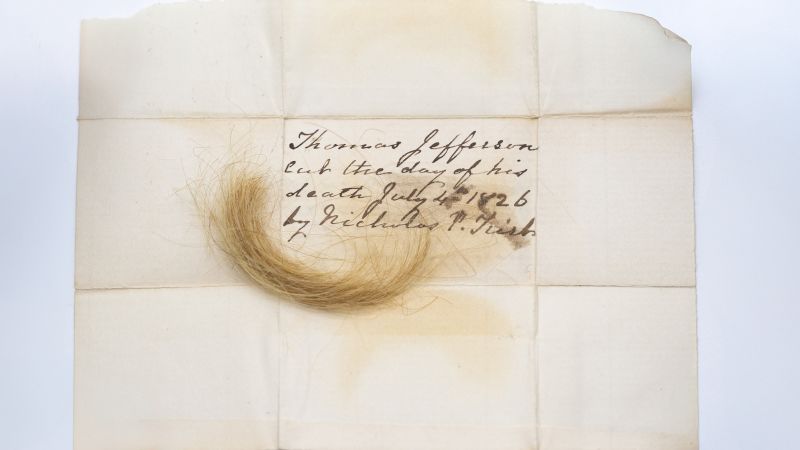
That result did not end the inquiry. Researchers later examined other hair samples associated with Jefferson in historical records. The Thomas Jefferson Foundation at Monticello provided a packet of strands that had not previously been available for DNA analysis, including a lock associated with Jefferson’s deathbed.
How the family comparison strengthened the findings
DNA evidence from Thomas Jefferson was difficult to recover because historic hair can be fragmented, degraded and contaminated. The team reconstructed partial genetic sequences and compared them with DNA from 16 living participants, including descendants of Jefferson, his wife Martha, his brother Randolph, Madison Hemings and Eston Hemings.
The study’s significance comes from examining patterns across several branches of both families rather than relying on a single comparison. That broader approach allowed researchers to evaluate whether the inherited genetic patterns were more consistent with Jefferson being the father of Hemings’ children than with alternative explanations involving other relatives.
“What made this study so powerful is that researchers weren’t just comparing two genomes,” said Éadaoin Harney, a senior population geneticist at the 23andMe Research Institute. “Instead, they collected DNA samples from multiple people from different branches of the family tree.”
Kurin also wrote History by a Hair: Thomas Jefferson, Sally Hemings & Solving a 200-Year-Old Mystery, published September 22. The research adds a new scientific layer to a history already informed by family testimony, archival documents and the lived experiences of Hemings and her children.
FAQ: Thomas Jefferson and Sally Hemings DNA Research
What does the new DNA research show?
The analysis found a 99.96% probability that Thomas Jefferson fathered at least one child with Sally Hemings. It is based on partial DNA recovered from hair attributed to Jefferson and comparisons with living descendants from relevant family lines.
Why was the 1998 DNA study not considered conclusive?
The 1998 research linked Hemings descendants to the Jefferson male line through a Y-chromosome marker. It could not distinguish Thomas Jefferson from another male member of the Jefferson family.
Was the hair discovered inside Jefferson’s Bible used as evidence?
No. Mitochondrial DNA testing showed that the hair found in the Bible did not match Jefferson’s maternal line, so researchers concluded it was not his.
Has the new methods paper been peer reviewed?
No. The methods paper was posted to the bioRxiv preprint platform on September 21 and had not yet undergone peer review.