
A mysterious ‘cold blob’ in the ocean has puzzled scientists. A new study says it’s an ominous sign
A Mysterious ‘Cold Blob’ in the Ocean Has Puzzled Scientists. New Study Says It’s an Ominous Sign
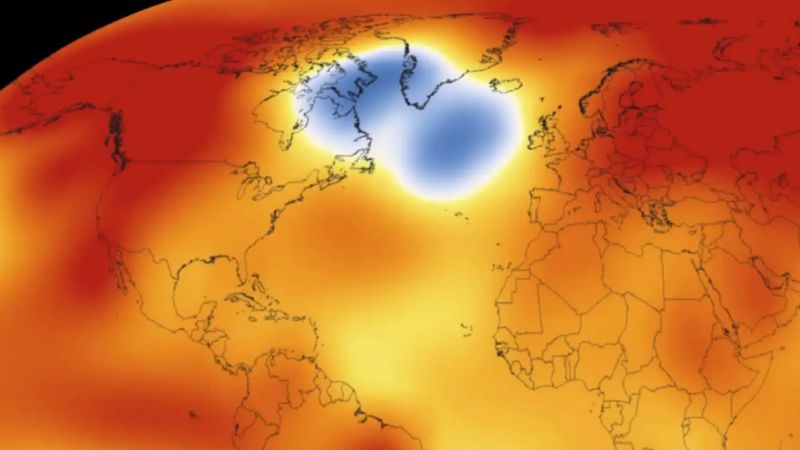
A mysterious cold blob in the ocean – For years, researchers have studied an enigmatic region in the North Atlantic Ocean, south of Greenland and Iceland, where temperatures are dropping at an alarming rate. This area, often referred to as the “cold blob” or “warming hole,” has defied expectations by cooling by nearly 1 degree Celsius (1.8 Fahrenheit) since 1900, even as the surrounding waters warm. A recent study has provided a compelling explanation for this phenomenon, suggesting it could be a harbinger of a major climate tipping point. The findings highlight a growing concern: the Atlantic Meridional Overturning Circulation (AMOC), a vital system of ocean currents, may be nearing a critical threshold that could disrupt global weather patterns and ecosystems.
The Cooling Anomaly and Its Significance
The cold blob’s unusual behavior has sparked intense scientific debate. Unlike the rest of the ocean, which is warming due to climate change, this patch has shown a marked decrease in temperature. The study, which combines real-world data with advanced climate models, points to the AMOC as the primary driver of this cooling trend. According to the research, the AMOC’s weakening has led to a redistribution of heat, creating a localized area of cold water. This discovery has raised alarms, as it may signal a broader shift in oceanic and atmospheric dynamics.
The AMOC functions like a giant conveyor belt, moving warm water from the tropics toward the Northern Hemisphere. As this water cools, it sinks and flows back south, maintaining a balance of heat and salinity across the Atlantic. However, recent observations suggest this system is slowing down. The study’s authors argue that the cold blob is not just a surface-level anomaly but a deeper indicator of the AMOC’s declining strength. This challenges previous assumptions that the cooling could be attributed solely to atmospheric factors such as wind and cloud changes.
Scientific Consensus and Divergent Views
“It is changing ocean heat transport,” said Stefan Rahmstorf, a study co-author and professor of physics and oceanography at Potsdam University, Germany. “This is driving the cooling we observe in the cold blob.”
Rahmstorf and his team analyzed ocean heat data from a variety of instruments and satellite measurements. Their findings revealed that the cooling in the cold blob extends beyond the surface, affecting deeper layers of the ocean. This suggests that the AMOC’s weakening is having a more profound impact than previously thought. The study also notes that the cold blob’s location aligns closely with the region where the AMOC delivers significant amounts of heat, further supporting the link between the two.
While the study provides strong evidence, other scientists have offered cautious perspectives. René van Westen, a marine and atmospheric researcher at Utrecht University, acknowledged that the cold blob could still be influenced by atmospheric conditions alone. He noted, “Previous studies have demonstrated it’s possible to generate a cold blob through changes in wind and cloud patterns.” However, he praised the new research for its comprehensive approach, stating that the consistency across multiple datasets “strengthens the robustness of the conclusions.”
David Thornally, a professor of ocean and climate science at University College London, also highlighted the importance of the study’s methodology. He emphasized that while the cold blob’s cooling is likely tied to the AMOC, the limited availability of real-world data means that the current findings should be viewed as approximations rather than definitive proof. “The sparseness of data means our datasets are best seen as good guesses,” he explained. “They’re not perfect, but they give us a clearer picture than before.”
Consequences of an AMOC Shutdown
If the AMOC continues to weaken, the implications could be severe. A complete shutdown of this system would disrupt the natural flow of heat across the Atlantic, leading to dramatic changes in global climate. For example, the US East Coast could experience accelerated sea level rise as the Gulf Stream, a key component of the AMOC, slows. Europe might face harsher winters, with colder air masses moving northward, while Africa could see shifts in monsoon patterns, resulting in prolonged droughts. These effects would ripple across the planet, affecting weather systems and ecosystems in unpredictable ways.
The study’s authors stress that the cold blob is not an isolated event but a symptom of a larger systemic issue. They argue that the AMOC is already supercharging sea level rise along the US coastline, a trend that could intensify if the system continues to weaken. “The cold blob has been interpreted by some as a fingerprint of AMOC change,” Rahmstorf added. “Its location is precisely where the AMOC delivers the most heat, so its cooling is a clear signal of the system’s disruption.”
Looking Ahead: Uncertainties and the Path Forward
Despite the study’s groundbreaking insights, questions remain about the full extent of the AMOC’s decline. Jonathan Baker, a senior climate scientist at the UK Met Office, echoed this sentiment, stating, “I would view this study as adding evidence for an AMOC contribution to the cold blob, rather than definitively settling the question.” He highlighted the need for further research to confirm the AMOC’s role in the phenomenon, particularly as climate models continue to evolve and new data becomes available.
The AMOC’s weakening is part of a larger pattern of climate change, with human-driven global warming accelerating the process. Melting ice sheets and increased freshwater runoff are key factors disrupting the system’s delicate balance. As the AMOC slows, its ability to transport heat and regulate climate diminishes, leading to cascading effects. The study’s findings underscore the urgency of addressing these changes, as the AMOC could reach a tipping point within this century, potentially triggering a collapse that would have irreversible consequences.
While the cold blob’s cooling is a clear indicator of AMOC instability, the study also emphasizes the need for continued monitoring. Scientists are working to refine their understanding of how the AMOC interacts with other climate systems, and new research is expected to shed more light on this issue. For now, the cold blob stands as a stark reminder of the complex and interconnected nature of Earth’s climate, urging a deeper investigation into the planet’s most vulnerable systems.
René van Westen noted that the study’s conclusions are bolstered by independent evidence of the AMOC’s weakening. “There’s plenty of other data pointing to a decline in the AMOC’s strength,” he said. “This cold blob is just one piece of the puzzle.” David Thornally agreed, emphasizing that while the study is significant, it should be seen as part of an ongoing effort to understand the AMOC’s role in climate change. “This research adds to the body of evidence,” he said. “But we need more data to be certain.”
As the world grapples with the effects of climate change, the cold blob serves as a focal point for understanding the AMOC’s behavior. Its cooling trend, combined with the system’s slowing, highlights the fragility of the planet’s climate systems and the potential for sudden, large-scale disruptions. Scientists warn that the AMOC’s weakening could be a harbinger of a global catastrophe, one that would reshape weather patterns and accelerate sea level rise. With the stakes so high, the study’s findings offer both a warning and a call to action for further research and climate mitigation efforts.
