
Coding classes are rewriting futures in a Kenyan youth prison
Coding Classes Are Rewriting Futures in a Kenyan Youth Prison
Coding classes are rewriting futures – Paul Akwabi, a tech entrepreneur from Kenya, found himself reflecting on his own past when he visited Shimo La Tewa Borstal Institution and Boys Education Centre near Mombasa. The visit stirred memories of his childhood in Nairobi’s Kibera slum, where he once delivered drugs and guns for older boys. Yet, instead of a life of crime, Akwabi’s path shifted when he taught himself electronics through books and repaired radios as a teenager. His journey from street vendor to tech innovator now fuels his mission to empower young offenders with digital skills.
A Bridge Between Past and Future
After completing secondary school, Akwabi worked as a street vendor while studying Computer Science at the Technical University of Mombasa. “Technology became more than an interest—it became my pathway to possibility,” he explained. This realization led him to launch TechKidz Africa, a Mombasa-based academy focused on nurturing young Kenyan innovators. Now, he’s applying the same principles to the prison setting, aiming to reshape the lives of incarcerated youth.
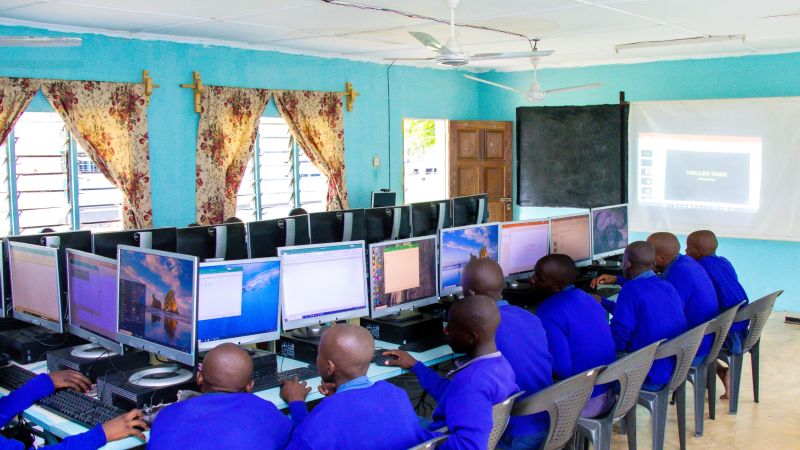
Partnering with Close the Gap Kenya, a nonprofit that refurbishes and donates IT equipment, TechKidz installed a computer lab in the facility and introduced a three-month digital literacy course. The program targets young offenders aged 4 to 19, equipping them with ICT skills tailored for employability and online safety. Of the initial 25 participants, 21 had no prior experience with technology, highlighting the program’s role in bridging a critical gap in access.
“At first, it was difficult to operate the computer,” wrote a 19-year-old learner from Nyeri County in response to a CNN question. “I had never interacted with one before.”
Akwabi’s initiative, referred to as “learners” within the program, addresses a broader issue in Kenya. Despite the country’s rapid tech growth, a disparity persists in digital access. A 2024 government survey revealed that while over half of Kenyans use mobile phones, only 11.6% own computers. Urban areas, according to the Center for International Governance Innovation, boast significantly higher internet access and digital literacy than rural and underserved regions.
Transforming Lives Through Technology
Shimo La Tewa Borstal Institution, which houses boys aged 15 to 18 convicted of serious crimes, now incorporates digital training as part of its rehabilitation efforts. Inmates must enroll in formal education, vocational training, or agricultural programs during their three-year sentences. However, the prison’s approach has evolved, emphasizing reintegration and positive habits for the future.
The three-month course begins with foundational concepts like digital ethics and hardware repairs, gradually building to advanced topics such as coding, web design, and robotics. One 18-year-old learner from Meru County shared, “I was able to use a computer for the first time and enjoyed typing activities. I hope to use my graphic design skills to promote my plumbing business when I’m released.” Such stories underscore the program’s potential to connect skills with real-world applications.
“I thought, ‘This could have been me,’” Akwabi reflected, linking his personal history to the program’s purpose. “Technology became more than an interest—it became my pathway to possibility.”
Senior superintendent Jostinah Wawasi Mwang’ombe of Shimo La Tewa Institution noted that the facility primarily houses youth from low-income rural areas, many of whom lack basic computer literacy. “We had to start from way, way lower—just understanding what computers are and their purpose before teaching them how to use them,” Akwabi said. The program’s structure ensures that even those with minimal exposure can grasp essential digital tools.
Rehabilitation and Digital Reentry
Kenya’s adult prisons face severe overcrowding, but recent judicial efforts have prioritized rehabilitation over punishment. Shimo La Tewa Borstal Institution aligns with this shift, offering inmates a chance to engage in vocational training and community probation. The digital hygiene training provided by TechKidz complements these efforts, preparing young offenders to navigate technology responsibly.
The curriculum is designed to build practical skills, starting with email etiquette and Microsoft Excel before progressing to coding and video production. This step-by-step approach ensures that learners can apply their knowledge in diverse fields. For example, some have already demonstrated proficiency in carpentry, barbering, and agriculture, which TechKidz now enhances with digital tools.
Akwabi’s program also highlights the importance of education in reducing recidivism. By equipping inmates with marketable skills, the initiative aims to create pathways to employment and independent living. “We’re not just teaching them to code—we’re building confidence and opportunities,” he stated. This philosophy is evident in the program’s focus on employability, which includes training in graphic design and online safety.
Breaking the Cycle of Inequality
The collaboration between TechKidz Africa and Close the Gap Kenya addresses systemic inequalities in Kenya’s tech sector. While urban populations benefit from higher internet access, rural communities remain underserved. The prison program serves as a microcosm of this challenge, offering a unique opportunity to reach youth who might otherwise lack exposure to digital resources.
By integrating technology into the prison’s rehabilitation framework, Akwabi and his team are challenging traditional perceptions of incarcerated youth. “Technology has the power to change narratives,” he said. The program not only provides skills but also fosters a sense of purpose, helping learners envision a future beyond the confines of the facility.
As Kenya’s tech industry expands, initiatives like TechKidz Africa are critical in ensuring that all youth—regardless of socioeconomic background—can participate in the digital economy. The success of the prison program may inspire similar efforts in other facilities, further promoting the idea that second chances are possible through education and innovation.
The journey of the learners in Shimo La Tewa Institution is a testament to the transformative potential of technology. From overcoming initial difficulties with computers to mastering coding and graphic design, their progress reflects the program’s impact. As Akwabi continues to refine TechKidz’s approach, the hope is that these young minds will emerge not just as skilled individuals, but as agents of change in their communities.
