
The new tastemakers are cutlery designers
The new tastemakers are cutlery designers
A Collection Born from a Personal Shift
The new tastemakers are cutlery designers – Dung Ngo, a design writer and collector, has amassed over 10,000 pieces of cutlery across his lifetime. His journey into this niche world began 25 years ago, during a pivotal moment in his personal evolution. At age 30, he realized that the mass-produced sets he purchased from Target after college no longer reflected his identity or aesthetic values. This realization led him to a vintage shop, where he stumbled upon a 40-piece set priced at $400. The design, attributed to the celebrated Finnish creator Tapio Wirkkala, caught his attention. He spent days poring over old design journals to confirm its provenance, eventually identifying it as *Composition*, a work from the early 20th century.
Today, a full Wirkkala set can command prices exceeding $3,600, a testament to its enduring appeal and craftsmanship. This discovery ignited a deep passion in Ngo, prompting him to embark on a global quest for iconic cutlery. Through eBay and antique shops, he amassed a collection that now spans decades, driven by a desire to connect with the historical essence of flatware. “I became hooked,” Ngo reflected, “because cutlery is among the most intimate objects in daily life.” The tactile nature of these pieces, combined with their cultural significance, became a driving force behind his work.
The Book and Exhibition That Shape the Narrative
Based on his extensive collection, Ngo has developed a 600-page book titled *Knife Fork Spoon: Modernist Cutlery 1900–2025*, set to release in August. The publication serves as a comprehensive survey of flatware design, featuring over 150 iconic pieces showcased in an accompanying exhibition at the Denver Art Museum. The display is organized chronologically, highlighting themes such as aviation, childhood, and travel. These projects trace 125 years of evolution in the field, but Ngo believes the story is incomplete.
“There is also a future to this category,” he noted, “and maybe I can actually participate in that future in a real, physical way, rather than just writing about it.” His vision extends beyond historical preservation to reimagining cutlery for contemporary and future contexts. This ambition led him to explore innovative production methods, particularly 3D printing, which has the potential to transform traditional design practices.
Revolutionizing the Craft of Cutlery Production
Ngo’s research uncovered a structural issue within modern cutlery manufacturing: despite over a century of innovation, the fundamental techniques have remained largely unchanged. “We start the production with a flat sheet of metal, and then you bend it,” he explained, emphasizing the simplicity of the process. While the forms can become complex, he argues that they rarely achieve a level of sculptural artistry. This observation highlights a disconnect between the functional needs of cutlery and its artistic potential.
The decline of traditional craftsmanship further deepened his concerns. During a visit to Solingen, Germany’s historic hub for cutlery makers, Ngo found that only a few manufacturers still practiced the old methods. Similarly, in England, a trip to David Mellor’s workshop near Sheffield—referred to as the “Steel City” for its industrial legacy—revealed a similar trend. “It’s nearly all gone,” he said, expressing a sense of loss. “That was heartbreaking.”
3D Printing as a Catalyst for Change
As Ngo contemplated the future of cutlery, he was inspired by a 3D-printed metal set featured in his book. Designed by architect Greg Lynn for Alessi in 2007, the set was initially an experimental project costing between $10,000 and $20,000 per unit, with only a limited number produced. “I called Greg and said, ‘Can I take your design and put it back into production?’” Ngo recalled. “He said, ‘Absolutely. Now is the time—twenty years later is perfect.’”
This collaboration sparked a broader initiative. Ngo invited eleven international artists to reinterpret cutlery through a modern lens, setting three key guidelines: personal expression, cultural relevance, and the use of 3D-printing technology on sintered steel. The latter, made from compressed steel powder, offers a unique medium for creating intricate shapes. “You can buy that stuff from anywhere for fifty bucks,” he said, encouraging designers to prioritize form over function.
Breaking Boundaries with Diverse Designs
The resulting exhibition, *Knife, Fork, Spoon 3.0*, curated by Ngo and presented by the Los Angeles gallery Marta at the 3 Days of Design in Copenhagen, showcases a wide array of creative approaches. One standout piece is the work of Korean designer Minjae Kim, who crafted a cutlery set alongside chopsticks, blending Western and Eastern traditions. “This set is about accessibility,” Kim explained, noting how chopsticks reflect a cultural preference for hands-on dining.
Nigerian designer Nifemi Marcus-Bello added another layer to the narrative with a resin-printed bowl paired with his graphically stylized cutlery. The bowl, he said, symbolizes the ritual of dining in Nigeria, where diners often choose between using their hands or utensils. “If you say hands,” Marcus-Bello described, “you’re brought a bowl of water to clean your hands—a tradition that enriches the experience.”
Pioneering a New Design Language
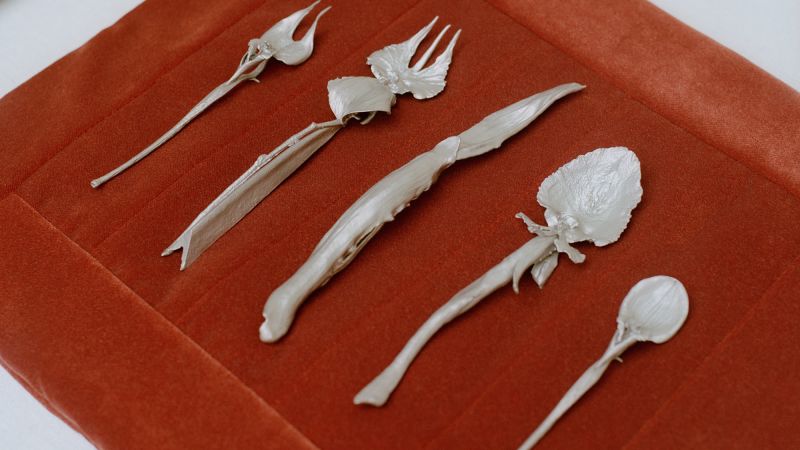
Among the most striking contributions is the work of Polish botanical artist Marcin Rusak, whose design redefined the brief entirely. Rusak, who grew up surrounded by his grandfather’s orchids, described the natural world as his first visual language. “Growing up, my grandfather was a nationally famous orchid breeder,” he shared, “and in some ways, orchids are my first learned visual language.” This insight informed his cutlery set, which incorporates organic forms and botanical motifs, challenging conventional expectations of flatware.
Rusak’s design, according to Ngo, exemplifies the potential of 3D printing to create shapes that would be impossible with traditional methods. The set’s fluid lines and intricate detailing reflect a fusion of nature and technology, a concept that resonates deeply with Ngo’s vision. “It’s not just about making something beautiful,” he added, “it’s about creating objects that speak to both personal and cultural narratives.”
From Collector to Architect of a New Era
Ngo’s role as both collector and curator underscores a shift in the design landscape. While he began as a passionate individual seeking to honor the past, his work now bridges historical appreciation with forward-thinking innovation. The *Knife, Fork, Spoon 3.0* exhibition is a testament to this duality, offering a glimpse into the possibilities of the future. By partnering with artists from diverse backgrounds, Ngo ensures that the designs are not only visually compelling but also culturally resonant.
His focus on inclusivity is evident in the selection of designers, many of whom are women, historically underrepresented in the field. This deliberate choice adds a new dimension to the narrative, highlighting the contributions of a broader range of voices. Each piece in the exhibition tells a story—whether it’s the interplay of tradition and modernity in Marcus-Bello’s work or the botanical elegance of Rusak’s set—emphasizing the evolving role of cutlery as a medium for cultural expression.
As the exhibition and book prepare to debut, Ngo envisions a future where cutlery transcends its utilitarian purpose. The combination of 3D printing, cultural storytelling, and personal artistry represents a bold departure from the past. “This is about making something that can only exist through new technologies,” he said, underscoring the significance of the project. His work not only preserves the legacy of modernist design but also invites the next generation to redefine it.
With the exhibition running earlier this month and the book set for release in August, Ngo’s contributions mark a turning point in the design world. By merging his passion for collecting with a forward-looking creative vision, he has positioned himself as a leader in this field. As the audience engages with these innovative designs, the boundaries of cutlery as an art form continue to expand, proving that even the most everyday objects can carry profound cultural and aesthetic meaning.
In a world increasingly defined by digital innovation, Ngo’s work stands as a reminder of the enduring value of craftsmanship and personal connection. The tools he has gathered over the years, from the vintage Wirkkala sets to the cutting-edge 3D-printed pieces, form a bridge between eras. By reimagining cutlery through a modern lens, he invites us to see it not just as a necessity, but as a canvas for creativity and identity.
