
Tear your eyes away from the ballroom. This courthouse is the real face of Trump-era architecture
Tear your eyes away from the ballroom. This courthouse is the real face of Trump-era architecture
A New Facade for Federal Architecture
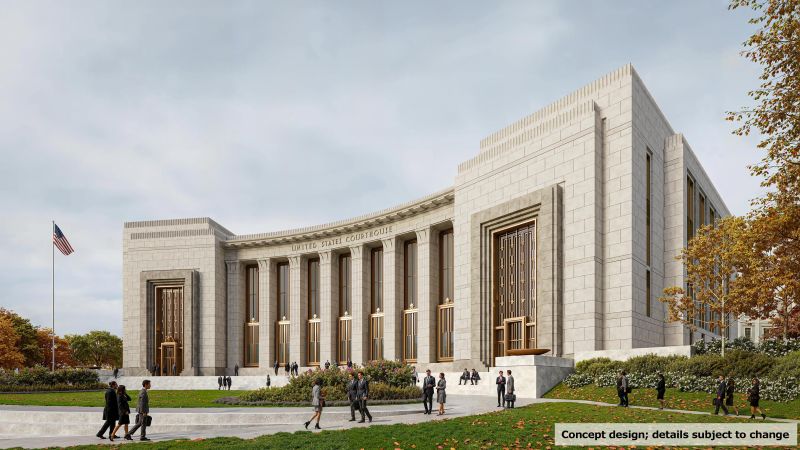
Tear your eyes away from the ballroom – While President Donald Trump’s opulent $400 million ballroom at the White House and his vision of a grand triumphal arch have long been the focal points of architectural discourse, a more subtle yet telling example of his design philosophy has emerged in Tennessee. This week, officials in Chattanooga quietly launched a project that, though not as ostentatious as Trump’s other ventures, embodies the essence of his executive directive to “Make Federal Architecture Beautiful Again.” The new federal courthouse, set to open in 2030, is a striking blend of Art Deco and classical Greek elements, standing as a testament to the shift in federal design priorities under the current administration.
The building, designed by the contemporary firm HOK, features a muscular, columned structure that mirrors the grandeur of ancient temples. Its imposing presence is a stark contrast to the more streamlined, modernist designs that dominated federal architecture in recent decades. Yet, this transformation is not merely aesthetic; it is a calculated statement. The courthouse represents the first major federal project to materialize since Trump issued his executive order, which called for a return to “classical and traditional” styles in public buildings. Critics argue that this shift signals a broader cultural movement aimed at reinforcing traditional values through the built environment.
The Blueprint of a Political Statement
The National Civic Art Society (NCAS), an organization that has been a vocal advocate for classical design, praised the Chattanooga courthouse as a “showpiece” of Trump’s vision. The society, which incidentally helped draft the president’s directive, described the style as “Greco-Deco,” a term that blends the geometric precision of Art Deco with the grandeur of ancient Greek architecture. According to NCAS president Justin Shubow, the design proves that classicism can still thrive in the modern era, offering both tradition and originality.
“Classicism is still alive, can be done well, and can be both traditional and original,” Shubow stated in a video call. “Many judges, regardless of whether they were appointed by a Democrat or a Republican president, want a courthouse that looks like a courthouse.”
However, not all architects see the project as a triumph. Kevin D. Murphy, a professor of art history at Vanderbilt University, contends that the design evokes the aesthetic of 1930s classicism, which he associates with fascist regimes. “This is not just a courthouse—it’s a kind of architectural propaganda,” he said, highlighting how the building’s rigid forms and monumental scale could be interpreted as a symbol of unyielding authority.
The design’s resemblance to the 1930s Joel W. Solomon Federal Building and US Courthouse in Chattanooga is intentional. HOK’s interpretation retains the blocky, rectangular framework of the existing structure while adding a layer of Art Deco ornamentation. The result is a building that appears both familiar and updated, a deliberate nod to the past while claiming to represent the future of federal architecture.
A Debate Over Meaning and Influence
Christopher Hawthorne, a former architecture critic for the Los Angeles Times and now the editor of the Punch List newsletter, offered a more balanced perspective. He called the Chattanooga courthouse a “handsome design” that “has the potential to be perfectly competent.” While acknowledging its visual appeal, Hawthorne questioned whether the project truly reflects the values of contemporary society. “Architecture has a responsibility to say something fundamental about the world we live in,” he noted. “I don’t think this design does anything more than mirror the current occupant of the White House.”
Trump’s executive order, issued last year, has sparked controversy within the architecture community. Many professionals view it as a nostalgic attempt to revive the grandeur of the past, potentially stifling innovation in favor of derivative styles. Op-eds have criticized the directive as a move toward “pastiche” and “derivative mimicry,” suggesting it could entrench a narrow definition of beauty at the expense of creativity. Yet, the public’s reaction appears more divided. A 2020 Harris Poll commissioned by the NCAS found that over 70% of Americans, irrespective of political affiliation, favor traditional designs for federal buildings over modern or postmodern alternatives.
This sentiment is reflected in the recent debate over the FBI’s plan to vacate the J. Edgar Hoover Building, a classicist structure that has stood since the 1930s. While some have called for its demolition, others have defended it as an enduring symbol of American architectural tradition. Similarly, reports of potential plans to raze the angular Dallas City Hall have not generated significant public outcry, suggesting that traditional designs may hold more sway than previously thought.
The Weight of Symbolism
Despite its accolades, the Chattanooga courthouse is not without controversy. Murphy argues that its solid, fortress-like appearance undermines the principles of transparency that modern courthouses are meant to embody. “To me, it isn’t at all transparent,” he said. “It is very formidable and very solid, in a very conventional way. Is that the message you want to send about the judiciary? That it’s intimidating?”
Shubow, on the other hand, defends the design as a necessary evolution. “Architecture firms should be very wary of having their work enlisted in this sort of culture war,” he added. “The goal isn’t to erase the past, but to reintroduce a sense of dignity and permanence to public spaces.” His argument reflects a broader tension within the profession: the balance between honoring tradition and adapting to contemporary needs.
The project’s completion in 2030 will mark a pivotal moment for federal architecture. While HOK has not commented on the debate, the firm’s design is a clear reflection of the political climate that has shaped its development. The building’s muscular columns and symmetrical facade are not just stylistic choices—they are a visual declaration of power, one that aligns with Trump’s broader agenda of projecting strength and authority through design.
A Cultural Shift in Stone and Steel
As the Chattanooga courthouse nears its opening, it serves as a microcosm of the larger conversation about the role of architecture in shaping national identity. Trump’s executive order has prompted a reevaluation of what federal buildings should represent, with some seeing it as a revival of classical ideals and others as a political tool to solidify his legacy. The design’s success will depend not only on its visual impact but also on its ability to resonate with the public’s evolving tastes.
The debate over the courthouse underscores the growing influence of political ideology on architectural decisions. For those who support the design, it is a celebration of timeless aesthetics and a reminder of the enduring appeal of classical forms. For critics, however, it is a symbol of a culture war that risks transforming federal buildings into monuments of partisan power. As the building takes shape, it will stand as a physical testament to the ideological forces shaping America’s built environment—and perhaps, a barometer for how the public perceives the intersection of politics and design.
Ultimately, the Chattanooga courthouse is more than a structure of stone and steel. It is a battleground for ideas, a reflection of the nation’s priorities, and a glimpse into the future of federal architecture. Whether it is seen as a revival of dignity or a new era of political symbolism, one thing is certain: the building will be a focal point of discussion for years to come. As its grand columns rise against the skyline, they may just become the most iconic feature of Trump’s architectural legacy—not the ballroom, not the arch, but the quiet, enduring presence of a design that seeks to redefine the face of federal power.
