
The Great Hydration Break Debate takes over the World Cup
The Great Hydration Break Debate Takes Over the World Cup
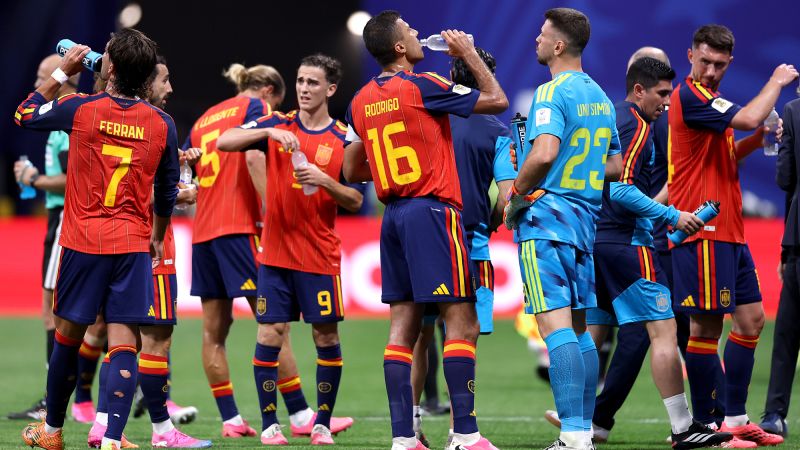
The Great Hydration Break Debate takes – As the World Cup progresses into its second week, the initial excitement has given way to a heated discussion over a seemingly minor yet contentious rule change. The tournament, held across North America, has already seen 24 group-stage matches and 75 goals scored, but the most talked-about moment of the week came not from a dramatic goal or a last-minute comeback, but from a three-minute pause in the action. These pauses, known as hydration breaks, have sparked a divide among fans, players, and analysts, questioning whether they’re a necessary safeguard for athletes or a disruptive move toward commercial dominance.
A New Rule for an Old Game
The hydration breaks, implemented by FIFA, have become a defining feature of the World Cup. Designed to address the challenges of extreme summer heat, the rule mandates a stoppage of three minutes midway through each half. This pause allows players to replenish fluids and electrolytes, a measure intended to mitigate the physical toll of high temperatures and humidity. While the idea appears logical, its execution has drawn mixed reactions. Critics argue that the breaks are not always aligned with the actual conditions, as seen in the Ghana vs. Panama match in Toronto, where the air temperature hovered at 19°C (66.2°F) — hardly a scenario requiring urgent hydration intervention.
Additionally, the rule applies to indoor stadiums, where climate control is a factor. This means that even in cooler, climate-regulated venues, the game is halted for three minutes. The decision has been justified by FIFA as part of its broader effort to prioritize player welfare, with experts in sports science endorsing the measure. However, for many fans, the breaks feel like an unnecessary interruption to the flow of the game, especially when they occur without clear cause.
Commercialism vs. Player Safety
Supporters of the hydration breaks point to the tangible benefits for athletes, particularly in a region where heatwaves are becoming more frequent. The summer of 2026 has brought record-breaking temperatures, with some matches being played under conditions that can push players to their limits. FIFA’s stance is that these breaks are a proactive step to ensure safety, especially for teams from countries less accustomed to high-stakes heat exposure. Yet, the debate has intensified with the realization that the rule’s application is not always tied to the intensity of the weather.
“It’s interesting how the hydration breaks have become a talking point,” said Virgil van Dijk, the Netherlands’ captain, during a press conference. “I’ve watched almost every game up to this point, and each time the break happens, it feels like the game is being paused for reasons beyond just player hydration.” Van Dijk’s remarks reflect the growing frustration among fans who view the breaks as a strategy to maximize commercial opportunities. With broadcasters like FOX incorporating ads during the stoppages, the breaks have inadvertently created a rhythm that mirrors US sports leagues, such as the NFL or NBA, where advertising slots are a core part of the viewing experience.
“For me, it’s a coaching break more than a cooling break, so to me it’s very important,” Belgium’s manager Rudi Garcia remarked, highlighting the strategic angle the rule has taken. “Managers use the time to reorient their teams, which can shift the momentum of a match.”
Garcia’s comments underscore the dual purpose of the breaks. While FIFA emphasizes health, the pauses also serve as a platform for tactical adjustments, allowing coaches to implement new strategies. This has led to instances where a team’s fortunes flip dramatically after the break, with some matches resembling a chess game rather than a flowing football contest. The changes are subtle, yet impactful, as teams exploit the brief intermission to fine-tune their approach. For example, in the Mexico-South Africa opener, the hydration break coincided with a pivotal moment that saw the team’s performance improve significantly in the second half.
A Cultural Divide on the Pitch
The debate over hydration breaks has revealed a cultural rift between traditionalists and modernizers in the world of football. While some see the rule as a natural evolution, others argue it dilutes the purity of the game. “It’s not just about the heat — it’s about the integrity of the match,” said a fan from England, who voiced their discontent after the team’s 4-2 victory over Croatia on Wednesday. “When the referee calls for a hydration break, it feels like an arbitrary pause that disrupts the rhythm of the game.”
For fans who grew up watching football as a continuous flow of play, these three-minute breaks are a source of irritation. The interruptions have also led to criticism from players, with some complaining about the loss of momentum and the forced pauses. “It’s a bit like a game of chess, where every move is calculated,” Van Dijk added. “But for the neutral viewer, it’s not so much about strategy as it is about losing the sense of immersion in the match.”
Despite the backlash, FIFA remains steadfast in its support of the rule, citing data from medical experts who have analyzed the physical demands of the tournament. “The hydration breaks are a critical part of our commitment to player welfare,” stated a FIFA spokesperson. “They provide essential time for recovery and help prevent heat-related injuries, which are a growing concern in this summer’s climate.” However, the rule’s universal application — regardless of conditions — has raised questions about its necessity and fairness.
Canada’s Mixed Performance in the Opening Match
While the hydration breaks dominate the headlines, the tournament has also showcased moments of brilliance and resilience. Canada, one of the co-hosts, provided an early example of this duality in its opening match against Bosnia and Herzegovina. The team struggled in the first half, appearing second-best and vulnerable to set-piece attacks. But in the second half, manager Jesse Marsch introduced tactical changes, including the inclusion of winger Ali Ahmed and striker Cyle Larin, which transformed their performance. The result was a game that swung from weakness to strength, highlighting the importance of adaptability in high-pressure environments.
The Canadian squad’s turnaround underscores the broader narrative of the World Cup — a tournament where teams must constantly adjust to the unpredictable nature of the competition. Whether it’s the heat, the logistics of scheduling, or the strategic implications of hydration breaks, every element adds a layer of complexity. For fans, the challenge is to reconcile these changes with the sport’s traditional essence, while for organizers, the goal is to balance performance with profitability.
As the World Cup continues, the debate over hydration breaks is likely to persist. With more matches to come and the summer heat only intensifying, the rule may prove to be a lifeline for players or a symbol of the growing commercialization of the game. Whatever the outcome, one thing is certain: these three-minute pauses have become an unavoidable part of the tournament, shaping the way fans watch and players play. For now, the focus remains on whether these breaks will ultimately enhance the game or detract from its spirit.
Meanwhile, the World Cup’s second week has brought fresh excitement, with underdog teams challenging established favorites and historic moments unfolding. As the debate rages on, the players and coaches must navigate both the physical and strategic challenges of the new format. For fans, the question remains: can a game as dynamic as football truly thrive under such interruptions, or is it a sign of a changing era?
