
John Roberts fought for decades to overturn Humphrey’s Executor
Supreme Court Overturns Key Precedent in Landmark Ruling
John Roberts fought for decades to overturn – Chief Justice John Roberts, a figure central to the evolving interpretation of executive power, has spent over four decades advocating for a president with expansive authority to remove heads of independent regulatory agencies. His legal arguments, rooted in a belief that the current system grants the executive branch insufficient control, reached a critical juncture this week when the Supreme Court unanimously reversed the 1935 decision in Humphrey’s Executor v. United States. This landmark ruling effectively stripped Congress of its ability to limit the president’s power to dismiss agency leaders, marking a significant shift in the balance of power between the executive and legislative branches.
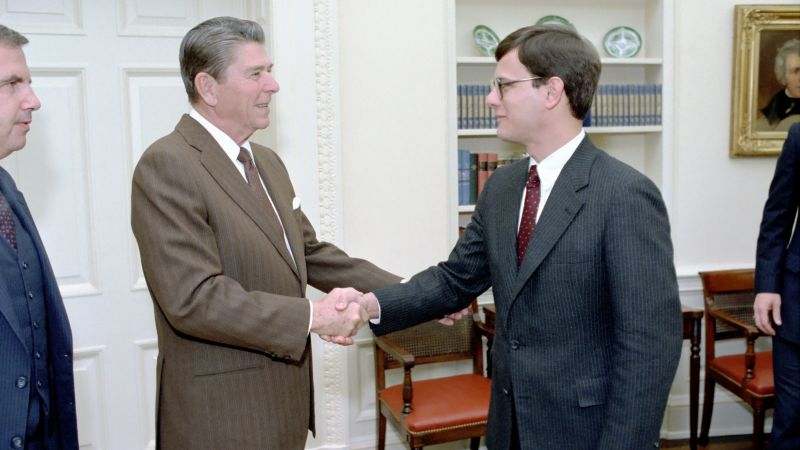
Roberts’ campaign for this constitutional change began in earnest during his early years as a Reagan administration lawyer. In 1983, he penned a memo to White House counsel that laid the foundation for his later arguments, stating, “the time is ripe to reconsider the constitutional anomaly of independent agencies.” At the time, the memo focused on the potential for presidential flexibility, but its implications extended far beyond the immediate context, foreshadowing a long-term strategy to reshape the framework of executive authority.
The Foundation of Roberts’ Argument
When Roberts was elevated to chief justice in 2005, he brought his philosophy of centralized presidential power to the bench. Over the years, his opinions consistently emphasized the importance of a strong executive. In a 2010 case, he articulated his stance in a strikingly direct manner: “Without such power, the President could not be held fully accountable for discharging his own responsibilities; the buck would stop somewhere else.” This assertion underscored his view that the president must retain the ability to act decisively, even in areas traditionally managed by independent agencies.
The recent decision in Humphrey’s Executor was the culmination of this effort. Roberts, leading a 6-3 majority, argued that the 1935 precedent had created an imbalance in the constitutional structure. He contended that the ruling had allowed Congress to impose constraints on the president’s authority, thereby undermining the original intent of the Constitution. “If anything more is left of Humphrey’s, we overrule it,” he declared, signaling the court’s resolve to restore presidential dominance over regulatory leadership.
Broader Implications for American Governance
While the debate over regulatory authority may appear less dramatic than issues like abortion rights or immigration, its impact is deeply felt across everyday life. Independent agencies such as the Federal Trade Commission (FTC), the Environmental Protection Agency (EPA), and the Food and Drug Administration (FDA) regulate industries, enforce safety standards, and protect consumers. Roberts’ reversal of Humphrey’s Executor means these agencies’ leaders can now be removed by the president at will, raising concerns about the potential for executive overreach.
Roberts’ approach to presidential power has been consistent in its scope. His legal philosophy, which prioritizes the executive branch’s autonomy, has been evident in several high-profile cases. One notable example was the 2024 decision that granted former President Donald Trump significant immunity from criminal prosecution. The ruling hinged on the argument that the president’s authority to act unilaterally must be preserved, even when it challenges existing laws. “The President is not all powerful—not by any means,” Roberts wrote, “but he is not impotent either.” This dichotomy has become a defining feature of his jurisprudence.
The chief justice’s strategic patience has paid off. By aligning with a group of like-minded conservative appointees, he has secured a supermajority that enables sweeping changes to the legal landscape. This has been particularly evident in cases involving the Federal Trade Commission and the Voting Rights Act. The FTC, established in 1914 to protect consumers and curb unfair business practices, has faced renewed scrutiny under the new framework. Similarly, the Voting Rights Act of 1965, a cornerstone of civil rights legislation, was recently weakened as the court struck down key provisions that safeguarded voting access for minority communities.
Reactions from the Judicial Left
Justice Sonia Sotomayor, representing the liberal wing of the court, delivered a passionate dissent in the Monday ruling. She warned that the decision would erode the independence of regulatory agencies, which are crucial for maintaining public trust in government oversight. “The Court gives the President a power unknown even to the English Crown against which the Founders revolted,” Sotomayor wrote, highlighting the potential for the executive to act without checks. Her critique focused on the transformation of the president’s duty to “take care that the laws be faithfully executed” into a license to disregard them.
Sotomayor’s dissent also emphasized the historical role of Congress in establishing independent agencies. The 1935 case had allowed lawmakers to set terms for agency commissioners, ensuring their independence from presidential whims. By overturning this precedent, Roberts’ majority has effectively handed the president a tool to reshape regulatory priorities with minimal legislative oversight. This shift could have far-reaching consequences, particularly for agencies tasked with enforcing complex regulations in areas like workplace safety and environmental protection.
Roberts’ argument rests on the premise that the president is the sole guardian of executive power, a role that transcends the three branches of government. His 36-page opinion in the Humphrey’s Executor case elaborated on this idea, framing the reversal as a return to constitutional clarity. “Our Constitution creates three branches, but only one President,” he wrote, a statement that encapsulates his vision of a unified executive authority.
The long-term implications of this decision are already being felt. For instance, during Trump’s second term, the administration sought to replace Democratic appointees at the FTC, including Rebecca Slaughter, who was in the final year of a seven-year term. The ability to remove such leaders without clear justification has raised questions about the stability of regulatory frameworks. Critics argue that this power could lead to abrupt shifts in policy, favoring short-term political goals over long-term public interest.
Roberts’ reversal of Humphrey’s Executor is part of a broader trend of judicial activism aimed at expanding presidential control. His approach mirrors previous efforts to curtail the influence of Congress, as seen in the ongoing debate over the Voting Rights Act. With the court’s composition favoring conservative interpretations, the potential for further executive empowerment remains substantial. As the ruling takes effect, the balance of power in American governance will continue to be tested, with the president’s authority now arguably more absolute than ever before.
