
Bondi defends DOJ’s handling of Epstein files but says Blanche was in charge
Former AG Pam Bondi Shifts Focus to Todd Blanche in Epstein Files Testimony
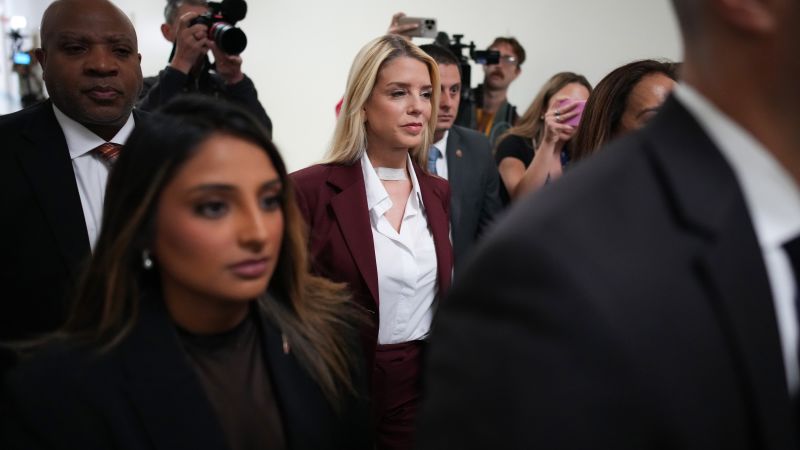
Bondi defends DOJ s handling of Epstein – On Friday, former Attorney General Pam Bondi faced intense scrutiny during a long-awaited interview with House lawmakers, as Democrats accused her of evading direct answers about the Justice Department’s management of the Jeffrey Epstein files. Despite her insistence that the DOJ had acted transparently during her time in office, the session revealed tensions over who ultimately oversaw the release of the documents. Bondi, who had previously maintained a composed demeanor, was said to have avoided elaborating on specific aspects of the investigation, instead redirecting attention to her successor, Todd Blanche, who took charge of the process.
Bondi’s prepared remarks ahead of the interview emphasized her commitment to transparency, claiming the DOJ “demonstrated an unprecedented commitment to openness” under her leadership. However, during the actual meeting, Democratic lawmakers from the House Oversight Committee argued that her responses were insufficient. They pointed to questions about President Donald Trump’s awareness of Epstein’s crimes, which Bondi reportedly answered with vague assertions. Rep. Robert Garcia, the committee’s top Democrat, stated that Bondi attempted to assign responsibility to Blanche, noting that she claimed, “Acting Attorney General Blanche was managing the entire investigation.” This, Garcia suggested, indicated a lack of accountability from Bondi.
“She said and I quote, ‘Acting Attorney General Blanche was managing the entire investigation,’” said Garcia. “It’s as if she’s trying to shift the narrative away from herself.”
Bondi’s defense of the DOJ’s actions was met with skepticism by lawmakers, who saw it as an attempt to deflect criticism. During the closed-door session, she was observed moving her body rather than her head to communicate, a physical limitation stemming from recent surgery to treat her thyroid cancer. The sight of her restrained movements added a layer of scrutiny to her testimony, as she relied on gestures to convey points while her voice remained steady.
Following the interview, Bondi swiftly challenged the Democrats’ interpretation of her remarks through a social media post on X. She wrote, “NOT TRUE,” asserting that she had praised Blanche’s management of the investigation. “I said his ethics are beyond reproach and that he is an incredible Attorney General,” she added, highlighting her support for the acting official. Republicans on the oversight panel echoed this sentiment, with one insider stating that Bondi’s focus on Blanche was a natural progression of leadership responsibilities rather than an attempt to avoid blame.
The DOJ official present during the session, Harmeet Dhillon, defended the delegation of tasks to senior officials, calling it “very common” for high-ranking leaders to entrust complex operations to deputies. “The former Attorney General had thousands of responsibilities,” Dhillon explained, “and it’s typical for many components of her role to be delegated to other officials.” This rationale, however, did little to quell Democratic concerns, as Rep. James Walkinshaw noted that Bondi’s uncertainty about Trump’s knowledge of Epstein’s crimes was central to the committee’s inquiries.
Democrats accused Bondi of stonewalling during the interview, claiming that Dhillon intervened to prevent her from answering questions about Trump’s involvement. “He stopped Ms. Bondi multiple times from answering questions,” Garcia stated, suggesting that the DOJ official was steering the conversation to align with the committee’s established protocols. At one point, when asked directly about Trump’s awareness of Epstein’s crimes, Bondi responded with, “I’m not certain to the extent of his knowledge,” leaving lawmakers dissatisfied with the clarity of her answers.
Meanwhile, the delegation of responsibilities became a point of contention among Democrats, who viewed it as a sign of Bondi’s reluctance to take ownership of the investigation’s outcomes. “It’s a sham in there,” said Rep. Dave Min, describing the session as a orchestrated effort to minimize her accountability. Dhillon, however, defended the structure of the meeting, stating that the interventions were meant to keep lawmakers focused on the predefined topics and format. “She was simply ensuring they followed the ground rules set by the committee,” he added.
Bondi’s testimony also touched on Ghislaine Maxwell, Epstein’s accomplice, with the former attorney general expressing a firm stance on her fate. According to a source close to the proceedings, Bondi told the committee that Maxwell should “die in prison” and not receive a presidential pardon. She described Maxwell as “evil,” a term that underscored her belief in the severity of her crimes. Bondi maintained that she was unaware of Maxwell’s prison transfer and emphasized that such moves were standard when security concerns arose. “I did not request it,” she stated, though she acknowledged the practice as routine.
While Bondi’s prepared statement highlighted her delegation of oversight to Blanche, it also underscored the challenges of leading a vast department. “As the head of a large Department with broad responsibilities, I did not lead every aspect of this effort,” she explained, making it clear that Blanche had played a pivotal role in the document release process. This division of labor, she argued, was necessary given the scale of the DOJ’s operations. Yet, critics viewed it as a way to avoid personal accountability for the investigation’s handling.
Despite the focus on Blanche, the interview remained a significant moment for the Epstein files, which had become a flashpoint for scrutiny within Trump’s administration. Two months after her removal from the position and just days after revealing her cancer diagnosis, Bondi’s appearance before lawmakers provided a rare opportunity to examine her tenure. The session’s timing, coinciding with her ongoing recovery, added a personal dimension to the political questions she faced.
As the interview progressed, Bondi’s interactions with the committee revealed both her strategic approach to defense and her physical vulnerability. Her inability to move her head side to side, due to the bandage across her throat, made her gestures a focal point of the proceedings. This limitation, combined with her sharp responses to questions about the investigation, created a striking contrast between her public assertions and the logistical challenges of her role. The session ultimately became a test of her ability to reconcile her leadership responsibilities with the demands of accountability.
With the Epstein files still at the center of political debates, Bondi’s testimony underscored the complexities of her time in office. While she positioned herself as a proponent of transparency, the Democrats’ criticisms highlighted the gaps in her explanation. As the panel concluded its questions, the conversation about the DOJ’s handling of the case remained unresolved, with Bondi’s shifting focus on Blanche serving as a key element of the discussion. The session set the stage for further scrutiny, as the full implications of the documents continued to unfold.
