
Iran’s reopened underground missile sites show limits of US bombing plan
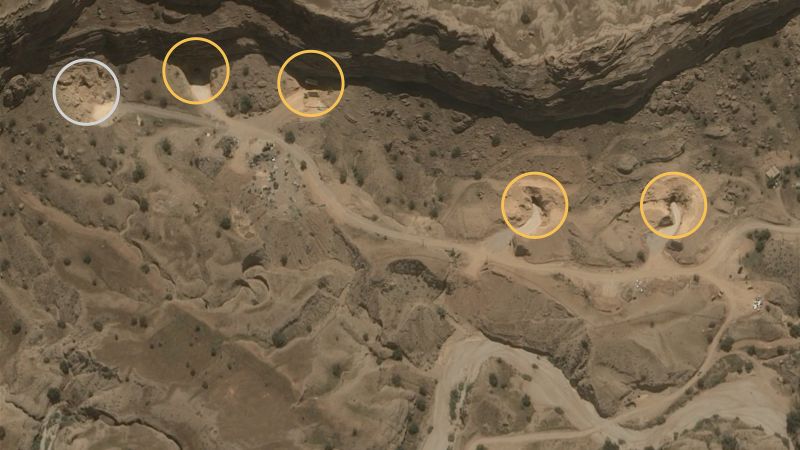
Iran s reopened underground missile sites – Iran is poised to fire far more long-range missiles at Israel and other Middle Eastern nations after rapidly digging out its buried arsenals – an effort that highlights the limits to US bombing strategy, experts said. For weeks, strikes by the United States and Israel restricted Iran’s access to its underground missile sites by destroying roads and burying tunnel entrances. But satellite images reviewed by CNN show how Iran has used simple equipment such as bulldozers and dump trucks to counter those costly campaigns — suggesting that Tehran’s missile capabilities can’t be destroyed just by targeting tunnel entrances, experts said.
While Iran and the US have reached a tentative agreement to reopen the Strait of Hormuz, months of work remain to hammer out details. If hostilities do resume, Iran is in position to “continue launching missiles so long as they have launchers and crews, even if production has halted,” said Sam Lair, a research associate at the James Martin Center for Nonproliferation Studies who analyzes Iran’s missile capabilities. “There’s nothing to prevent the launchers from being armed with the ample stockpile of missiles that the Iranians still have.” During the fighting, Iran worked to excavate the tunnel entrances at great peril, with the US and Israel often striking the equipment used for digging.
That work enabled Tehran to continue firing missiles throughout the war, though at vastly reduced rates. Since the ceasefire more than seven weeks ago, Iranian efforts to excavate the bases have accelerated significantly. CNN found that Iran has now unblocked 50 out of the 69 tunnel entrances struck by the US and Israel at 18 underground missile facilities.
Iran has repaired other parts of the bases as well, including roads that the US and Israel bombed to prevent missile launchers from using them. Satellite images show almost all these craters have now been filled, and at two sites, even repaved. “The US military is good at delivering tactical successes, and entombing and suppressing the Iranian missile force is a great example of that,” said Lair.
“However, if that isn’t accompanied by a set of reasonable strategic war aims and an achievable theory of victory, it can end up being a strategic failure.” Pentagon spokesman Sean Parnell did not respond to specific questions about CNN’s findings, repeating an earlier statement that “America’s military is the most powerful in the world and has everything it needs to execute at the time and place of the President’s choosing.” President Donald Trump has repeatedly pointed to Iran’s arsenal of missiles as a reason for the war, with its destruction being one of the key goals. In a March post to Truth Social, Trump listed “completely degrading Iranian Missile Capability, Launchers, and everything else pertaining to them” as one of five “objectives” of the war. Iran’s network of underground missile bases, which it began building more than 20 years ago, offers considerable protection to its missiles and launchers.
The depth of the facilities, some of which are under hundreds of meters of rock, limit the options the US and Israeli militaries have for attacking the bases. So, in the early weeks of the conflict, the militaries turned to striking their entrances, which combined with efforts to find and destroy launchers, resulted in significantly limiting Iranian missile fire. Those strikes heavily damaged the bases, burying most tunnel entrances under mountains of debris and shattering roads leading to the sites.
Satellite images reviewed by CNN at the time showed facilities like the Isfahan North Missile Base, a key underground missile location, ravaged by multiple strikes with rubble covering tunnels and launchers destroyed outside. The US and Israel also undertook a broad effort to wreck Iran’s missile supply chain, from factories where small electronic components are produced, to the sites where rocket propellants and missile bodies are manufactured. After the US and Iran agreed to a ceasefire on April 8, US Secretary of Defense Pete Hegseth cited the efforts, saying that Iran would be “digging out your remaining launchers and missiles, with no ability to replace them.
You have no defense industry.” Experts believe Iran still has around 1,000 missiles stored in the underground sites. That stockpile, deep below the surface, is unlikely to have sustained much damage from strikes at ground level, according to the experts, especially given that the Israeli military struck tunnel entrances in the same manner during the Twelve-Day War last year. “They were preparing for this kind of war for 20 years,” said Timur Kadyshev, a senior researcher at the Institute for Peace Research and Security Policy at the University of Hamburg who studies Iran’s missiles.
“They are very prepared.” To reopen the bases, Iran has used a variety of construction and earthmoving equipment. In the satellite images, front-end loaders are visible scooping up rubble as dump trucks fill craters with dirt. At one base, outside of Isfahan, the US and Israel conducted numerous strikes to block four tunnel entrances during the war.
At least 18 craters could be seen at a pair of the entrances, indicating just how many munitions were expended to block the tunnels. In early May, a satellite image showed a dump truck being used to fill in the craters. The other two entrances, also blocked by craters and debris, had already been opened, and the roads to them, previously destroyed by bombing, had been repaved.
At a base outside of Khomeyn in mid-April, an image showed at least 10 construction vehicles engaged in efforts to reopen one entrance. As Iran recovers its missiles, and restores functionality to its missile bases, analysts are concerned that the continued threat posed by this arsenal is being underestimated, especially given the dwindling supply of US missile interceptors. The strikes on Iran’s missile factories also may not prevent Tehran from reconstituting its missile production capabilities for as long as the US and Israel would like.
During the Twelve-Day War some of these same factories were attacked as well. Although the recent strikes have been much broader, satellite images showed Iran had already rebuilt some of the facilities targeted last June. US intelligence assessments indicate Iran has already been rebuilding key military capabilities, including restarting drone production and replacing missile launchers and production capacity.
“The Iranians have exceeded all timelines the (intelligence community) had for reconstitution,” one US official told CNN. For Kadyshev, that difference in technologies exposes the difficulty in pursuing military options against Iran. “You have to use very sophisticated, very expensive weapons to do this kind of damage, and the recovery is very low tech – it’s just bulldozers.” CNN’s Gianluca Mezzofiore contributed to this report.
