
Again, Trump said nobody left his speech. Again, that wasn’t true
Trump’s Claim of No Departures: A Persistent Pattern
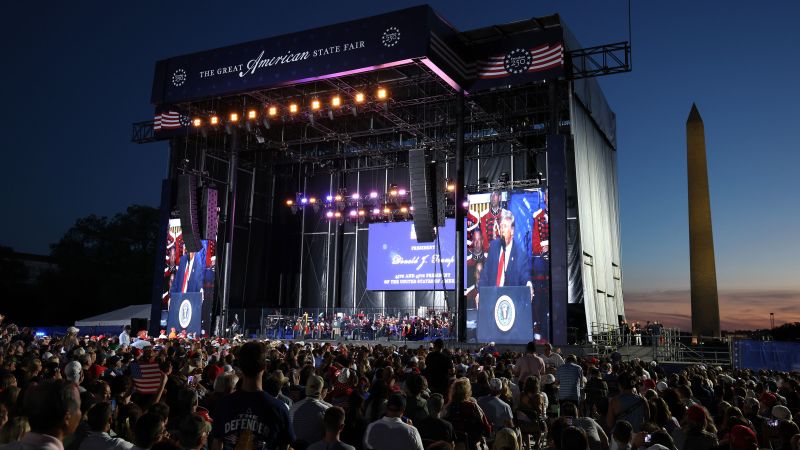
Again Trump said nobody left his speech – On Thursday, President Donald Trump shared a social media post celebrating the speech he delivered the prior day at the Great American State Fair in Washington, DC. In the post, he asserted, “Everybody stayed right until the end of my Speech because they loved hearing about a truly successful America.” However, this claim was quickly challenged by evidence showing the contrary. A video published by The Bulwark, a media outlet critical of Trump, captured dozens of attendees exiting the event about 17 minutes into his 28-minute address, disproving his assertion.
Discrepancies in Attendance
CNN’s senior correspondent, Donie O’Sullivan, who attended the event, noted that hundreds of people began leaving as the speech progressed. While Trump emphasized the event’s bipartisan nature and its focus on the nation’s 250th-anniversary commemoration, the crowd on the National Mall—a pedestrian-friendly area in a Democratic-controlled capital—was likely more diverse in composition than typical Trump rallies in rural regions. This mix of attendees included individuals with varying levels of commitment to the political discourse, which may have influenced their decision to leave early.
“The people that you see leaving… Because nobody ever leaves”
Trump’s insistence that “nobody leaves” his speeches has been a recurring theme throughout his political career. Yet, as his latest post demonstrated, this claim often lacks factual support. The Detroit Free Press documented a notable instance during a fall 2024 event in Michigan, where the crowd thinned significantly as the 85-minute speech continued. Similarly, the New York Times highlighted that at a North Carolina rally days before the 2024 election, audience members began departing shortly after the speech began, forming a “steady exodus” that persisted throughout the event.
A History of Exaggeration
During the 2024 presidential campaign, Trump frequently repeated his assertion that “people don’t leave my rallies.” This came in response to his opponent, then-Vice President Kamala Harris, who claimed in a televised debate that attendees often left his events early due to exhaustion and boredom. Trump dismissed this, insisting, “We have the biggest rallies, the most incredible rallies in the history of politics.” Yet, as the campaign unfolded, this narrative was contradicted by numerous reports. For example, at a Michigan event, he claimed “nobody leaves early,” but the Detroit Free Press noted that the audience grew visibly thinner as his speech stretched on.
“Scores of people” had left early from many Trump events in 2024
The Washington Post also highlighted that early departures were a common occurrence at multiple Trump events during 2024. One notable example involved an Atlanta rally where “hundreds if not thousands” of attendees exited before the conclusion. These individuals cited a range of reasons, including the desire to avoid traffic, a dog waiting at home, or dissatisfaction with the sound quality. The Guardian further reported that at a Georgia event in the fall of 2024, about three out of every 10 attendees left before the speech ended, despite Trump arriving late to the proceedings.
Consistency in Deception
Despite these contradictions, Trump has consistently framed his speeches as universally attended events. His ability to recite false claims—even after they have been debunked—has become a hallmark of his public persona. However, this particular assertion faltered during a September 2024 rally in Michigan. There, he initially said, “The people that you see leaving… Because nobody ever leaves,” only to later add, “And when they do, I finish up quick, believe me.” This moment revealed a disconnect between his rhetoric and the reality of audience engagement.
While Trump’s exaggerations often serve to inflate his perceived popularity, they also reflect a broader pattern of self-serving narratives. The fact that many attendees left early did not hinder his electoral success, as he still secured victory in the 2024 presidential race. Yet, the incident at the State Fair underscores a recurring theme: the gap between his claims of unwavering support and the actual behavior of his audience. This discrepancy is not unique to the event in question; it has been observed at multiple rallies across the country, suggesting that Trump’s assertion of complete attendance is more of a rhetorical strategy than an accurate reflection of reality.
One might wonder whether Trump’s insistence on “everybody” staying until the end is intentional or if he is genuinely unaware of the people departing. The Bulwark’s video, which showed attendees leaving early, could have influenced his perspective, but he has yet to fully acknowledge the evidence. This pattern of behavior aligns with his long-standing reputation as a serial liar, often downplaying or ignoring factual data that undermines his image. Even when confronted with direct evidence, such as the exodus from his speeches, Trump remains steadfast in his claims, attributing the departures to trivial reasons like lining up for photos or brief discomfort.
The implications of this claim extend beyond the immediate event. It reinforces a narrative of Trump as a charismatic leader whose speeches command full attention, even as data suggests otherwise. His ability to craft such narratives has been central to his political brand, allowing him to maintain a perception of widespread support. However, the persistence of early departures at his events raises questions about the accuracy of his assertions and the extent to which they shape public perception. As the 2024 campaign demonstrated, Trump’s speeches often serve as a platform for reinforcing his image, even when the facts tell a different story.
Ultimately, the incident at the State Fair is not an isolated case but part of a larger pattern of exaggeration and selective truth-telling. While it is true that most of the audience remained until the conclusion of his speech, Trump’s use of the phrase “everybody” implies a universality that is not supported by the evidence. This highlights the importance of media scrutiny in holding political figures accountable for their claims. As the crowd’s behavior revealed, even in a nonpartisan setting, the allure of Trump’s speeches is not as absolute as he suggests. Yet, his ability to maintain this illusion continues to be a key component of his political strategy.
