
Utah canyon BASE jump kills 2, including extreme athlete Andy Lewis
Tragic BASE Jump Incident Claims Lives in Utah Canyon
Utah canyon BASE jump kills 2 including – Two individuals lost their lives in a BASE jumping mishap at a Utah canyon, including Andy Lewis, a seasoned extreme athlete celebrated for his daring performances. The Grand County Sheriff’s Office confirmed the incident occurred during a tandem jump at Mineral Bottom, a secluded desert area straddling the Utah-Colorado border. Lewis, whose career spanned high-adrenaline sports, was among the casualties, alongside Danny Joe Kregle, a 68-year-old man who was also a father and grandfather.
From Super Bowl Stunt to Extreme Sport Pioneer
Andy Lewis gained widespread recognition when he performed during Madonna’s 2012 Super Bowl halftime show. Dressed in a Roman toga, he executed acrobatic maneuvers on an inch-thick slackline, creating a visually stunning spectacle as the pop icon sang in the background. The stunt catapulted him into the public eye, transforming him from a relatively unknown athlete into a household name. Reflecting on the moment, Lewis humorously noted the overwhelming attention it brought, even joking that his phone “rung itself to death” for days afterward.
“My phone actually rang itself to death three days in a row,” Lewis said in a 2012 interview with Conan O’Brien’s late-night show.
A Career Built on Risk and Innovation
Throughout his career, Lewis was known for his fearless approach to extreme sports. In the BASE jumping community, he earned a reputation for taking calculated risks, such as leaping from tighter spaces or delaying parachute deployment longer than most peers. John McEvoy, a BASE jumping instructor from Twin Falls, Idaho, described Lewis’s blend of athleticism and audacity. “He had an incredible level of athleticism and skill developed over years of practice,” McEvoy said. “But then he would take an incredible amount of risk.”
As a co-owner of BASE Jump Moab, Lewis specialized in tandem jumps, pairing inexperienced jumpers with seasoned guides. His company’s promotional videos depict pairs of people stepping off towering cliffs, free-falling briefly before deploying parachutes. While these jumps are designed for safety, McEvoy highlighted the inherent controversy in the sport. “Within BASE, it’s a very controversial topic,” he explained. “There’s a lot of people who say it’s the stupidest thing in the world and others arguing: `No, we’re giving people the experience of their lives.’”
Legacy of Slacklining and Tricklining
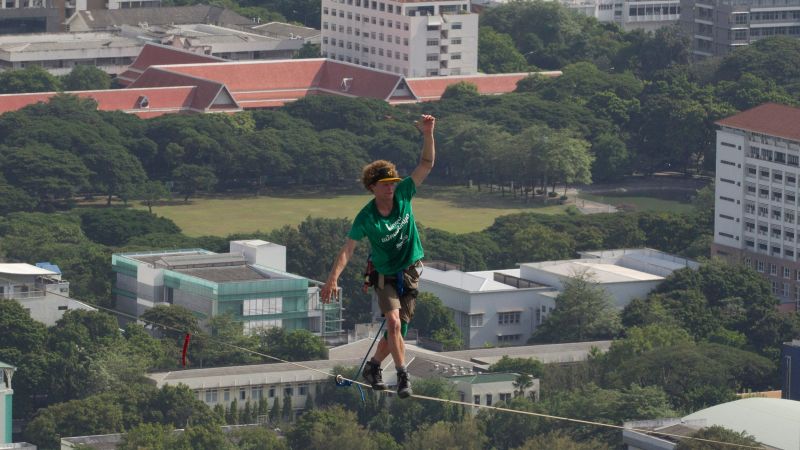
Beyond BASE jumping, Lewis was a trailblazer in slacklining and tricklining. These disciplines merge high-wire walking with aerial acrobatics, often performed at dangerous heights. His mastery of these arts earned him four consecutive world championships in competitive slacklining from 2008 to 2011. In 2011, he set a Guinness World Record for slackline surfing, balancing on a narrow line above China’s Diaoshuilou waterfall while swaying his feet in a rhythmic motion reminiscent of surfing.
Lewis also demonstrated his versatility by walking a slackline between two hot air balloons more than 4,000 feet above the Nevada desert in 2014. These feats underscored his ability to push physical and creative boundaries, making him a respected figure in niche athletic communities. However, the accident in Utah serves as a stark reminder of the sport’s dangers, even for those with years of expertise.
Accident Details and Tandem Jump Risks
Emergency services were called to the scene on Sunday after reports of an injury during a BASE jump attempt at Mineral Bottom. Though the exact cause of the tragedy remains under investigation, the tandem nature of the jump likely played a role. In tandem jumps, two individuals share a single parachute, with the less experienced jumper relying entirely on their partner’s skill and judgment. McEvoy, who had collaborated with Lewis, emphasized the dual nature of this risk. “They tend to be the most low-risk, basic types of jumps,” he said. “But the fact that two people are strapped together adds a layer of complexity.”
Global BASE Jumping Statistics and Fatalities
BASE jumping, a sport involving jumps from fixed objects like bridges, cliffs, or buildings, carries significant risks. According to data from BASEaddict.com, the sport has claimed 540 lives worldwide since 1981, with 30 fatalities recorded in 2022 alone. Notable cases include the 2015 deaths of Dean Potter and Graham Hunt during a wingsuit flight in Yosemite National Park. A 2007 study in a medical journal compared BASE jumping to skydiving, finding the former’s risk of injury or death to be five to eight times higher. Lewis himself acknowledged this peril, stating in a 2022 interview: “It’s weird to think about how many people are dead, because it’s like a normal thing.”
Personal Impact and Community Reflection
Danny Joe Kregle, the other victim, was remembered by family members for his vibrant personality and passion for magic. His granddaughter, Sydney Laverty, shared that Kregle had a “wonderful sense of humor” and loved entertaining others with his tricks. Lewis, who often blended athleticism with artistry, was also a beloved presence in the local community. His business, Aerial Arts Moab, described him as “co-owner and best friend,” highlighting the personal and professional bonds he cultivated.
The tragedy has left many in the extreme sports community shaken. While tandem jumps are intended as a safer entry point for novices, the incident underscores the unpredictable nature of the sport. “You can’t control everything,” McEvoy remarked. “Even with experience, the smallest mistake can lead to catastrophe.” As of Monday, no one from BASE Jump Moab had responded to calls or messages, leaving the team and fans in mourning.
Conclusion: A Life of Adventure and Impact
Andy Lewis’s death marks the end of an era for a man who lived his life on the edge. From the glitter of the Super Bowl stage to the rugged beauty of Utah’s canyons, his journey epitomized the thrill of risk-taking. While his accomplishments in slacklining and BASE jumping continue to inspire, the accident serves as a sobering reflection on the cost of pushing limits. For those who knew him, Lewis was not just an athlete but a symbol of courage and creativity, whose legacy will endure in the memories of those he touched.
As the investigation into the incident continues, the community grapples with the question of how such risks can be managed. Yet, for Lewis, the answer was clear: to live fully, one must embrace the possibility of falling. His life and work remain a testament to the human spirit’s relentless drive to conquer the extraordinary, even in the face of uncertainty.
