
The USA’s red card controversy explained and why the decision won’t be overturned
The USA’s Red Card Controversy: A Disputed Decision That Stands
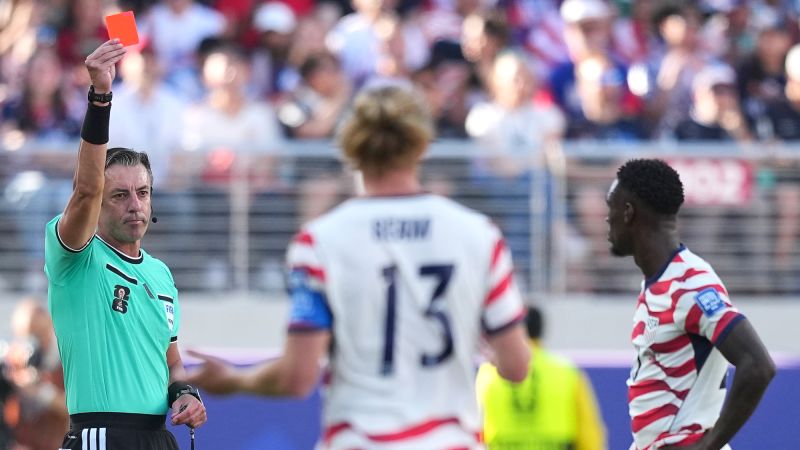
The USA s red card controversy – As the World Cup progressed, one of the most talked-about moments came during the United States’ 1-0 victory over Bosnia and Herzegovina. The game, which showcased a dramatic turn of events, became a focal point for fans and analysts alike when a controversial red card was shown to Folarin Balogun. While the U.S. team secured the win, the decision to send off their star striker raised questions about fairness, consistency, and the role of technology in modern soccer. The debate quickly spread, with many wondering whether the call could be reversed. The answer, according to FIFA’s regulations, is no—at least for now.
A Moment of Controversy in the Heat of the Game
During the second half, the U.S. team appeared to be on a roll, with Balogun scoring the opening goal and the match seemingly heading toward a comfortable victory. However, the momentum shifted when Balogun collided with Bosnia defender Tarik Muharemović. The incident, which occurred in the final minutes, left Muharemović visibly dazed, prompting the referee to pause play. The initial decision was met with mixed reactions, but it wasn’t until the video assistant referee (VAR) review that the full story emerged.
Replays revealed that Balogun had extended his right leg toward the ball, causing his cleats to scrape Muharemović’s calf. The defender’s ankle, planted awkwardly on the ground, became the focal point of the challenge. While Balogun didn’t appear to have malicious intent, the slow-motion footage highlighted a dangerous play that left fans divided. The referee, Raphael Claus, deemed the action severe enough to warrant a red card, sending the U.S. striker to the sideline. The decision sparked immediate discussion, with some arguing it was a harsh punishment and others defending its necessity.
FIFA’s Rules and the Appeal Process
“If a player or team official is sent off as a result of a direct or indirect red card (second caution), they will automatically be suspended from their team’s subsequent match,”
stated FIFA’s official guidelines for the current tournament. This rule means that once a red card is issued, the player is out for the next game, unless the suspension is extended by the governing body. US Soccer confirmed to CNN Sports that they would not be appealing the decision, leaving Balogun to sit out the Round of 16 clash against Belgium on Monday. This lack of an appeal option has drawn criticism from players and fans, with some calling it an outdated system that fails to account for the nuances of the game.
There was some initial confusion about the appeal process, but it was clarified that US Soccer could only challenge the red card if FIFA decided to lengthen Balogun’s suspension. Despite this, the decision remains firm. Balogun, who is set to miss at least one match, has expressed frustration, questioning the fairness of the system. “It’s bogus,” he said, referencing similar incidents that went unpunished earlier in the tournament. The inconsistency in officiating decisions has become a recurring theme, with fans pointing to moments like Lionel Messi’s accidental stamp on a defender’s leg in Argentina’s first group match as evidence.
The Unpredictable Nature of Soccer and Its Consequences
Soccer’s charm lies in its unpredictability, and this moment exemplifies that. While some may argue that the red card was justified, others see it as a missed opportunity to correct a mistake. The incident also raised questions about the role of VAR in high-pressure situations. For example, could a different referee or a more precise review have changed the outcome? The technology has proven to be a double-edged sword, offering clarity in some moments while creating new controversies in others.
Balogun’s dismissal has had tangible effects on the U.S. team’s strategy. With key players like him sidelined, the squad must adapt quickly to maintain their competitive edge. The game against Belgium, a team known for its tactical discipline, will test the U.S. defense and midfield. Balogun’s absence could be a setback, but it also forces the team to explore new formations and playmakers. This flexibility is crucial in the high-stakes environment of the World Cup, where every decision can alter the course of a match.
Global Reactions and the Human Element
Reactions to the red card varied widely, reflecting the subjective nature of soccer officiating. Former NFL star JJ Watt, along with NBA champion Josh Hart and NFL superstar Patrick Mahomes, expressed surprise at the decision, highlighting the confusion among even non-soccer fans. The incident has sparked a broader conversation about how referees balance the rules with the reality of the game. Is a red card always the right call, or are there moments where a yellow card would have sufficed?
For fans, the moment became a symbol of the unpredictability that makes soccer so captivating. While some criticized the decision, others praised it as a necessary measure to protect defenders from dangerous challenges. The debate underscores the human element in the sport—how a single moment can spark such strong opinions and influence the outcome of a match. Balogun’s red card, though controversial, serves as a reminder that even in a game as structured as soccer, decisions are often made in the heat of the moment.
Spain’s Position in the Tournament
Meanwhile, Spain’s campaign has continued to unfold as a model of consistency. After a shaky draw against Cape Verde in their opening match, the Spanish team has since delivered two commanding victories, securing their place at the top of Group H. The performance has been a testament to their tactical adaptability and depth. Young talent Lamine Yamal, who has been a standout in the tournament, appears to have fully recovered from an earlier injury, contributing to the team’s cohesion. However, the absence of left winger Nico Williams remains a concern, as his injury could impact Spain’s attacking options in the next phase.
Spain’s progress has made them the favorites to advance from the Round of 32, but the U.S. and Belgium will be determined to challenge that narrative. The U.S. must now navigate their own set of challenges, with Balogun’s red card serving as a hurdle in their quest for a deep run in the competition. As the World Cup reaches its midpoint, the story of the red card and the broader themes of fairness and unpredictability continue to shape the conversation around the sport.
Looking Ahead: What’s Next for the Teams
With the World Cup reaching this critical stage, fans are eager to see how the teams will adapt. The U.S. faces Belgium in a high-stakes clash, while Spain looks to solidify their position in Group H. For Balogun, the red card is a bittersweet memory of a game that was ultimately a triumph for his team. Despite the controversy, the U.S. will carry forward, hoping to turn the next chapter of their campaign into a story of resilience and determination.
As the tournament continues, the discussion around officiating decisions will remain a central theme. Whether it’s a controversial red card or a missed penalty, these moments define the pulse of the competition. For now, the U.S. must move on from the incident, focusing on the task at hand and the potential for a strong showing in their upcoming matches. The beauty of soccer, after all, is its ability to keep fans on the edge of their seats, no matter the controversy that arises.
