
‘I am a living statue’: How DR Congo’s most famous soccer fan is keeping Patrice Lumumba’s legacy alive
‘I am a living statue’: How DR Congo’s most famous soccer fan is keeping Patrice Lumumba’s legacy alive
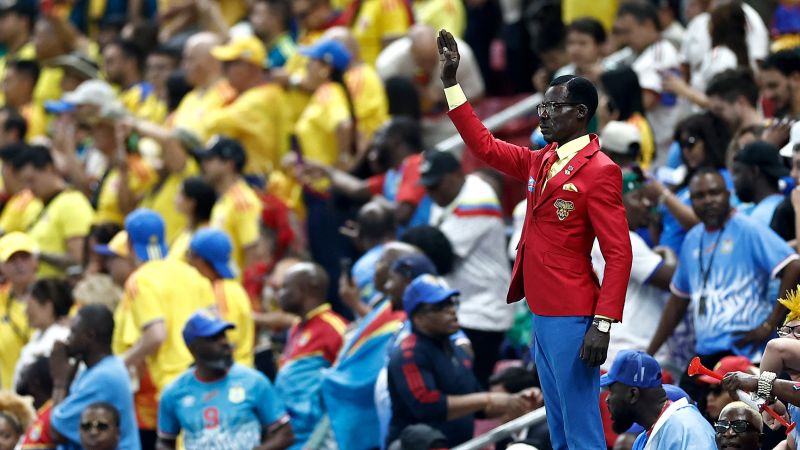
I am a living statue – The DR Congo team’s debut World Cup clash against Portugal was a momentous event, marking the nation’s return to international football after a 52-year absence. The match, played in the heart of Mexico, carried immense historical weight, not just for the players donning the iconic sky blue jersey, but for the fans who gathered in anticipation. Among them was Michel Kuka Mboladinga, a man whose silent presence on the sidelines became a defining symbol of national pride. Known as “Lumumba Vea” – a nod to Congo’s revolutionary leader Patrice Émery Lumumba – Mboladinga’s act of standing motionless for the entire duration of the game captured global attention, turning him into an unofficial 12th man for Les Léopards.
A silent guardian of unity
While thousands of supporters celebrated with chants and dances, Mboladinga chose to remain still, his right arm raised as if in a salute. This ritual, which he has repeated at every DRC national team match since the 2025 Africa Cup of Nations, serves as a tribute to the nation’s founding father. The connection between the fan and Lumumba is more than superficial; Mboladinga’s striking resemblance to the late leader, combined with his unwavering stance, has made him a living embodiment of the ideals Lumumba once championed.
“Patrice Lumumba is a symbol of unity – the one who taught Congolese to stand and to be proud,” Mboladinga said during the World Cup match. His words, though simple, carried the weight of a nation’s collective memory. Lumumba, who led Congo to independence in June 1960, was a figure whose legacy transcends politics, remaining deeply embedded in the cultural consciousness of the DRC. His assassination in January 1961, just months after independence, was a blow that resonated through generations, yet his spirit endures in unexpected ways.
The man who shaped a nation
Patrice Émery Lumumba’s life was a testament to resistance and hope. Born in 1925, he became a leader during Congo’s brutal fight for freedom from Belgian colonial rule, a struggle that began in 1885 when King Leopold II established the Congo Free State. Lumumba’s leadership in the 1960 independence movement inspired millions, and his vision of a united, sovereign Congo continues to echo today. His iconic speech on June 30, 1960, at the Palace of the Nation in Léopoldville (now Kinshasa) remains a cornerstone of national identity, where he declared, “We shall show the world what the Black man can do when working in liberty, and we shall make the Congo the pride of Africa.”
“Although this independence of the Congo is being proclaimed today … no Congolese will ever forget that independence was won in struggle,” Lumumba had said. “Morning, noon and night, we were subjected to jeers, insults and blows because we were ‘Negroes.’”
Dr. Reuben Loffman, a historian specializing in DR Congo, called the speech “one of the most important in the 20th century.” He explained that Lumumba’s words resonated beyond the borders of Africa, especially during the Cold War, when his rhetoric was interpreted as a potential threat to Western interests. “His scathing remarks of June 1960 were fundamental to his reputation, but also marked him out in the United States’ mind,” Loffman noted. “They were particularly paranoid, thinking, ‘You’re a communist.’”
Despite his political aspirations, Lumumba’s message was clear: Congo belonged to its people. Yet, his dream was short-lived. Just three months after his speech, he was ousted from power by President Joseph Kasa-Vubu. The coup set the stage for his downfall, as military forces under Mobutu Sese Seko – who later ruled for 32 years – captured him and transported him to Katanga. There, he endured torture and was executed by firing squad. His body was then discarded in a shallow grave, only to be dismembered and dissolved in acid. The only remnant of his remains was a single gold-crowned tooth, a symbol of a leader whose impact outlived his death.
A bridge between past and present
Mboladinga’s actions during the World Cup match were not merely a tribute to Lumumba but a statement about the enduring power of his ideals. By embodying the leader’s image, he transforms the game into a canvas for historical memory, ensuring that every goal and every victory is celebrated through the lens of Congo’s revolutionary past. “He’s my inspiration,” Mboladinga told CNN Sports from Mexico. “Patrice Lumumba is a symbol of unity – the one who taught Congolese to stand and to be proud.”
The DRC’s recent World Cup appearance brought a new chapter to this legacy. Yoane Wissa’s towering header in the first half was not just a goal but a moment of triumph for a nation that had waited decades to reclaim its place on the global stage. For Mboladinga, the match was a chance to reconnect the present with the struggles of the past, highlighting how sports can serve as a powerful medium for cultural and political expression. His static presence on the field, though seemingly simple, underscores the deep reverence for Lumumba, whose life and death continue to inspire.
Lumumba’s assassination was a turning point in Congo’s history, dividing the nation between those who supported his vision of a united state and those who saw him as a threat. Yet, his legacy persists in the hearts of many, including Mboladinga, who uses his platform to keep his memory alive. The DRC’s journey from colonial rule to international football is a story of resilience, and Mboladinga’s act of standing still during matches is a reminder of the sacrifices made to achieve that independence.
As the DR Congo team continues to compete, Mboladinga’s presence remains a silent but powerful testament to the leader who once stood for the nation’s freedom. His ritual, now a global phenomenon, bridges the gap between history and the present, turning the soccer field into a stage for national pride. Through his unyielding stance, he ensures that Lumumba’s spirit is not forgotten, and that the lessons of the past continue to shape the future of a nation still striving for unity and recognition.
In the end, the World Cup match against Portugal was more than a game; it was a celebration of progress, a tribute to perseverance, and a reminder of the ideals that once ignited a revolution. Michel Kuka Mboladinga, with his steady posture and outstretched hand, stands as a guardian of that legacy, ensuring that the story of Patrice Lumumba remains etched in the collective memory of the DRC. His presence on the field, though motionless, speaks volumes about the enduring power of a leader who, despite his short time in power, became an eternal symbol of hope and unity.
