
Democratic socialist holds large early lead in DC mayoral primary
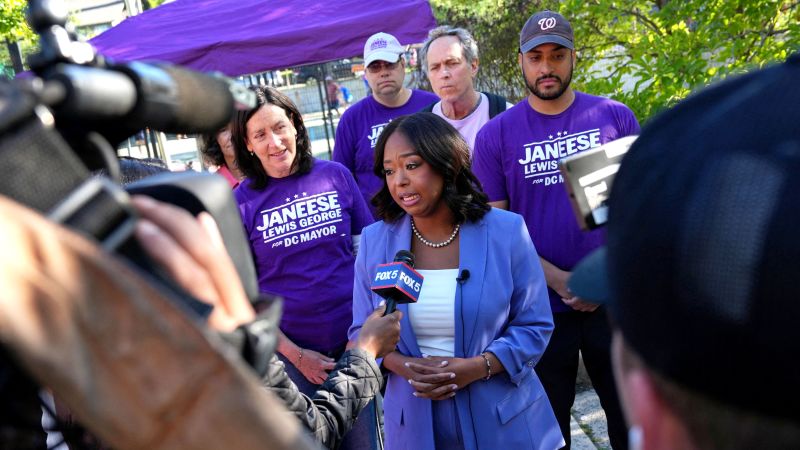
Democratic Socialist Holds Strong Lead in DC Mayoral Primary
Democratic socialist holds large early lead – Washington, D.C., is witnessing a pivotal moment in its political landscape as initial results from the Democratic mayoral primary indicate a significant early advantage for Janeese Lewis George. Running as a democratic socialist, Lewis George has positioned herself as a progressive voice in the city, emphasizing her commitment to affordable housing, enhanced government services, and a robust stance against the policies of President Donald Trump. While CNN has not yet officially projected a winner, the current standings suggest that Lewis George is well on her way to securing the nomination.
As of the latest updates, 64% of the estimated votes have been counted, with Lewis George leading the field at nearly 53%. Kenyan McDuffie, a former DC Councilmember and trial attorney under Barack Obama, trails closely behind at approximately 36%. The race is still not decided, as the remaining ballots—particularly those from mail ballot drop boxes and later-arriving mail-in votes—could shift the dynamics. This scenario introduces the possibility of ranked-choice voting, a system that could determine the outcome if Lewis George’s support dips below 50%.
McDuffie’s campaign has focused on issues such as economic equity and law enforcement reform, drawing a diverse coalition of voters. However, Lewis George’s message of affordability and government accountability has resonated more strongly with the electorate so far. The initial results reflect a broader trend of progressive voters aligning with candidates who prioritize social programs and reduced costs for residents. With the vote count still incomplete, the final outcome remains uncertain, but Lewis George’s lead appears formidable.
Broader Implications for the Democratic Race
Although Lewis George’s early lead is impressive, the significance of the results extends beyond her personal campaign. The primary serves as a barometer for the Democratic Party’s priorities in the nation’s capital, where issues of autonomy and representation have taken center stage. The second Trump administration has intensified debates over DC’s status as a federal district, with concerns about its political independence and resource allocation. Lewis George’s platform directly addresses these challenges, positioning her as a candidate who could redefine the city’s political future.
McDuffie, who previously served on the DC Council, brings a wealth of experience to the race. His background in public service and legal advocacy under Obama underscores his credibility on policy matters. However, the current vote tally suggests that his efforts to appeal to a wider electorate have not yet translated into a substantial lead. The possibility of a ranked-choice runoff adds an extra layer of complexity, as it could test the loyalty of voters who may be hesitant to support a candidate with a smaller margin of victory.
As the vote count continues, the DC Board of Elections will report additional results and, if needed, release the first set of ranked-choice outcomes on Sunday. This process highlights the intricate nature of D.C.’s electoral system, which combines mail-in voting with a structured method for resolving ties. The final outcome will hinge on whether Lewis George maintains her lead or if McDuffie can close the gap through the remaining ballots.
Delegates and the Political Climate
While the mayoral race captures much of the attention, the Democratic primary for the city’s nonvoting delegate seat in Congress is also unfolding with its own set of dynamics. CNN’s Decision Desk projects that Robert White will emerge victorious in this contest, defeating a field of notable contenders. White’s victory is seen as a reflection of his strong grassroots appeal and strategic focus on DC’s autonomy, a key issue in the current political climate.
White’s campaign centered on the idea of amplifying DC residents’ voices in Congress, despite the delegate’s limited voting power. He emphasized his work as a lead staff member on congressional oversight hearings for Eleanor Holmes Norton, the long-serving delegate who has been a prominent figure in D.C. politics for decades. Norton, who filed to end her reelection campaign in January, has faced scrutiny over her ability to represent the district effectively in a time of heightened political tension.
“Drafting legislation to loosen Congress’ grip over DC government in favor of greater autonomy and independence for DC residents,”
White quoted during his campaign, underscoring his dedication to policy changes that would enhance the city’s self-governance. His previous role as the first director of community outreach for the city’s attorney general office further highlights his experience in public service and advocacy. White’s background in law and politics positions him as a candidate who understands both the challenges and opportunities facing the district.
The delegate race included a number of high-profile figures, such as Ward 2 Councilmember Brooke Pinto, former senior Norton aide Trent Holbrook, and Kinney Zalesne, a former Democratic National Committee official. Greg Jaczko, the former chairman of the Nuclear Regulatory Commission, also entered the fray. Despite this crowded field, White’s ability to connect with voters and articulate a clear vision for DC’s future has given him a distinct edge. His victory signals a shift in the Democratic Party’s priorities, as the district’s voters increasingly support candidates who advocate for greater independence.
White’s win comes at a critical juncture for D.C. politics, with the city’s autonomy being a central theme in both local and national discourse. The delegate’s role, though nonvoting, is vital in shaping legislation and influencing federal policies that affect the district. As the political landscape evolves, the outcome of the primary could have lasting implications for the balance of power in Congress and the future of DC governance.
Looking Ahead to the Final Results
With the remaining votes still to be counted, the focus remains on the mayoral race and the delegate seat, both of which are expected to conclude by Sunday. The DC Board of Elections has confirmed that the initial set of ranked-choice results will be released at that time, providing clarity on the final standings. For Lewis George, the upcoming tally is a test of her campaign’s strength and the loyalty of her supporters, who may be divided over the city’s direction.
McDuffie, meanwhile, is positioning himself as a viable contender in the event of a runoff. His campaign has highlighted his experience in legal and legislative matters, which could be a decisive factor in a ranked-choice scenario. The size of Lewis George’s lead suggests that her support is unlikely to wane significantly, but the possibility of a close race remains, especially as voters have the opportunity to rank their preferences and adjust their choices.
As the primary results draw closer, the political energy in D.C. continues to build. The race for mayor and delegate is not only a contest of ideas but also a reflection of the city’s evolving priorities and voter sentiments. Whether Lewis George secures the nomination or if McDuffie can challenge her in a ranked-choice round, the outcome will shape the next chapter in D.C.’s political history. The broader implications for the Democratic Party and the nation’s capital will be closely watched, as the results could signal a shift in the direction of progressive governance in the region.
