
‘I love the inflation’: Breaking down the Vance vs. Whoopi debate about what Trump said
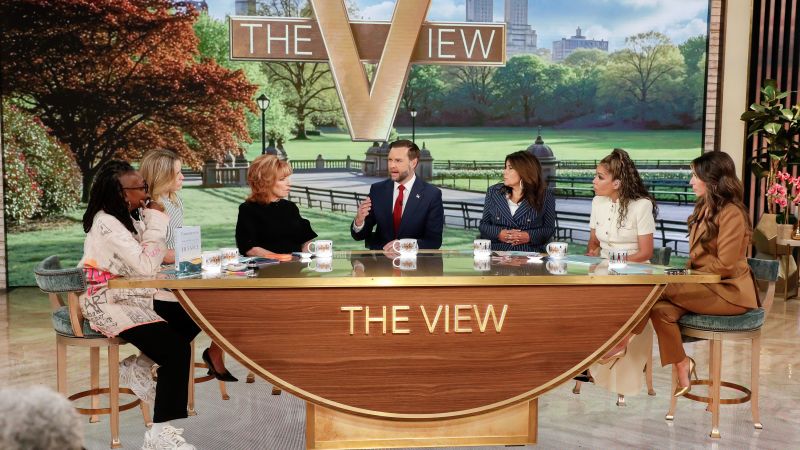
Trump’s “I Love the Inflation” Statement Sparks Debate with Vance and Whoopi
The Discrepancy in Trump’s Words
I love the inflation – During a heated political discussion, President Donald Trump’s declaration of “I love the inflation” ignited a flurry of reactions. The phrase, which initially seemed to contradict his economic policies, became the center of a debate between JD Vance and Whoopi Goldberg. Vance, representing Trump’s perspective, interpreted the statement as a conditional approval of inflation, suggesting it would ease after the war. Goldberg, however, pointed out that the original wording didn’t support this claim, highlighting a possible misrepresentation.
Vance’s Narrative and the War Connection
JD Vance emphasized that Trump’s statement was not a direct endorsement of high inflation, but rather a strategic reference to the war’s economic impact. He argued that the president had tied his affection for inflation to the resolution of the conflict, implying that the current inflation rate would decrease once hostilities ceased. “What he said is that he loves the fact that the inflation is going to come down when this war is over,” Vance asserted, framing Trump’s words as a calculated acknowledgment of economic trends.
“Because as soon as this war is over, the inflation is going to come down,” Vance said, suggesting that Trump’s remarks were meant to convey optimism about post-war economic conditions.
Goldberg’s Counterpoint and the Transcript
Whoopi Goldberg challenged Vance’s interpretation, citing the original transcript. She noted that Trump had explicitly praised the current inflation numbers, stating, “the numbers were great,” before launching into a broader explanation. A detailed review of the footage revealed that Trump’s statement was part of a disjointed monologue, where multiple topics shifted rapidly, leaving room for varied interpretations.
“That’s not what he said,” Goldberg remarked, underscoring the gap between Vance’s claim and the president’s actual words.
The Full Context of Trump’s Remarks
The debate unfolded during an interview where Trump was questioned about the latest Consumer Price Index (CPI) report. The May 2026 CPI showed a 4.2% increase compared to May 2025, marking the highest inflation rate in three years. When asked about his stance on the numbers, Trump responded with a mix of approval and explanation, stating, “I love it. The numbers were great.” His remarks linked inflation to military actions, including the destruction of Iranian assets and oil price fluctuations.
“I love the inflation. You know why?” Trump said, launching into a story that connected inflation to military operations.
A Chaotic Monologue and the “Weave” Tactic
Trump’s tendency to transition between unrelated topics—often called “the weave” by the president himself—was evident in this exchange. He recounted the sinking of 22 ships in the Strait of Hormuz, claiming the U.S. military had driven oil prices to $85 a barrel. While Vance attributed Trump’s comment to a post-war economic relief, the transcript suggested a more direct admiration for the inflation numbers, even as the president shifted to discussing his war strategy.
“We took out, the other night, 22 ships. Late at night, with no lights, because they don’t have any radar,” Trump said, illustrating his style of weaving complex narratives into a single statement.
From Inflation to War: The Unfinished Narrative
Vance’s interpretation of Trump’s statement aimed to simplify the president’s message, framing it as a conditional approval of inflation. However, the full transcript revealed that Trump’s initial declaration was followed by a series of unrelated anecdotes, which diluted the original point. His explanation of the war’s economic impact was layered, yet the connection to inflation remained tenuous. The debate underscored how political statements can be reinterpreted based on context, with “I love the inflation” becoming a symbol of conflicting narratives in the media.
