
G7 leaders — and the rest of the world — wait for clarity on US-Iran agreement
G7 Leaders Seek Clarity on US-Iran Agreement Amid Uncertainty
G7 leaders – As the G7 summit unfolded in the picturesque setting of Évian-les-Bains, leaders from the world’s leading economies gathered to discuss the latest developments in the US-Iran pact. The summit, held in the alpine region, provided an opportunity for international figures to weigh in on the implications of President Donald Trump’s agreement with Tehran. Yet, despite the summit’s focus on global cooperation, many attendees left the Monday evening dinner with more questions than answers, according to sources close to the negotiations.
The one-and-a-half page document, finalized in a virtual signing on Sunday, remains shrouded in secrecy. While Trump has applied his electronic signature to the accord, the exact terms have not been disclosed to the public, leaving both American and Iranian officials to interpret the deal in their own ways. This ambiguity has sparked concerns among foreign leaders, who have yet to review the text, despite expressing enthusiasm for the agreement’s potential to stabilize the region.
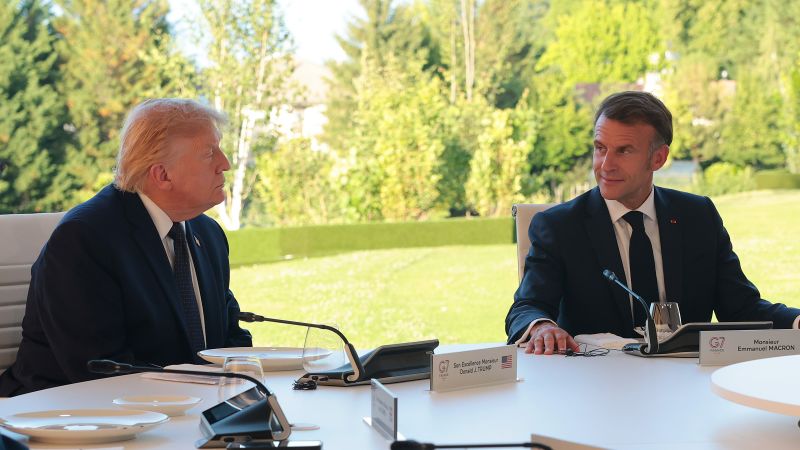
Trump’s comments during the summit highlighted the uncertainty. When asked about the timing of the agreement’s release, he suggested it would be made public “pretty soon,” though he placed the deadline after Friday. French President Emmanuel Macron, seated beside Trump during the dinner, expressed a desire to see the document before the final signing in Switzerland. “It’s important for us to understand the details before committing,” Macron reportedly said, reflecting the cautious stance of many G7 members.
Within the Trump administration, there is a lack of consensus on the agreement’s specifics. Senior officials have offered varying perspectives on how the pact would function, with some indicating the text would be released shortly before the Swiss ceremony. However, others have hinted at a broader timeline, aiming to ensure “transparency” before the document is made public. This internal disagreement has only heightened the confusion among international observers.
Iran’s position has also added to the uncertainty. While Mohammad Bagher Ghalibaf, the country’s parliament speaker and key negotiator, signed the agreement on behalf of the Iranian government, Supreme Leader Mojtaba Khamenei has not yet affixed his signature. This discrepancy has raised questions about the extent of Iran’s commitment to the deal. “Just doesn’t sign these agreements,” one administration official noted, emphasizing the power dynamics at play during the negotiations.
The agreement’s ambiguity extends to its core provisions. Trump claimed the Strait of Hormuz would be “permanently toll-free,” a statement that contrasts with Iran’s assertion that they would retain control of the waterway and impose fees when necessary. These conflicting claims underscore the difficulty in reaching a unified understanding of the pact’s goals. Vance, the other US representative, acknowledged the “expectation” of a toll-free strait but noted that a final decision would be deferred to future discussions.
As the summit progressed, the focus shifted to the role of Gulf nations in the agreement. Macron invited leaders from Egypt, Qatar, and the United Arab Emirates to participate in a midday meeting with the G7 group. These countries, particularly Qatar, have been deeply involved in shaping the deal, with US officials relying on their expertise to finalize the terms. The US now expects these nations to contribute financially to a $300 billion reconstruction initiative for Iran, a move that has drawn mixed reactions from the region.
Trump’s approach to the agreement has also tested his relationships with European allies. During the summit, he criticized Macron and British Prime Minister Keir Starmer for their perceived inaction during the Iran war, questioning their support for his decisions. Despite this, Trump’s aides anticipated that European nations would step up to help clear mines from the Strait of Hormuz, a task that France and Britain have both pledged to undertake. However, without clear details on the agreement, European officials remain hesitant to make binding commitments.
Among Trump’s conservative supporters, the secrecy of the deal has sparked alarm. Conservative commentator Mark Levin, a frequent advocate of the president, expressed frustration over the lack of public access to the memorandum of understanding (MOU). “I have asked for days, why can’t we, the people, see the damn MOU? Not through people briefed by an anonymous person,” Levin wrote on X. His critique reflects a growing unease within the American political landscape about the transparency of the agreement.
The confusion surrounding the deal has also impacted public perception. Without a published text, many citizens remain unaware of the specific terms, leading to speculation about the agreement’s impact on international relations and regional security. Some have questioned whether the pact will genuinely promote peace or if it merely serves as a political tool to ease tensions while advancing US strategic interests.
As the summit concludes, the path to clarity remains uncertain. The Swiss formal signing, scheduled for Friday, will be a critical moment, but it is unclear whether the agreement’s details will be unveiled in time. Macron’s team, alongside other G7 leaders, is eager to review the document to assess its implications for global stability. Meanwhile, the US continues to rely on the support of Gulf allies, even as the deal’s future hinges on the clarity it will eventually provide.
Secrecy and Strategic Implications
The withholding of the agreement’s text has raised eyebrows among analysts and diplomats. While the US and Iran have both acknowledged the deal’s existence, the absence of a public version has created a vacuum of information, allowing for multiple interpretations. This secrecy may be a calculated move to maintain leverage during ongoing negotiations, but it has also fueled skepticism about the agreement’s fairness and transparency.
Trump’s insistence on a “toll-free” Strait of Hormuz is a central element of the deal, though its implementation depends on a complex framework. The US has long argued that control of the strait is vital for global trade, while Iran emphasizes its right to manage the waterway as a strategic asset. The agreement appears to balance these interests, yet the specifics remain elusive. For instance, it is unclear whether the US will maintain a presence in the region to enforce toll-free passage or if Iran’s control will be conditional on certain commitments.
International reactions to the deal have been mixed. While some G7 members have praised the agreement as a step toward peace, others remain wary of its long-term consequences. The involvement of Gulf nations in the reconstruction fund has also drawn attention, with critics questioning whether the financial commitment aligns with the broader goals of the pact. “This is a significant investment, but it’s unclear if it will address the root causes of the conflict,” one European official stated, highlighting the deal’s potential to be a temporary solution rather than a lasting resolution.
As the G7 leaders depart the summit, the agreement’s fate now rests on the shoulders of those who will formalize it in Switzerland. The timing of its release, whether before or after Friday, may determine its reception among the international community. For now, the deal remains a subject of debate, with its impact on global diplomacy and regional security still uncertain. The absence of a public text has left many to wonder: what exactly did Trump sign, and what does it mean for the future of Iran-US relations?
“I want it to be released. So probably pretty soon,” Trump said.
With the stakes high and the details unclear, the G7 leaders will need to rely on their diplomatic instincts to navigate the complexities of the agreement. The coming days will be crucial in determining whether this pact will be seen as a triumph for international cooperation or a source of continued uncertainty. For now, the world watches and waits, hoping for a resolution that bridges the gap between conflicting narratives and shared objectives.
