
A submersible ride revealed a vast whale graveyard. And it holds more than just bones
A submersible ride revealed a vast whale graveyard. And it holds more than just bones
A submersible ride revealed a vast – A team of researchers recently ventured to a secluded region of the southeastern Indian Ocean, uncovering one of the largest and deepest whale graveyards ever documented. The site, located in the Diamantina Zone, contains hundreds of fossilized remains, including a specimen that may represent an entirely new species. What makes this discovery even more remarkable is the presence of both ancient and modern whale skeletons, indicating that this underwater necropolis has been accumulating remains for at least 5 million years.
Massive Accumulation of Remains
Scientists observed that the graveyard spans approximately 746 miles (1,200 kilometers) in length, with bones scattered across a vast expanse. Some areas within the zone hold around 760 remains per square kilometer—a density far exceeding previous records from similar deep-sea sites. The team estimates that over 10 million whale remains lie on the ocean floor, though even more could be hidden beneath layers of sediment.
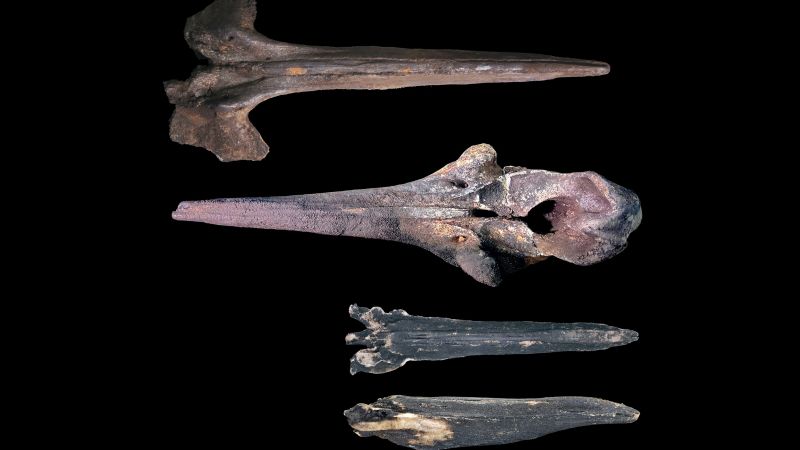
The site’s uniqueness lies in its continuous accumulation of bones. Fossil skulls found nearby, snagged by trawlers or fishing vessels off Iberia, South Africa, and the Kerguelen Islands, suggest that beaked whales have long been associated with this region. These deep-diving creatures, known for their slender snouts and elusive nature, rarely surface, making their remains rare in the fossil record. However, the Diamantina Zone appears to be a hotspot for their carcasses, which have settled there for millennia.
Whale Falls: A Deep-Sea Ecosystem
Among the ancient bones, researchers also encountered modern whale carcasses, some of which still bore scavengers. Known as “whale falls,” these decaying bodies provide critical nourishment for deep-sea communities, sustaining a range of organisms from bone-eating worms to chemosynthesis-dependent bivalves. The study authors noted that many of these species might be entirely new to science, highlighting the ecological significance of the site.
“Until now, whale falls were mostly based on large cetacean carcasses, mostly baleen whales,” said Olivier Lambert, a vertebrate paleontologist at the Royal Belgian Institute of Natural Sciences in Brussels. “Here the authors show that beaked whale carcasses can play a similar role in some specific deep oceanic regions.”
Lambert, who was not part of the expedition, emphasized that the graveyard’s scale is extraordinary. “It isn’t entirely surprising to learn that a graveyard full of whale bones has been accumulating for millions of years,” he added. “This ocean region is known to host numerous species of beaked whales, and fossil skulls have been discovered nearby. But the sheer number of remains in this one location is still stunning.”
Exploration of the Deep
The discovery was made during a mission under the Global Hadal Trench Exploration Program, an international effort to study Earth’s most unexplored oceanic depths. The team used the research vehicle Tan Suo Yi Hao, equipped with the submersible Fendouzhe (“Striver” in Chinese), which had previously descended to the Challenger Deep in the Mariana Trench in 2020. This vehicle allowed the researchers to navigate the extreme depths of the Diamantina Zone, which reaches 15,000 to 23,000 feet (5,000 to 7,000 meters) below sea level.
The expedition conducted 32 dives between February and March 2023, during which the team documented 485 fossil deposits and identified five modern whale falls. One of the most striking findings was the density of remains in certain areas, with scavengers actively feeding on the more recent carcasses. For instance, a single whale fall was observed hosting up to 2,800 organisms, including long-armed brittle stars and snails that thrive on decomposing tissue.
Geological Origins and Ongoing Research
The Diamantina Zone itself is a geological marvel, formed between 30 and 40 million years ago during the separation of the Australian and Antarctic landmasses. Its deep-sea trenches and ridges create an environment where whale remains can accumulate over time, shielded from surface disturbances. The site’s age and location suggest it has been a natural repository for marine life for an extended period, offering a window into the evolutionary history of whales and other deep-sea creatures.
“Although this is a truly massive whale graveyard, reaching it is extremely difficult due to the great depth,” said Peng Zhou, a co-lead author of the study and researcher at the Institute of Deep-Sea Science and Engineering (IDSSE) in Beijing. “The sheer scale of the remains and their distribution across the site were unexpected.”
Zhou and his colleagues used a combination of imaging and robotic sampling to document the graveyard. The submersible’s robotic arm collected 43 fossils, while a specialized device called a slurp sampler gathered samples of scavengers. The process was challenging, requiring precise navigation through the abyssal terrain. “When we first observed this site, it came as a complete surprise to everyone,” Zhou recalled. “And then we saw the little head.”
The discovery has sparked new interest in understanding how deep-sea ecosystems function. Whale falls are known to support unique biodiversity, but the Diamantina Zone’s concentration of both ancient and modern remains offers an unparalleled opportunity to study the long-term dynamics of these habitats. Scientists are particularly intrigued by the possibility that the site hosts species previously unknown to science, which could reshape our understanding of deep-sea life.
Implications for Paleontology and Marine Biology
The graveyard’s persistence over millions of years raises questions about the environmental and biological factors that contribute to such a phenomenon. Beaked whales, which are deep-diving and less frequently seen, may be more susceptible to sinking into this specific area than other whale species. This could explain the high density of their remains, which contrasts with the more scattered fossils of baleen whales.
Further research is needed to determine the exact mechanisms behind the graveyard’s formation. The presence of modern whale falls suggests that the site remains active today, bridging the gap between past and present. “This discovery underscores the importance of deep-sea exploration in uncovering hidden aspects of marine ecosystems,” Zhou said. “It’s a reminder that even in the most remote areas, life continues to thrive in ways we’ve only begun to understand.”
The Diamantina Zone’s findings also highlight the role of deep-sea environments in preserving evolutionary history. By studying these remains, scientists can trace the development of whale species and their interactions with the deep ocean. The graveyard may serve as a natural archive, revealing how these creatures have adapted to extreme conditions over time.
As the research continues, the Diamantina Zone promises to yield more insights into the mysteries of the deep. Its vast expanse and the continuous flow of whale remains suggest a dynamic, self-sustaining ecosystem that has endured for millions of years. For now, this underwater necropolis stands as a testament to the resilience and complexity of life in Earth’s deepest waters.
