
The website where crypto promoters pay people to tattoo ads on themselves
The Website Where Crypto Promoters Pay People to Tattoo Ads on Themselves
A Crypto Bounty in Chennai
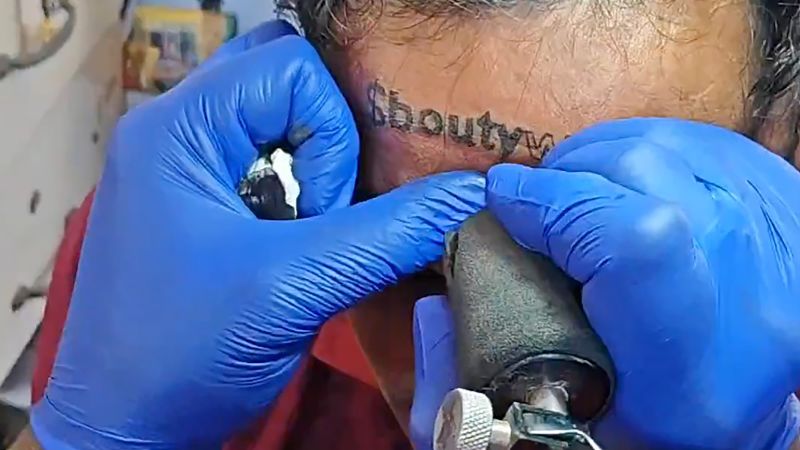
The website where crypto promoters pay people – In early June, a man with a receding hairline entered a tattoo parlor located on a Chennai beach, showing the owner a message on his phone screen. With a video camera capturing the moment, he agreed to have a line of text permanently inked across his forehead. The man, identified as Arivu, was following a directive posted by Ayush, a 21-year-old in Florida, on Pump.fun, a cryptocurrency trading platform. In exchange for the tattoo, Ayush promised to compensate him with approximately $3,000 worth of crypto. Arivu, who requested privacy, declined to share his full name.
Pump.fun and the Memecoin Economy
Pump.fun specializes in the creation and exchange of memecoins—cryptocurrencies with little intrinsic value, often driven by internet trends. The platform’s business model relies on the attention economy, where users compete to amplify the visibility of their digital assets. Last week, Pump.fun introduced a new initiative called Pump.fun GO, allowing individuals to set public bounties in crypto for completing specific tasks. The feature’s description on X (formerly Twitter) highlighted its global reach: “Pay ANYONE to do ANYTHING. Create & complete bounties for ANY task and leverage the power of humans & money across the globe.”
The Incentive for Permanent Disfigurement
The concept of paying for self-disfiguration may seem unusual, but for some, it’s a lucrative opportunity. Ayush’s request to Arivu, which involved tattooing a cryptocurrency promotion on his face, underscores how the platform turns personal branding into a transaction. “I was just shocked, but at the same time that $3,000 is him working for 5 years,” Ayush shared in a direct message on X. Similarly, Jordan, a 27-year-old Toronto-based artist using a pseudonym, accepted a $3,000 reward for getting a tattoo advertising a crypto casino on his leg. “I’m struggling financially, and my girlfriend is a tattoo artist, so it was a little easier for me,” Jordan explained.
Bounties and Moderation Challenges
Pump.fun GO operates by connecting bounty creators with individuals willing to perform tasks, often requiring social media proof. Arivu’s case involved posting a video of his tattoo session to X, a common practice to validate transactions. However, the platform’s popularity has raised concerns about its potential for exploitation. Vetle Lunde, head of research at K33, a crypto analysis firm, noted that Pump.fun has long thrived at the intersection of controversy and the internet’s attention-driven economy. “During the memecoin frenzy of 2024, Pump.fun’s livestreams became infamous for encouraging extreme behavior, such as threats of self-harm or animal abuse,” Lunde remarked.
A Diverse Range of Tasks
The variety of tasks available through Pump.fun GO highlights its adaptability. Some bounties are seemingly benign, like a user who earned over $300 for visiting a McDonald’s and sharing proof on social media. Others, however, have taken on more dramatic forms. In one instance, a user offered 15 Solana—equivalent to about $1,000—to bail out a jailed individual. A video captured the process, showing the user paying $35 bail for a 70-year-old homeless man named Dickie Schultz in Lincoln, Nebraska, and providing him with food and transportation to a shelter. Yet, the platform’s reach extends to more unsettling endeavors, such as a bounty of 10,000 Solana (around $690,000 at the time) for someone to film their own suicide. The listing has since been removed, but it remains a striking example of the platform’s potential for radical incentives.
Legal Ambiguity and Anonymity
The legal framework governing these bounties is unclear. Cryptocurrency’s pseudonymous nature complicates accountability, making it easier for users to engage in activities without immediate consequences. “The greater the precarity and vulnerability of a given population, the more predatory instincts emerge,” said Nicholas Vrousalis, a philosophy professor at Erasmus University in Rotterdam. His book, “Exploitation as Domination,” explores how economic disparities fuel such practices. Vrousalis pointed to Pump.fun’s history of incentivizing extreme actions, from violence to shock content, as evidence of its role in amplifying risk-taking behavior.
Pump.fun’s Response to Criticism
Following backlash over its livestreams, Pump.fun temporarily halted the feature, citing the need for better moderation. The platform later reintroduced the service with revised policies, banning violent, harassing, or sexually explicit content. Despite these changes, the bounty system has quickly evolved into an exploitative marketplace, according to Vrousalis. “Even with moderation, the lure of quick money often overshadows ethical considerations,” he observed.
The Human Cost of Crypto Fame
For individuals in regions with low wages, the rewards offered by Pump.fun can be transformative. Laborers earning less than $10 daily are now being asked to trade their appearance for cryptocurrency. This dynamic raises questions about consent and the pressures of financial necessity. “It’s not just about money—it’s about visibility,” said one user who participated in multiple bounties. “People want to be part of the crypto movement, even if it means altering their bodies.” The platform’s success hinges on its ability to tap into this desire for recognition, often at a personal cost.
A Lack of Response from Key Figures
As of now, Pump.fun’s co-founder, Alon Cohen, has not responded to multiple inquiries about the platform’s initiatives. Social media accounts and email addresses associated with the company remain silent, leaving users to speculate about its intentions. Stephen D. Palley, Cohen’s lawyer, stated via phone that he was unable to comment further, adding to the mystery surrounding the platform’s operations. Without clear communication, the potential for misuse continues to grow, with users navigating a landscape where attention is the ultimate currency.
Amid this trend, the broader implications of crypto-driven bounties are becoming apparent. While some tasks are mundane, others challenge the boundaries of human behavior, reflecting the platform’s ability to turn everyday actions into digital marketing tools. As the memecoin economy expands, Pump.fun GO may serve as a microcosm of how cryptocurrency can reshape labor and self-expression, creating a new era of influencer culture where the body itself becomes a billboard for virtual wealth.
What began as a simple transaction—paying for a tattoo—has evolved into a global phenomenon, where individuals trade their time, effort, and even their appearance for crypto rewards. The platform’s success in connecting creators with performers underscores the power of decentralized incentives, yet it also highlights the growing tensions between financial gain and personal sacrifice. As Pump.fun continues to experiment with new features, the question remains: How far will users go to secure a share of the digital economy’s fleeting rewards?
