
The underground tunnel village where Vietnamese people lived for years to hide from war
The Underground Tunnel Village: Vịnh Mốc’s Hidden Legacy
The underground tunnel village where Vietnamese – Nestled in central Vietnam, the underground tunnel village where residents once hid from the Vietnam War stands as a remarkable testament to human ingenuity and perseverance. Today, Vịnh Mốc is a peaceful coastal village with bustling markets and quiet storefronts, but beneath its surface lies a labyrinth of tunnels that safeguarded hundreds of families during decades of conflict. This network of subterranean shelters, crafted with simple tools, allowed communities to endure relentless bombing while maintaining their daily lives.
A Coastal Village Reborn in Stone
Before the war, Vịnh Mốc was a serene fishing town in Quảng Trị province, its charm defined by rice paddies, basalt cliffs, and the South China Sea’s golden waves. Life was shaped by the tides and the seasons, far removed from the chaos of war. However, the 1954 Geneva Accords divided the country, creating the Demilitarized Zone (DMZ) and setting the stage for the Vietnam War. Vịnh Mốc’s location near the DMZ made it a strategic target, prompting its transformation into a subterranean stronghold.
The decision to build the tunnels was driven by necessity. “We had no choice,” explains Văn Ngọc Vũ, a local tour guide. “Every day, bombs rained down, and the surface was too dangerous.” The community’s expertise in digging small shelters, honed through generations, became the foundation for an extensive underground network. This system, unique to Vịnh Mốc, allowed families to survive for years despite constant bombardment and displacement.
Engineering a Fortress Beneath the Earth
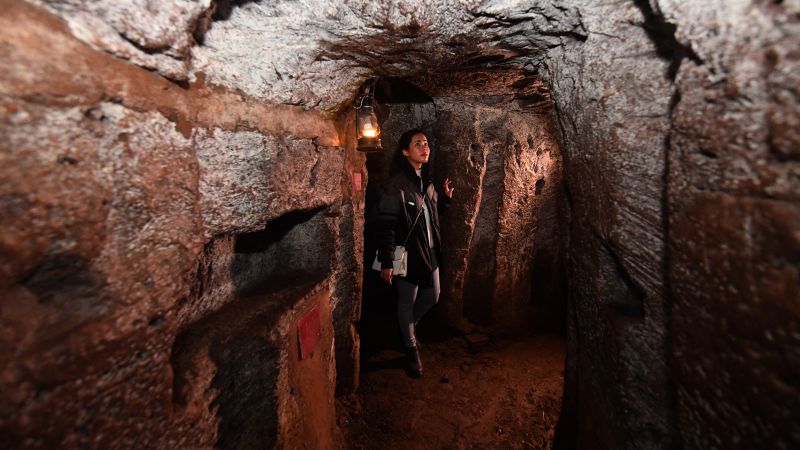
Construction of the tunnel village began in 1965 and took two years to complete, led by Lê Xuân Vy, a border police commander. The design was meticulous, with wide tunnels accommodating entire households and zigzag paths to deflect blast waves. Arched ceilings and reinforced walls provided added security against shrapnel and gunfire. “These tunnels weren’t just for hiding—they were built to support life,” says Vũ. “We had kitchens, bedrooms, and even storage spaces for food and supplies.”
Strategic exits were critical to the system’s survival. Thirteen entrances connected the underground complex to farmland and the sea, enabling discreet supply lines to Cồn Cỏ Island, a key logistics hub. Water sources were also carefully integrated, with wells ensuring fresh supplies while cross-ventilation systems kept the air breathable. This engineering marvel transformed Vịnh Mốc into a self-sustaining sanctuary, where families endured the war’s violence while preserving their traditions and routines.
Life in the Shadows: A Claustrophobic Yet Resilient Existence
Living underground during the war meant trading the open sky for dim, damp tunnels. The narrow corridors and low ceilings created a sense of confinement, but residents adapted with ingenuity. Niches in the walls served as sleeping quarters, while communal spaces allowed for cooking and gatherings. “It was a way to stay safe, but also to keep our culture alive,” shares Trần Nam Trung, a former Communist Party official. “We didn’t let the war take our identity.”
Despite the challenges, the tunnel village became a symbol of resilience. Families navigated the darkness with borrowed light and makeshift tools, turning survival into a daily practice. The tunnels, once a necessity, now serve as a powerful reminder of the Vietnam War’s impact and the enduring spirit of the people who lived through it. “Every inch of these tunnels tells a story of struggle and hope,” says Trần My Hoa, a guide from Connect Travel. “They’re not just history—they’re a living memory.”
“The tunnels were more than just shelters—they were a complete living environment,” notes Hoa. “Every detail was planned to support survival.”
