
DNA reveals identities of 4 sailors from doomed 1845 Franklin expedition
Genetic Breakthrough Unlocks Secrets of the 1845 Franklin Expedition
DNA reveals identities of 4 sailors – For over 160 years, the fate of the 1845 Franklin expedition has captivated historians and scientists alike. Recently, a team of researchers has made a significant advancement by identifying the remains of four crew members through DNA analysis. By comparing genetic material from the bones to living relatives, they have not only confirmed the identities of these sailors but also resolved a long-standing confusion in their records. This discovery marks a pivotal moment in unraveling the mysteries of the ill-fated Arctic voyage that ended in tragedy.
The Tragic Voyage of Sir John Franklin
Sir John Franklin’s 1845 expedition aimed to chart the Northwest Passage, a crucial maritime route through the Arctic that would connect the Atlantic and Pacific oceans. This passage, located north of the Canadian mainland, was highly sought after by British naval officers, traders, and polar adventurers, as it promised a more direct trade path between Europe and Asia. The expedition set sail with two ships, the HMS Erebus and the HMS Terror, and 129 crew members. However, the journey quickly turned disastrous when the vessels became frozen in Arctic ice for nearly two years. By April 1848, most of the crew had abandoned the ships, leaving just 105 men stranded on the west coast of King William Island, now part of Nunavut in Canada.
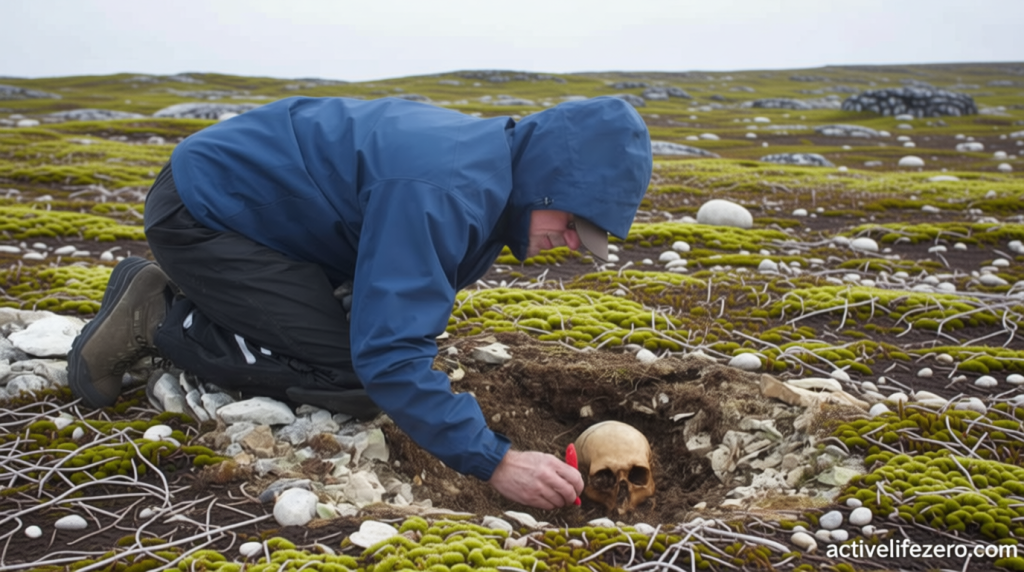
Despite their efforts, the survivors did not endure the harsh conditions. The expedition’s remains, including scattered bones and artifacts, were later discovered across King William Island and the Adelaide Peninsula. Yet, for decades, connecting these fragments to specific individuals proved elusive. The lack of complete skeletons and the passage of time made it difficult to determine which bones belonged to which crew members. However, recent genetic research has offered a new approach to this enigma.
Connecting Bones to Families
Dr. Douglas Stenton, a lead author of the study and adjunct professor of anthropology at the University of Waterloo, explained that the team’s work involved a meticulous process. “We had to track down people who were directly related to a member of the Franklin expedition with an uninterrupted inheritance of DNA from one generation to the next,” he said. This method allowed scientists to match genetic markers from the remains to living descendants, ultimately identifying three additional crew members from the HMS Erebus and one sailor from the HMS Terror.
The breakthrough came after a combination of archaeological work and genetic analysis. Researchers had previously studied the remains to determine age, sex, and physical conditions, selecting specific bones and teeth for DNA testing. The samples were analyzed at the Paleo-DNA Laboratory at Lakehead University in Thunder Bay, Ontario. Once the genetic profiles were complete, the team could cross-reference them with the DNA of descendants, providing a clearer picture of who each skeleton was.
Among the identified sailors was James Fitzjames, the captain of the HMS Erebus, whose remains showed evidence of cannibalism. This finding added another layer to the expedition’s grim story. The DNA matches also corrected earlier misidentifications, ensuring that the crew members’ stories were accurately reconstructed. As more descendants contribute their genetic data, the researchers hope to uncover further details about the expedition’s fate.
Uncovering Wreck Sites with Modern Technology
The identification of the remains was made possible by advancements in technology and collaboration with Indigenous communities. In 2014, the HMS Erebus was located using sonar imaging and oral traditions shared by the Inuit. A year later, the wreck of the HMS Terror was found through similar methods. These discoveries allowed teams to begin the process of excavating the site and recovering artifacts.
Dr. Stenton, who served as Nunavut’s heritage director in 2008, led the on-site investigation. He and his colleagues mapped the Franklin sites using photography and lidar technology, spending about six weeks each year between 2008 and 2023 on the project. “Once you get hooked by the Franklin expedition, you want to keep going back to try and find as many more pieces of the puzzle as possible,” he noted. The team also collected artifacts for conservation, ensuring they could be studied in greater depth.
The collection of remains was granted permission in 2013, allowing researchers to preserve the evidence for future analysis. Stenton emphasized the importance of combining traditional methods with modern science. “We wanted to think about how we might be able to contribute to work that others had done before us,” he said. By introducing genetic analysis, the team added a new dimension to the expedition’s story, bridging the gap between historical records and physical remains.
Legacy of the Franklin Expedition
The Franklin expedition remains one of the most infamous events in polar exploration history. Its failure has sparked countless theories about the causes of the crew’s demise, ranging from scurvy to lead poisoning. The recent DNA findings offer a fresh perspective, helping to clarify who was aboard the ships and how they perished. “We are trying to add more pieces to the puzzle, the genetic side of it, since it hadn’t been done before,” Stenton said. His words highlight the significance of this work, which is now reshaping our understanding of the tragedy.
The genetic analysis also underscores the role of family history in solving historical mysteries. As more descendants share their DNA, the research team is gaining insights into the lives of those who never returned home. This connection between past and present is particularly meaningful for the families of the sailors, who have long been part of the story’s emotional core. “Something that I like about this is that chapter is helping to be written by the families of the men who never made it home,” Stenton added. His statement reflects the collaborative nature of the research, where genetic data and personal histories converge to fill in the gaps.
The Arctic shipwreck, once a frozen relic of the past, is now revealing new chapters of its history. The combination of sonar technology, oral traditions, and genetic analysis has transformed the search for answers into a multidisciplinary effort. While the Franklin expedition is often remembered for its failure, these discoveries are providing a more complete narrative. The identification of the four sailors, in particular, serves as a testament to the power of modern science in resurrecting the stories of those lost to history.
As the research continues, the team remains optimistic about uncovering the reasons behind the crews’ decision to abandon the ships. The DNA revelations are not just academic achievements—they are personal stories that connect the past to the present. Through their work, the researchers are bringing closure to a 166-year-old mystery, one bone at a time. The Franklin expedition, though tragic, continues to inspire new ways of exploring the Arctic and its secrets, ensuring that its legacy lives on in both history and science.
