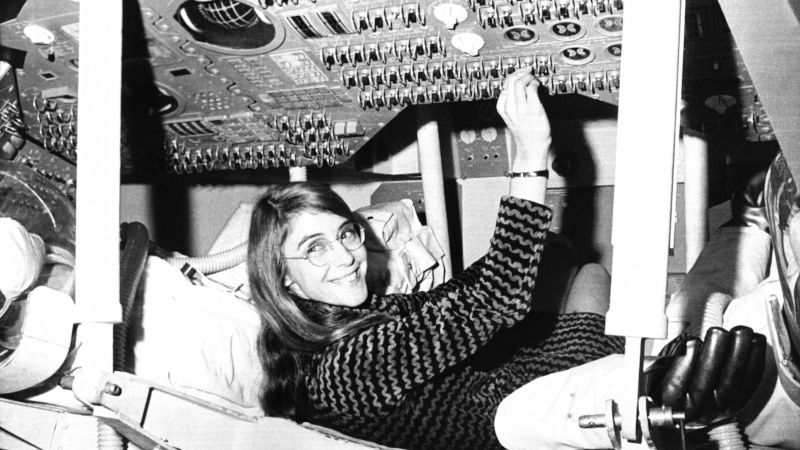
Margaret Hamilton, whose software helped land Apollo astronauts on the moon, has died

Daftar Isi
Margaret Hamilton’s Apollo Software Legacy Endures After Her Death at 90
Activelifezero.com – Margaret Hamilton, a computer scientist whose work was central to the Apollo program’s journey to the moon, has died at the age of 90. Her career helped define how complex software could be designed, tested and trusted in situations where failure was not an option.
The Massachusetts Institute of Technology, where Hamilton spent much of her professional life, confirmed her death through its Department of Aeronautics and Astronautics. No cause of death was disclosed.
Hamilton’s influence reached far beyond a single NASA project. She is widely recognized as a foundational figure in software engineering, both for the systems she helped build and for advancing the idea that software development should be treated as a rigorous professional discipline.
A critical role in the Apollo era
Hamilton joined MIT in 1959 and remained there until the middle of the 1970s. During that period, she became manager of the Software Engineering Division at the MIT Instrumentation Laboratory, an organization deeply involved in the technology behind the Apollo missions.
In 1961, the division received a NASA contract connected to the Apollo effort. Hamilton eventually directed a group of 100 engineers responsible for creating software that would help guide the agency’s lunar missions. The work formed part of the larger technical system that enabled astronauts to travel to the moon during the intense space competition of the 20th century.
The achievement demanded more than writing instructions for a computer. Apollo software had to operate within a mission environment involving limited computing resources, demanding schedules and decisions that could carry extraordinary consequences. Hamilton and her team worked on software for one of the most technically ambitious undertakings ever attempted.
Her contribution is especially notable because the profession itself was still developing. At the time, computer programming was not yet widely understood as the specialized engineering field it would become. Hamilton helped establish standards of thinking about software as a discipline requiring careful planning, organization and accountability.
Helping name a profession
Hamilton is credited with coining the term “software engineering,” a phrase that reflected her conviction that software should be built with the same seriousness applied to other branches of engineering. The term was not merely a description of code. It expressed the need for dependable methods when programs were expected to support complicated, high-stakes systems.
Today, software engineering is embedded in nearly every part of modern life, from communications and transportation to medicine, finance and scientific research. Hamilton’s Apollo work remains a prominent example of why dependable software matters: carefully designed programs can become an essential part of a mission’s success.
Her leadership also carried significance in an era when women were often excluded from recognition in technical fields. Hamilton became known for work that combined scientific skill with managerial responsibility, leading a large team while contributing to a project that captured global attention.
“To say Margaret Hamilton was a pioneer — to say she was ahead of her time — would be a dramatic understatement,” said Olivier de Weck, the Apollo Program Professor and interim head of the MIT Department Aeronautics and Astronautics.
“She was a software engineer at a time when that field was in its infancy, and she not only developed advanced code herself but also led a team in using that nascent technology to develop one of the most complex systems humanity had ever achieved.”
Recognition for a historic contribution
Hamilton received the Presidential Medal of Freedom in 2016 from President Barack Obama, honoring her contributions to science and space exploration. The award placed her work within the broader story of American innovation and the people whose expertise made the Apollo missions possible.
The moon landings are often remembered through images of astronauts, rockets and mission control rooms. Hamilton’s career is a reminder that the achievement also depended on engineers who built the invisible systems operating behind those images. Software had to translate human plans and technical measurements into instructions that spacecraft could use during a journey far from Earth.
Her legacy remains relevant as software takes on an ever-larger role in exploration and daily life. The principles associated with engineering reliable programs continue to matter whenever computers are asked to support complicated tasks, particularly where precision and safety are essential.
Hamilton’s death marks the loss of a defining figure from the Apollo generation. Yet the field she helped shape continues to reflect the importance of her work: ambitious technology depends not only on bold ideas, but also on disciplined engineering capable of making those ideas function in the real world.
Related Reading
Frequently Asked Questions
What is Margaret Hamilton whose software helped land?
Margaret Hamilton whose software helped land is the main topic of this guide. The article explains the context, practical details, and next steps readers should understand.
Why does Margaret Hamilton whose software helped land matter?
Margaret Hamilton whose software helped land matters because readers are looking for a useful answer, not just a short summary. Good content should match search intent and help them decide what to do next.