‘A five-alarm fire’ confronts President Trump in red-state October blitz

Daftar Isi
Trump Takes Midterm Campaign to Republican Strongholds as Party Anxiety Grows
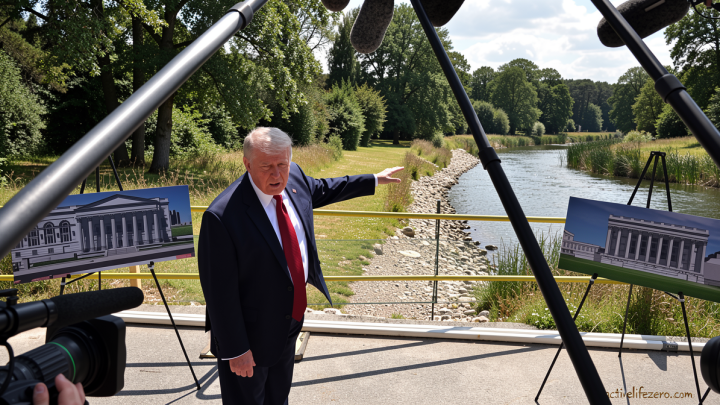
Activelifezero.com – President Donald Trump opened a new stretch of midterm campaigning in Grand Island, Nebraska, using a rally in one of the country’s most Republican regions to urge supporters to protect GOP control in Washington.
The visit comes as Republicans confront difficult political conditions less than two years after Trump carried Nebraska by 20 points. His itinerary has increasingly centered on states where he won comfortably, reflecting an effort to energize loyal voters while the party faces expanding contests for Congress.
Addressing a receptive audience at the Nebraska State Fairgrounds, Trump cast the campaign in sweeping terms and leaned into the identity of his political movement.
“Everyone here tonight is part of the greatest political movement in the history of the country,” Trump told cheering supporters. “MAGA, MAGA, MAGA!”
Grand Island sits in Nebraska’s 3rd Congressional District, a vast, deeply conservative district that includes 80 of the state’s 93 counties. Trump received 76% of the vote there in 2024. Agriculture and cattle production are central to much of the region’s economy, making the stop a natural setting for a president looking to reinforce support in rural Republican territory.
A Campaign Route Through Friendly Territory
Trump’s recent schedule illustrates the political challenge facing his party. Over roughly a week, he traveled through Texas, Oklahoma, Alabama, Ohio and Nebraska before returning to Texas. Each of those states backed him by double-digit margins in 2024.
Rather than spending his time primarily in the closest congressional battlegrounds, Trump has focused on places where large crowds and dependable supporters can help generate enthusiasm ahead of Election Day. The approach underscores how urgently Republicans are seeking turnout from their base.
At a weekend event in Ohio, Trump delivered a blunt message to voters.
“Just get out and vote,” Trump told the crowd. “If you do that, we’re going to win and we’re going to win big. And we’re going to shove it up their ass.”
Trump has also acknowledged a familiar historical obstacle for presidents: the party occupying the White House often struggles in midterm elections. In 2006, President George W. Bush visited Grand Island just two days before an election that ultimately ended Republican control of both the House and Senate for the final two years of his presidency.
Trump himself faced a divided result in his first midterm contest. Republicans lost the House in 2018, though they narrowly increased their Senate majority. This year, the stakes are again high, especially as a difficult economic environment and the continuing war in Iran weigh on the political landscape.
“Whether you have a great president or not, Republican or Democrat, they don’t do well in the midterms,” Trump said at a Friday event in Mobile, Alabama. “I don’t know why. Nobody’s explained it.”
Nebraska’s Senate Contest Draws National Attention
The Grand Island rally was designed in part to assist Republican Sen. Pete Ricketts, who is facing independent candidate Dan Osborn. The Senate race has become one of the contests contributing to Republican concerns about holding their majority, where the party has little room for losses as more seats become competitive.
Ricketts has pointed to fuel costs as a major concern for voters in Nebraska, particularly in a state where long distances and agricultural activity can make energy prices especially consequential for households and businesses.
“There’s no doubt that high fuel prices put a strain on the budgets for every Nebraska family,” Ricketts said, adding that he welcomed the president’s visit. “That’s one of the things I hear when I travel the state.”
Osborn, a former union leader, is making another statewide bid after losing to Republican Sen. Deb Fischer by fewer than seven percentage points in 2024. This time, Democrats have chosen not to field a candidate against him, an intentional strategy aimed at consolidating opposition to Ricketts behind the independent challenger.
That decision gives the race an unusual structure. Instead of a conventional Republican-versus-Democrat contest, Ricketts must defend his seat against a candidate attempting to assemble support from voters dissatisfied with both major parties. In a closely divided Senate, even a contest in a state with a strong Republican history can carry national consequences.
The Competitive District Trump Did Not Visit
Trump’s Nebraska trip did not include the state’s two other congressional districts, including the highly competitive 2nd District centered on Omaha. Often called the “blue dot,” the district was one of only three Republican-held districts nationwide that Trump lost in 2024.
Rep. Don Bacon’s retirement has intensified the competition there. Major Democratic and Republican super PACs each cut more than $1 million from their planned spending in the race on Monday, while Democrats have expressed confidence that they can flip the seat.
The contrast between Trump’s overwhelming support in the 3rd District and the uncertainty surrounding Omaha highlights Nebraska’s unusual political map. Its rural areas remain among the most reliably Republican places in the nation, while the 2nd District has become a closely watched test of whether Democrats can make inroads in a state otherwise dominated by the GOP.
For Trump, the Grand Island rally offered a politically safe setting to rally supporters and spotlight Republican candidates. For his party, however, the broader campaign remains far less secure. Financial advantages in many battleground states may help Republicans compete, but Democratic concerns about being outspent on television advertising are matched by GOP unease over the economy, the war in Iran and the traditional midterm backlash against the party in power.
One Republican member of Congress described the atmosphere in especially stark terms.
“This is a five-alarm fire,” the lawmaker said. “We always welcome the president, but I don’t know if he’s aware of the feelings out here.”
Related Reading
Frequently Asked Questions
What is A five alarm fire confronts President?
A five alarm fire confronts President is the main topic of this guide. The article explains the context, practical details, and next steps readers should understand.
Why does A five alarm fire confronts President matter?
A five alarm fire confronts President matters because readers are looking for a useful answer, not just a short summary. Good content should match search intent and help them decide what to do next.