CNN, MS NOW and Politico to sue Trump administration over White House access

Daftar Isi
Three Major News Organizations Challenge White House Access Ban
Activelifezero.com – CNN, MS NOW and Politico are moving to restore White House access after President Donald Trump barred the three news organizations from the complex, setting up an urgent First Amendment dispute that could reach a federal judge in Washington this week.
The outlets said Monday that they had informed the government of their plans to file suit in the US District Court for the District of Columbia. Their legal action seeks emergency relief following the loss of credentials for reporters whose work Trump characterized as unfavorable.
“This morning, we notified the government that we are filing a lawsuit today to protect our First Amendment rights and defend the principle that the government does not decide what the press reports or publishes,” the three organizations said in a joint statement.
The dispute concerns more than physical entry to a government building. White House credentials allow journalists to work from designated press areas, cover events on the grounds, use broadcast positions and participate in the press pool system. Pool coverage is particularly important when access is limited, because participating outlets gather information and images that are shared more broadly with other newsrooms.
The organizations said the White House withdrew their credentials without advance warning or a procedure for challenging the decision. They argued that the action threatens both independent reporting and the public’s ability to receive news about the federal government without officials deciding which coverage is acceptable.
“Without notice or process, the White House revoked our journalists’ credentials because it objected to our reporting,” the statement said. “Left unchallenged, this threatens press freedom and the public’s right to independent journalism free from government interference.”
Reporters Turned Away at the White House
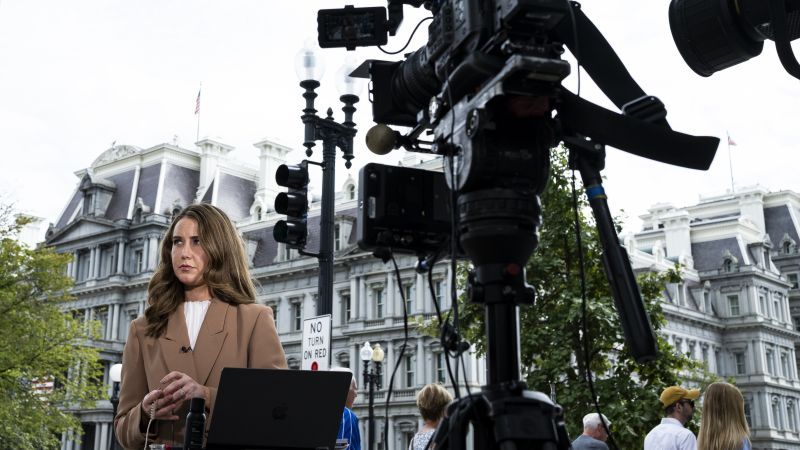
After Trump announced Friday that the outlets would no longer be permitted inside the White House, the press passes used to enter the grounds were deactivated. The following day, MS NOW reporter Akayla Gardner, CNN reporter Betsy Klein and Politico reporter Cheyenne Haslett each attempted to enter for news coverage. Secret Service personnel denied them access and took their credentials.
The immediate effects extend to day-to-day reporting. Journalists from CNN, MS NOW and Politico cannot use their assigned White House workspaces. CNN and MS NOW also lost access to television equipment and camera locations on the grounds.
CNN was additionally removed Monday from its scheduled role in pooled coverage. The network had been assigned television pool duty and was expected to travel with the president to New York that day. The outlet sought comment from the White House about the lawsuit.
Trump indicated Friday that other news organizations could face similar restrictions. That possibility has made the case significant beyond the three plaintiffs, because its outcome could affect the boundaries of access for the wider White House press corps.
A Test of Viewpoint Discrimination Rules
The anticipated court fight is expected to focus heavily on Trump’s stated explanation for the ban. He said he disliked “negative stories” from the outlets, while also suggesting he could choose not to admit them to what he called “the people’s house.”
“If they want to write them, that’s fine. I don’t have to let them into the people’s house,” Trump said.
That reasoning raises the constitutional issue known as viewpoint discrimination. Under that principle, the government generally cannot impose a penalty or withhold a benefit because it disagrees with a speaker’s perspective. In the context of White House reporting, courts have repeatedly scrutinized attempts to exclude individual journalists or outlets based on the content of their coverage.
First Amendment specialists and legal experts have already described the ban as potentially unconstitutional, abrupt and discriminatory. Their concerns reflect a longstanding judicial view that government officials cannot use access rules to punish protected reporting merely because it is critical.
One administration official argued during a television interview Sunday that a 1965 Supreme Court decision involving the government’s refusal to validate passports for travel to Cuba supported Trump’s position. The lawsuit will give the administration an opportunity to present that argument in court, while the news organizations will press their claim that White House press access cannot be withdrawn as retaliation for journalism.
Previous Court Decisions Shape the Challenge
Federal courts have previously addressed similar conflicts involving White House credentials. A key precedent arose in 1977, when the Secret Service revoked the press pass of Robert Sherrill, a reporter for The Nation. Courts in Washington restored the credential.
The US Court of Appeals for the DC Circuit held in that case that the denial of a White House press pass violates the First Amendment when it rests on the content of a journalist’s speech or discriminates against a protected category of speech. The ruling also recognized that the public has an interest in the work of journalists, not only the reporters and publications directly affected.
Related decisions have emphasized due process as well. When White House areas are generally available to the press and no national-security justification is presented, the government cannot simply revoke credentials without a meaningful procedure. Those protections matter because access decisions can determine whether reporters are able to ask questions, witness events and provide timely coverage of presidential actions.
The new lawsuit will be filed in the same federal district court that has heard other disputes involving press freedom and Trump administration policies. Several judges there have ruled against discriminatory measures affecting the press since Trump returned to office last year.
The coming proceedings may move quickly because the outlets are requesting emergency intervention. A judge could consider hearings and legal submissions from the administration as early as this week. The central question will be whether the White House can exclude journalists for coverage the president considers negative, or whether such a policy conflicts with constitutional protections for a free press and the public’s interest in independent reporting.
Related Reading
Frequently Asked Questions
What is CNN MS NOW and Politico to sue?
CNN MS NOW and Politico to sue is the main topic of this guide. The article explains the context, practical details, and next steps readers should understand.
Why does CNN MS NOW and Politico to sue matter?
CNN MS NOW and Politico to sue matters because readers are looking for a useful answer, not just a short summary. Good content should match search intent and help them decide what to do next.