Trump’s sanctions, inflation and a collapsing economy leaves Iran’s sick exposed

Daftar Isi
Iran’s medicine shortages deepen as economic pressure squeezes patients
Activelifezero.com – For people managing serious illnesses in Iran, finding medicine has become an exhausting and sometimes dangerous part of daily life. Drugstore shelves are increasingly unpredictable, prices can change from one visit to the next, and patients who once relied on insurance are often being asked to pay far more themselves.
Sima, 35, spent hours moving between pharmacies in Tehran in search of medication needed to protect her kidney function. She eventually located it at the seventh pharmacy she visited, in an affluent part of the capital. But the relief did not last: the price had risen again, forcing her to take less than the prescribed amount.
“They’ve stopped using cancer medication for people who they say are terminal or far along,” Sima said. “They only use it for those who are in the very early stages.”
She asked that her real name not be used. Her experience reflects a wider crisis for people with chronic diseases, cancer, mental-health conditions and other urgent medical needs. Some are cutting tablets, putting off appointments or turning to medicines that may be less effective than the products originally prescribed.
Specialized medicines face the greatest pressure
Iran produces more than 97% of its medicines by volume, Mehdi Pirsalehi, who heads the country’s Food and Drug Organization, said in February. Yet that figure does not mean the health system can meet every need domestically. Imported specialty treatments remain particularly vulnerable because they require payments in foreign currency.
Peivand Bastani, a senior lecturer at Flinders University who has studied sanctions and pharmaceutical procurement in Iran, said domestic manufacturing still depends on materials, equipment and technology sourced abroad. Some expensive and specialized treatments also cannot be replaced easily by locally made products.
US President Donald Trump’s maximum-pressure campaign has intensified scrutiny of Iranian banks and restricted oil exports, a central source of foreign currency for the country. The resulting pressure reaches far beyond financial institutions. When currency is scarce, importing medicines and the components needed to manufacture them becomes more difficult and costly.
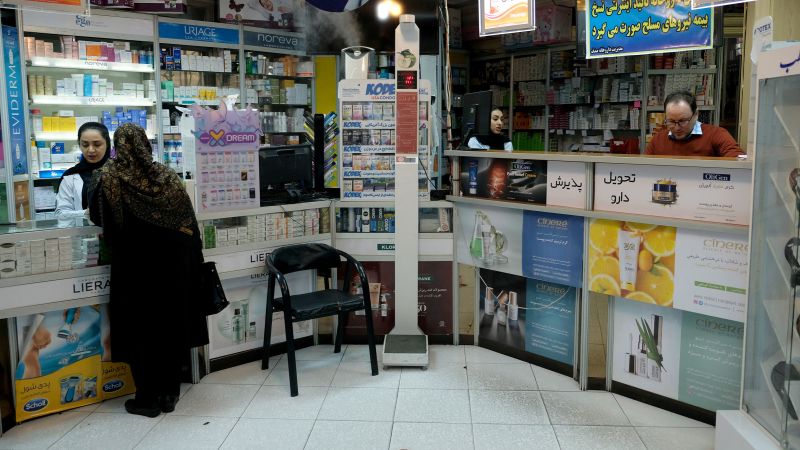
Drugstores contacted in Tehran described missing supplies and steep price jumps in several categories. Heart medicines are being replaced with local generic alternatives in some cases. Cholesterol treatments remain available but cost substantially more, while migraine medicines have disappeared from certain pharmacy shelves altogether.
The problem extends beyond those examples. Antidepressants, insulin, pregnancy-related medications and other treatments have been affected. A Tehran mother who lost her only daughter has had to switch from her antidepressant to a locally produced version she considers less effective. Seasonal flu vaccinations were also canceled this year after the government did not obtain supplies from Europe.
Patients confront impossible choices
Cancer patients are selling household possessions, including televisions and refrigerators, to afford medications priced far beyond their usual reach. A 55-year-old patient in Tehran said she has asked visitors and people returning from other countries to bring medicines that she cannot obtain locally.
“Between the illness and uncertainty of the war I have a hard time knowing what to do,” she said.
The Iranian Pharmacists Association has warned that shortages now affect nearly 800 medicines. Shahram Kalantari, the association’s head, said pharmacies are struggling to secure alternatives as costs climb. For patients, an alternative may mean a generic version, an interrupted course of treatment, or no medicine at all.
“Everyone says we’re brave,” the cancer patient said. “But I don’t know if being brave means anything when you’re dying.”
These shortages are not only a question of inventory. They can reshape treatment decisions. A patient who cannot afford the full prescribed dose may see their condition worsen. Someone unable to obtain a familiar medicine may be pushed onto a substitute. Delays in cancer treatment, diabetes care, heart medication or mental-health treatment can carry serious consequences, particularly when patients have little control over supply or cost.
Insurance arrears fracture the pharmacy system
The burden is also being shifted onto pharmacies and households by delayed insurance payments. Iranian officials have said insurance providers have stopped paying pharmacies in many cases. For millions of insured people, presenting a prescription may no longer result in the expected covered purchase; instead, the medicine may be unavailable or require a large out-of-pocket payment.
More than 18,000 private pharmacies are waiting for insurance reimbursements, representatives of the Pharmacists Association said last month. Outstanding insurance debts to pharmacies were put at nearly 800 trillion rials, or about $300 million.
That backlog makes it harder for pharmacies to restock. Without reimbursement, businesses have less capacity to pay suppliers. Suppliers, in turn, face high costs and foreign-currency constraints. The chain leaves patients at the final and most exposed point of the system.
For families already confronting inflation, the crisis turns routine medical care into a calculation of what can be postponed, reduced or sold. The consequences are felt one prescription at a time: a search across multiple pharmacies, a price that has risen again, and a decision no patient should have to make between treatment and affordability.
Related Reading
Frequently Asked Questions
What is Trump s sanctions inflation and a collapsing?
Trump s sanctions inflation and a collapsing is the main topic of this guide. The article explains the context, practical details, and next steps readers should understand.
Why does Trump s sanctions inflation and a collapsing matter?
Trump s sanctions inflation and a collapsing matters because readers are looking for a useful answer, not just a short summary. Good content should match search intent and help them decide what to do next.